A Real Case: Why Did Million-Yuan Orders Lose Over 200,000?
2026-07-25 10:01:49
A Real Case: Why Did Million-Yuan Orders Lose Over 200,000?
Last week I had tea with an old friend who runs a custom automation equipment factory. This year he took three million-yuan full-line orders, expecting nearly a million in profit — but the year-end count showed a net loss of over 200,000. Tracing it back, every problem sat in project management:
A BOM revision missed 3 sensors; purchasing never ordered; assembly stood still for 7 days — he paid 30,000 in late-delivery penalties plus 20,000 in rush overtime;
An outsourced structural part had wrong dimensions; a week of investigation revealed the designer had revised the drawing without syncing to purchasing or the machining vendor;
The warehouse held over 180,000 yuan of wrongly purchased and excess parts — leftovers from various projects, sitting for over a year with nobody able to use them.
This is not an isolated case. Eight out of ten small custom factories I know have stumbled into similar pits — mostly because they still manage projects the old way, refusing to switch to a fitting tool.
Misconception 1: Making Do With Excel or Generic Project Tools — "As Long as It Sort of Works"
Most custom factories start with three to five people taking one or two orders a month; Excel for BOMs and schedules genuinely suffices. But once projects multiply, a single project exceeds a thousand part types, and a revision happens two or three times, the problems all surface:
| Problem Scenario | Excel/Generic Tool Behavior | Actual Consequence |
|---|---|---|
| Design changes the BOM without syncing | Manual relaying, easily missed | Purchasing orders against the old version — shortages or overbuying |
| Part classification and splitting | Manual sorting, error rate over 10% | Standard, in-house, and outsourced parts confused |
| Project progress tracking | Entirely by meetings and asking | Nobody can say which operation a project is stuck at |
Generic project management tools cannot solve this, because their core is watching task milestones, not watching the BOM. The defining trait of custom automation is "one project, one BOM" — all purchasing, machining, and assembly actions revolve around the project BOM. Without a BOM-driven flow, it is still people relaying messages by mouth; errors are inevitable.
Misconception 2: Watching Only Delivery Progress Without In-Process Cost Accounting — Settling Accounts Only at Completion
Many owners think: ship the project, collect the money, then see whether it earned. But a custom project's costs scatter across every stage:
Standard parts bought 5 yuan over — a hundred pieces means 500;
Outsourced machining overran hours — a few thousand extra paid;
Ten extra cylinders bought and shelved — those few thousand sink into the warehouse.
Each sum looks small alone; added together they can devour an entire project's profit. I know custom factories five or six years old taking eight to ten projects a year — revenue looks fine but no profit shows. Digging around, they find six to seven hundred thousand locked in the warehouse in wrongly sent and leftover parts. Each project loses a little; the total is substantial.
Worse, without in-process cost accounting, the next quote for a similar project is still gut feel — forever unknown what price avoids a loss.
Misconception 3: Coarse Permission Control — Core Data Freely Edited, No One Accountable
This pit is the easiest for small factories to overlook. Many factories' systems either let everyone edit BOMs and inventory, or lock everything down wholesale — what should be seen can't be, and what shouldn't be seen gets seen.
I once met a customer whose designer deleted the BOMs of 3 in-progress projects before leaving; recovery took half a month and got back only half — delivery delayed, over 100,000 paid. In another case, an assembly worker mis-edited a BOM part quantity, wrong materials were issued, and the error surfaced at assembly — and there was no record of who changed what.
Many think "we're all one family, no need for such fine control". In fact, the opposite: staff turnover is not low in this industry and project roles are clearly divided. Designers handle only design; assembly handles only assembly. What you shouldn't change shouldn't be yours to change — this prevents mis-operations, enables traceability, and protects everyone.
The Moges PMS9 Approach: Three Cores That Fit Custom Business Logic
Project management for custom automation cannot be a generic template draped over the industry. Grab these key points:
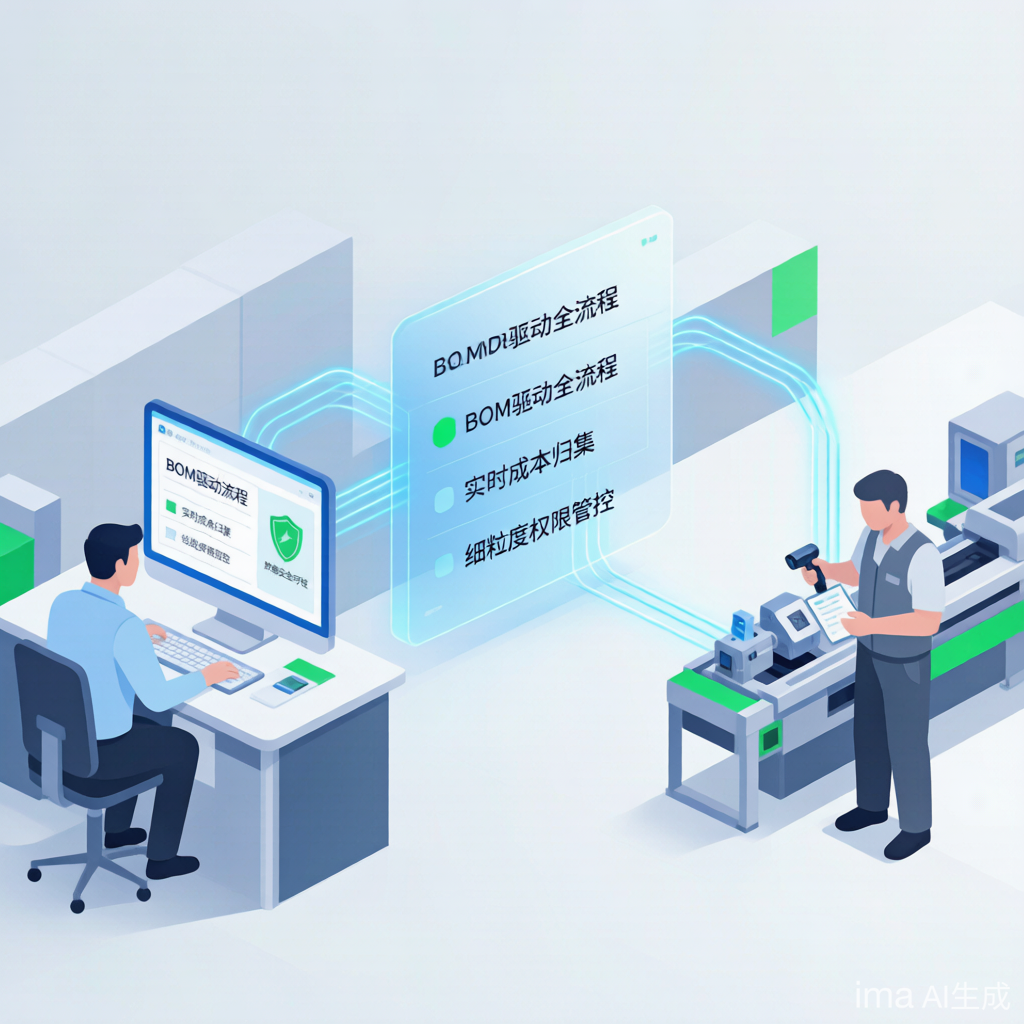
Core 1: The BOM must be the core driving the whole process
Once the BOM is done, one click splits standard, in-house, and outsourced parts, automatically calculates inventory gaps, and directly generates purchase orders, machining tasks, and outsourcing orders — no copy-paste, reducing errors at the root. All in/out transactions link automatically to the project BOM — no more overbuying or wrong buying.
Core 2: Every stage's status and cost must follow the project
From initiation, design, machining, assembly, and commissioning to delivery, each node's status is visible in real time — no daily meetings chasing progress. Every purchase expense, machining hour, and outsourcing fee collects into the project automatically; check anytime whether current cost is over budget, instead of settling accounts after delivery. Commissioning defects and assembly records are stored in the project, retrievable for later maintenance.
Core 3: Permissions matched to roles with fine-grained division
Administrators manage everything; ordinary employees operate only within their scope. For example, assembly workers see the parts list of only their own project and cannot edit the BOM; designers modify design information only for their own projects and cannot touch cost data — preventing mis-operations and data leaks at the permission level.
We have done digitalization in the custom industry for 14 years, and this logic is fully implemented in Moges' custom automation project management system, developed strictly along the full business flow of custom automation — covering the entire lifecycle from sales order intake to delivery and payment. Permissions alone reach fine-grained control of 187 items for administrators and 22 for ordinary users, fully matching a custom factory's division of labor.
Summary: Two or More Projects a Month Means You Need a System
I know plenty of 30-50 person custom factories that used to lose 20,000-30,000 yuan a month on average to stoppages and delays caused by BOM errors. After adopting a tool matched to their business, the error rate fell below 2% — the savings far exceed the tool's cost.
Many custom factory owners think systems are for big companies — "my small shop can muddle through." In fact, with two or more projects a month, losses from errors, delays, and waste already cover the tool's cost. Most of the time, projects aren't hard to manage — you're just running today's business with a ten-year-old tool.