How to Choose a Checking Fixture Design Outsourcing Company? A Practical Guide to Avoiding 3 Major Pitfalls + 4 Hard Standards
2026-07-30 08:01:39
Industry Reality: 80% of Small and Mid-Sized Factories Have Been Burned When Outsourcing Fixture Design
After nearly 14 years in precision mold machining, I've seen far too many small and mid-sized factories agonize over fixture design: keeping a full-time in-house design team costs hundreds of thousands a year in rent and salaries, the team can't keep up when things get busy, and there's nothing to do when things are slow — paying people to sit idle never adds up. So most factories with annual output between 10 million and 500 million yuan choose to outsource fixture design.
But I've seen at least 80% of factories get burned when they outsource: at the mild end, revisions delay things three to five days; at the severe end, an entire block of material is scrapped and penalty fees are paid to customers. Today I'll put together the pitfalls I've seen over the years as a heads-up for friends looking for fixture design outsourcing company recommendations.
Misconception 1: Competing Only on Quotes — Low Price Means Cheap
For many bosses, the first filter when choosing an outsourcing partner is price: whoever quotes lowest wins. That logic is actually wildly wrong. Fixture design is work that demands an extremely high level of experience; it's normal for a novice designer to quote half of what a five- or six-year veteran quotes, but the gap in the work delivered is far more than double.
| Real Case | Problem | Consequence |
|---|---|---|
| A Kunshan auto parts machining factory rushing a small-batch fixture order | Hired an individual designer whose quote was 60% lower than a proper company's; when drawing, they didn't properly calculate the locating block's geometric tolerances, nor consider deformation after quenching | When assembling after CNC machining, the locating pin wouldn't insert and the inspection datum was off by 0.12mm → three rounds of revisions and two blanks re-machined → 18-day delivery delay → fined over 30,000 by the customer, costing several times more than hiring a proper company |
Plainly put, the cost of fixture design is what it is; quotes far below market average are either novices practicing or items left out that come back later as revision fees that catch you off guard. Don't be fooled by low prices.
Misconception 2: Choosing a Full-Category Design Outsourcer, Ignoring Industry Focus
I've seen plenty of factories look for outsourcing firms that take on any kind of design — from architectural renderings to mechanical design to fixture design, they take it all. It looks like strength, but it's actually where the most pitfalls lie. Fixtures have wildly different requirements across industries:
Auto parts must meet IATF16949 tolerance requirements
Consumer electronics must match CMM inspection datums
The medical industry is even stricter about material deformation requirements
A team that designs everything can't possibly have a thorough grasp of every industry's requirements.
| Real Case | Problem | Consequence |
|---|---|---|
| A medical consumables mold customer hired a large local industrial design company | The designer didn't understand medical industry inspection precision requirements and set the fixture base tolerances too loose | Measured dimension data fluctuated beyond 0.05mm and failed the customer's quality control → had to find a team focused on mold fixture design to redo it → paid twice |
The saying "a trade gap is like a mountain" holds perfectly true in the fixture design business. Finding a team that only does fixtures for precision machining and molds is far more reliable than a full-category company that takes on anything.
Misconception 3: Only Looking at the Finished Drawings, Not Agreeing on Revision and After-Sales Rules Upfront
Many bosses, when signing the contract, only ask about the total price and how long until drawings are delivered — not how revisions are charged or who's responsible when problems arise. That's another huge pitfall. Fixture design can't be perfect the first time; it's completely normal to find issues needing adjustment during machining. Plenty of small teams take the design fee and then wash their hands of it: ask for a revision and they immediately say it's 50% of the original drawing fee, or they just don't reply for three or four days, waiting for you to pay up to expedite.
I once dealt with a boss in Dongguan who hired a remote team online to do the design. After the drawings were delivered, he found the datum hole positions didn't match his injection-molded parts. He asked the designer to revise, and the response was "sure, for another half of the design fee, otherwise it's not our problem." With no other option, the boss had to find a local designer to redraw everything, losing half a month in the process.
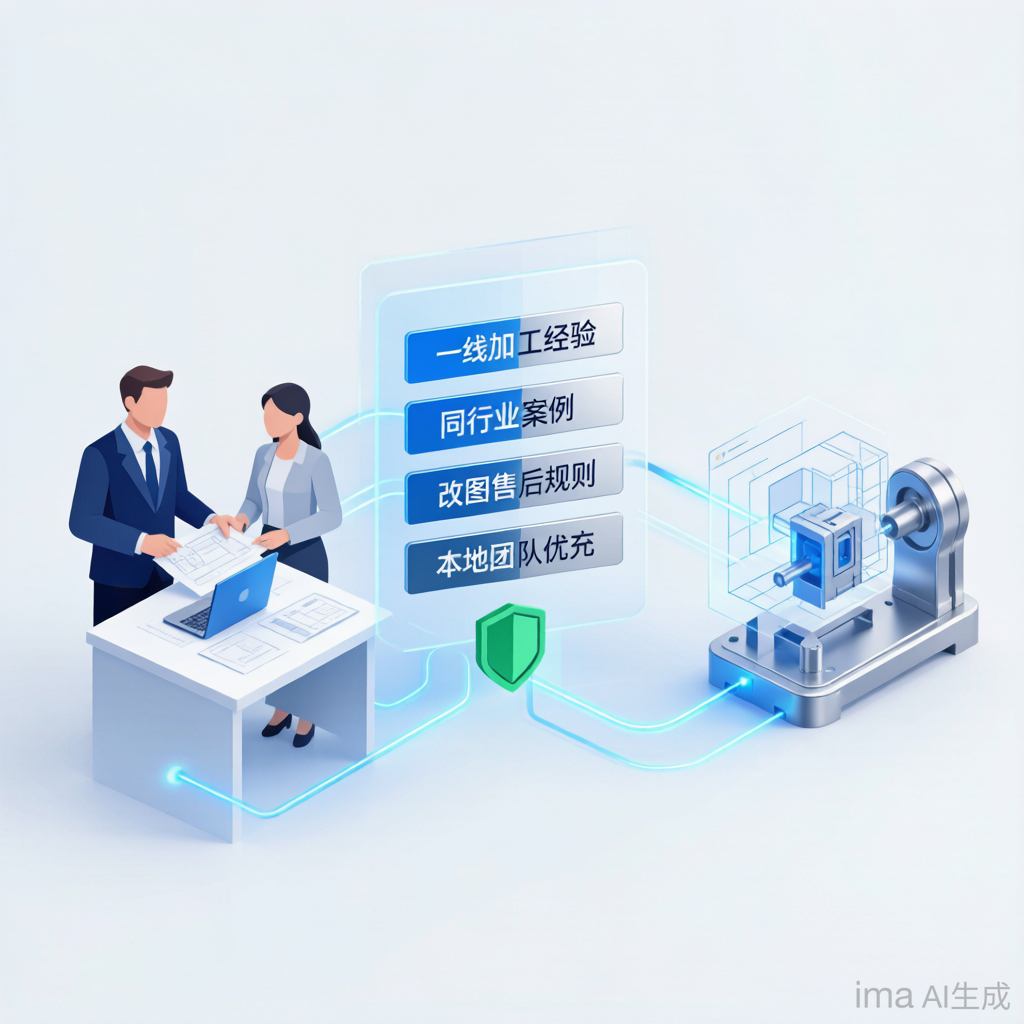
4 Hard Standards: You Won't Go Wrong Choosing a Reliable Fixture Design Outsourcing Company
Avoid the three pitfalls above, then choose according to these standards and you basically won't step on a landmine. These are the practical standards I've summarized for friends looking for fixture design outsourcing company recommendations:
| Hard Standard | Specific Requirement | Why It Matters |
|---|---|---|
| ① Core team has frontline machining experience | The designers themselves have done mold machining and fixture assembly | Designers who understand machining won't make rookie mistakes like "the machine can't clamp it" or "there's no allowance to mill," saving trouble in the machining stage |
| ② Enough cases in the same industry | Don't look at how many sets they've done — look at how many projects they've done in your industry | If you do auto parts, find someone who's done 100+ sets of auto parts fixtures; matching experience matters more than anything |
| ③ Sign revision and after-sales rules in advance | Whether reasonable adjustments before finalization are free, who's responsible for design errors, and response time — all written into the contract | Avoids finger-pointing and price hikes when problems arise |
| ④ Prioritize local teams in the industrial belt | Local teams in industrial belts such as Kunshan in the Yangtze River Delta and Dongguan in the Pearl River Delta | They can visit your site to see equipment, discuss dimensions, and handle issues face to face — far more reliable than remote individual designers |
Conclusion: What Fits Your Capacity, Industry, and Budget Is What's Truly Reliable
For small and mid-sized precision machining plants and mold factories, the biggest company isn't the best choice for fixture design outsourcing. Big companies often have slow processes and high quotes for small orders, and your small project gets no attention at all. Instead, teams that aren't large, focus solely on fixture design, and are rooted locally in the industrial belt offer better value and reliability.
Actually, whether you're outsourcing fixture design or a factory adopting a production management system, the logic is the same: what fits you is the best, and understanding industry pain points matters more than any flashy packaging. Moges has been doing mold industry management systems for all these years with exactly this approach — only solve the real problems of small and medium-sized factories, not big, empty solutions.
Many people asking for recommendations start by looking for the company ranked No. 1, but what is truly reliable is the one that fits your capacity, your industry, and your budget. After all, checking fixture design ultimately has to be executed in machining and get it right the first time; an outsourcing team that does not delay your delivery schedule is a good one.