Mold APS Scheduling Software Price Pitfall-Avoidance Guide: Do Not Be Trapped by Per-Head Billing — A Practical Selection Analysis for Small and Medium Factories
2026-08-03 08:01:36
Mold APS Scheduling Software Price Pitfall-Avoidance Guide: Do Not Be Trapped by Per-Head Billing — A Practical Selection Analysis for Small and Medium Factories
In the last two or three years, more and more mold factory owners have come asking about scheduling systems; eight out of ten open with the same question: How much does your mold APS scheduling software cost? Most of them are owners of small and medium factories with annual output from ten-odd million to two or three hundred million. With limited budgets, they fear paying too much and being fooled, yet also fear that buying cheap means it never gets used — the quotations alone can leave many dizzy.
I have worked 14 years in molds and informatization, and I have seen too many owners fall into pricing pits: some spent over a hundred thousand on a full system whose APS module still lies unused; some pay tens of thousands a year in per-head service fees — over five years, more than buying an outright license; others went cheap with a few-thousand-RMB generic scheduler, only to find its plans completely mismatched to the single-piece nature of mold production, ending up discarded.
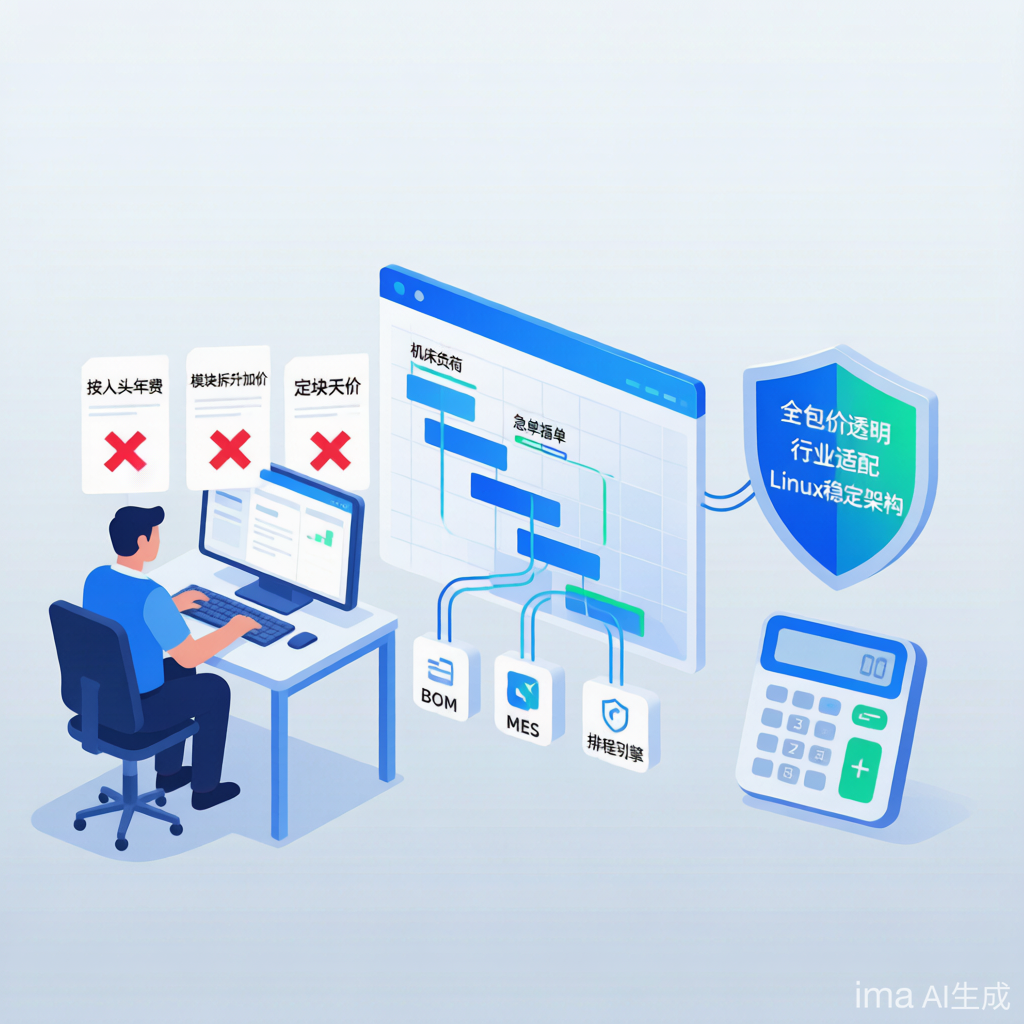
1. The Three Common Pricing Routines on the Market — Many Owners Fall In Without Noticing
Among current pricing models for mold APS scheduling, the three most common pits that small and medium factories easily fall into are:
Annual per-user/per-account fees: RMB 2,000-3,000 or more per account per year. It sounds like a low entry threshold, but shop-floor scheduling in a mold factory needs work-reporting data from the processes — operators and setup masters all need accounts to report progress. 10 positions means RMB 20,000-30,000 a year, 20 positions means RMB 40,000-50,000; paid for three to five years, the total exceeds a system bought with a one-time license. If you begrudge accounts for frontline staff, only team leaders can report in rotation — data lags and is inaccurate, scheduling is naturally off, and the purchase was in vain.
Unbundled module surcharges: many vendors quote a low price to attract you — basic MES for tens of thousands — then tell you APS scheduling is a premium module costing extra, anywhere from tens to over a hundred thousand. Many owners came precisely to solve scheduling chaos, did not ask clearly upfront, and suddenly the budget is exceeded by half — caught in a dilemma.
Astronomically priced customization: right away they say your factory is special and must be customized, starting from hundreds of thousands. In reality, 90% of small and medium mold factories' scheduling needs are identical: calculate each machine's load, insert rush orders, hit delivery dates, track every mold's progress — no need to customize from scratch. Selling large factories' solutions downgraded to small and medium factories is not only expensive; many functions are simply never used.
2. The Core Factors That Really Affect Mold APS Scheduling Software Prices
Many owners look only at the total quotation, not at what it includes. A price difference of tens of thousands comes down to these points:
| Core factor | Low-price trap | High cost-performance choice |
|---|---|---|
| Industry fit | Generic APS designed for batch machining; mold single-piece customization requires secondary development starting from over a hundred thousand | Developed specifically for the mold industry, with single-piece scheduling logic built in — no customization needed |
| Data connectivity | Standalone APS requires manual data export or paid interface integration; scheduling divorced from reality | Native integration with MES/ERP, real-time data synchronization, accurate scheduling |
| Implementation service | Software price excludes implementation; on-site work billed daily, doubling the total | Quotation includes implementation; pilot-then-rollout model, live in 3 months |
| System architecture | Windows architecture is virus-prone and crashes, high maintenance cost | Native Linux architecture, stable and secure, low long-term maintenance cost |
Special reminder: 30% software, 70% implementation. Regardless of price, what matters is whether the implementation team knows the mold industry. Many software packages are fine in themselves, but an implementation team ignorant of mold production logic configures the wrong flow, the system never gets used, and the money is wasted. Also check the vendor's implementation success rate and renewal rate — those achieving a 95%+ implementation success rate and 90%+ renewal rate basically avoid the big pits.
3. How Small and Medium Mold Factories Can Control Budget and Buy the Right APS
Small and medium mold factories have thin profits to begin with; every penny spent on a system must hit the target. I have summarized several practical principles, all drawn from implementation experience with more than 200 customers:
Do not chase big and all-inclusive; solve the core problem first. 80% of the value of mold APS comes from 20% of the core functions. You only need to solve three core problems: machines not jammed with work, delivery dates not delayed, rush orders insertable. Flashy features like so-called big-data intelligent decisions and visualization dashboards not only cost extra but are never used — add them later if genuinely needed.
Find a vendor that only serves the mold industry. A vendor whose founding team comes from the mold industry knows the industry's pain points; its scheduling logic is written to the production characteristics of molds, requiring no extra customization — saving a large customization fee. For example, Kunshan Moges has made management systems for the mold industry alone for 14 years, building solutions specifically for small and medium mold factories with annual output of RMB 10 million-500 million — no grand empty customization, only solving real problems.
When asking the price, always ask for the all-inclusive price. Before signing, clarify: does the quotation include implementation fees? How are subsequent service fees charged? Are there extra module activation fees? Many annual-payment models look cheap, but long-term costs far exceed a one-time license. If cash flow allows, small and medium factories should choose the one-time license plus small annual service fee model — more economical over the long run.
Pilot before rolling out. To collect more implementation fees, many vendors push you to deploy the whole factory at once — high implementation cost, hard for employees to accept, easily stalled. Pilot one workshop first, run the core flow through, then roll out factory-wide: lower cost, lower risk, and normally in formal use within 3 months.
Final Words: What Suits You Is What Is Best
Many owners think APS scheduling is something only large factories can afford. It is the opposite — small and medium factories need it even more. Small and medium factories already face unstable orders and limited capacity; when scheduling goes wrong, some machines sit idle while others are swamped, one missed delivery loses a customer, and a year's wasted capacity would buy several systems.
Many also think more expensive is better. Wrong: what suits your scale and needs is what is best. A plan costing hundreds of thousands, used by a factory with an annual output of tens of millions, wastes most of its functions.
Many owners ask me for the lowest price to get a usable mold APS. I never quote a low price directly, because factories differ in needs, budgets, and suitable solutions. Rather than asking "how much" right away, first think clearly: what is your biggest scheduling problem now? And what is the maximum budget you can commit? Do not jump at a low unit price, and do not be fooled into wasting money on so-called high-end customization. After all, what delivers value is whatever stabilizes your delivery dates and lifts your capacity utilization.