Sheet Metal MES vs ERP Explained: Don't Assume ERP Makes MES Unnecessary — Get the Roles Right and Save Wasted Money
2026-08-05 08:01:59
Sheet Metal MES vs ERP Explained: Don't Assume ERP Makes MES Unnecessary — Get the Roles Right and Save Wasted Money
Over the past six months I've taken no fewer than ten consultations from sheet metal shop owners, and the most frequent question is: "I already spent hundreds of thousands on ERP — do I still need a separate MES?" Many assume ERP already has a production management module, so why pay twice? This is actually the industry's most common misconception — not understanding the difference between sheet metal MES and ERP means either wasting money on redundant systems or settling for one that can't deliver. Either way, you lose.
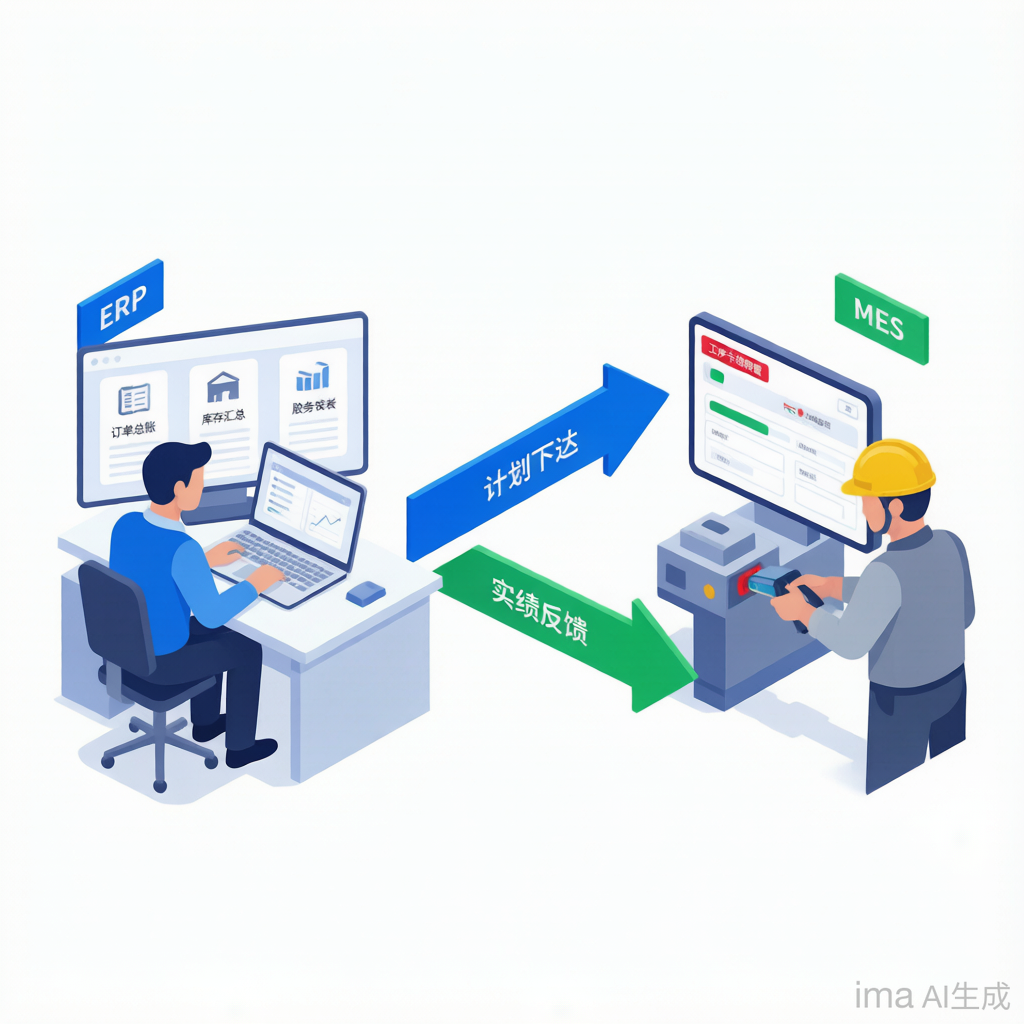
I. At the Foundational Level, They Were Never the Same Tier of System
Many say, "They both manage production — how different can they be?" In fact, they differ from their very conception:
ERP (Enterprise Resource Planning): operates at the company level, coordinating orders, raw materials, funds, and labor, producing accurate financial and inventory books. Its core is managing company-level resources.
MES (Manufacturing Execution System): operates at the shop-floor level, managing the full execution of every work order from material release to shipment — which operator ran each operation, how much was done, whether it passed, when it moved on. Its core is managing shop-floor execution.
In one sentence: ERP tells you "what to make, how much material you have, how much you should earn"; MES tells you "what's being made now, how much material was used, how much you actually earned." The two complement each other — neither replaces the other.
II. In the Sheet Metal Context, the Concrete Differences
Placed in the specific context of sheet metal fabrication, the differences become very clear:
| Dimension | ERP | Sheet Metal MES |
|---|---|---|
| Management granularity | Order-level, warehouse-level ledgers | Operation-level (cutting/bending/welding/outsourcing) real-time detail |
| Core goal | Books done right — supporting finance and strategic decisions | Production done right — meeting deadlines, controlling actual cost |
| Usage scenario | Office staff, low-frequency use | Frontline daily use — scan-to-report, minimal interaction |
| Data timeliness | Entered after the fact, lagging | Collected in real time, dynamically updated |
Management granularity is entirely different: for ERP, recording the total quantity and total purchase amount of 10 equipment enclosures is enough. But sheet metal flows through many operations — splitting down to CNC cutting, bending, welding, surface treatment, final inspection, even outsourced laser cutting. How long each operation took, how many passed, which outsourcing supplier, when parts return — that operation-level granularity is something ERP cannot manage and was never designed to manage. Quite a few factories discover an operation stalled half a month after opening the work order, precisely because information lags.
The core goal is entirely different: ERP ensures money and goods numbers reconcile — for tax filings and executive decisions. Sheet metal MES ensures every order ships on time with actual costs under control. Say a quote estimated 10,000 yuan by experience; ERP can only compute a standard cost. The two extra steel sheets actually consumed, the rework fees from outsourcing — only MES can precisely allocate those extra costs to each order, making profit or loss obvious.
Usage requirements are entirely different: ERP is mainly for office staff who open it two or three times a day — anyone who can use a computer can operate it. MES is used daily by frontline staff: operators reporting work, team leads dispatching, warehouse staff receiving outsourced parts. It must be scan-and-report with tasks visible on open — too complex, and it simply won't be adopted.
III. Running Sheet Metal Production on ERP: The Pits You Can't Dodge
This isn't to say ERP is bad — many owners simply misplace its role and force ERP to do MES's job. I've spent 14 years in precision machining; among the 200-plus factories I've dealt with, quite a few carry sheet metal business, and those forcing ERP to manage production almost all hit these unsolvable problems:
Delivery dates can't be pinned down: when a customer asks about progress, the salesperson runs through the workshop asking layer by layer — half an hour later there's still no reliable answer. Even loyal customers can walk.
Outsourcing reconciliation is chaos: finance flips through weeks of records and still can't reconcile quantities sent and received against fees — overpayments go unnoticed.
Costs can't be figured out: at month-end you only know the overall profit, not which orders earned and which lost — next quote is another blind guess.
Quality traceability is hard: a customer reports deformation; searching paper records for the material batch, operator, and operation log takes forever — you just eat the loss.
These problems really aren't about ERP not being powerful enough — it was never built for this. Making a system that manages company ledgers manage shop-floor operation flow is like making an accountant do the workshop supervisor's job. It won't go well.
IV. Choose Right, Not Expensive — Don't Throw Money Away
Once the difference between sheet metal MES and ERP is clear, many owners ask: when should I adopt MES? It has nothing to do with factory size and everything to do with your pain points:
If you have only a dozen-plus people, take fixed large orders, and Excel manages it all clearly — you don't need it at all.
If order volume keeps growing with many small jobs, deadlines are pressed hard, and you match two or more of the four problems above — it's time to consider a dedicated MES.
Don't be talked into a big-and-complete system — hundreds of thousands for features you mostly won't use, with implementation stalling for half a year. Well-run implementations in this industry exceed 95% success, and the core is exactly not going big-and-complete — only solving core pain points. 80% of problems can be solved with 20% of the core features. When Moges implements, core modules go first and the system is in use within 3 months. Small and mid-sized shops need to solve real problems, not build vanity projects.
Final Word: Get the Roles Right and Spend Where It Counts
Many owners feel small and mid-sized sheet metal shops earn hard-earned money and digitalization is a big-factory privilege. Think about it the other way: big factories have complete systems and high margins — they can absorb waste. Small and mid-sized shops survive on scattered orders and cost control; one missed deadline can lose a stable customer, one botched outsourcing reconciliation can cost half a month of work.
ERP manages your money and books; MES manages your production and progress. Don't expect one payment to solve everything. Ask yourself: is the most painful problem in your factory right now the books not reconciling, or the shop floor being unmanageable? Once the answer is clear, you won't stumble in system selection.