How to Choose Procurement Price Management Software for Non-Standard Factories? A Practical Guide to Solving 3 Common Problems + 3 Core Details
2026-08-06 10:01:55
Industry Reality: 72% of Non-Standard Factories Have No Fixed Procurement Price Records, and Profit Slips Away Quietly
Last year we did an informal survey of 37 small and medium non-standard automation equipment factories we had worked with, and the results showed:
| Problem | Share |
|---|---|
| No fixed procurement price archive; management relies entirely on procurement staff's personal memory of prices | More than 72% |
| The procurement price of the same material from the same supplier differs by more than 10% across projects | 61% |
| At month-end project cost accounting, actual procurement prices deviate from budget by more than 8% | Nearly 40% |
Procurement costs in the non-standard industry generally account for 60%-70% of total project cost, and a one-point price fluctuation can eat several points of project profit. Many factories have talked about cost reduction for years, but the first step was wrong: managing procurement prices properly.
3 Common Problems in Procurement Price Management in the Non-Standard Automation Industry
The non-standard industry is project-based; the BOM of every piece of equipment is redesigned, and repeated batch production is rare. This characteristic causes many common price management problems that generic manufacturing never encounters:
Common Problem One: Same Item, Different Price, with No Active Warning
The same model of AirTAC cylinder was purchased at RMB 185 in Project A last month. This month, for Project B, a different contact person buys from the same supplier at RMB 205. Unless finance deliberately checks historical orders during reconciliation, the problem cannot be found at all.
I once encountered a 25-person non-standard factory in Suzhou: the procurement supervisor took half a month of leave, and the temporary replacement bought 12 timing belts at a unit price 18% higher than the historical price, wiping out nearly 3 points of profit on the whole piece of equipment.
Common Problem Two: Historical Prices Cannot Be Found, and Data Is Lost When Procurement Staff Change
Many factories still use Excel to store prices, with the same material in several versions of spreadsheets. A newly assigned buyer searches for ages and cannot find the most recent transaction price, so the supplier is asked to quote again. In effect, every purchase is a fresh price negotiation, and a stable cooperative price can never be secured.
Common Problem Three: Prices Disconnected from Cost Accounting
The budget BOM uses estimated prices, while actual procurement uses another price. When finance calculates project profit, it still uses the budget price. Only after the project is delivered is the actual cost found to have exceeded the budget — too late, and there is no way to find which link went over.
| Annual Revenue | Procurement Cost (60%) | 2% Price Increase | Net Profit Lost |
|---|---|---|---|
| RMB 50 million | RMB 30 million | RMB 600,000 | Higher than the annual net profit of many factories |
Procurement Price Management Software Must Not Be a "Price Notebook" — It Must Fit Non-Standard Characteristics
Many generic procurement software products have a price management module that is just an archive: enter prices and be able to search them, and that's it. This is not suitable for the non-standard industry at all. The core of procurement price management in non-standard work is to connect with the project BOM and procurement process; otherwise you store a pile of prices but still cannot see them when placing orders, which is the same as having none.
Truly usable procurement price management software must meet several non-standard scenario requirements:
When a new project's BOM is split and procurement requirements are generated, all historical transaction prices of the same material are automatically brought up, without procurement searching manually
Classify by supplier: what each supplier provides, what prices were given historically, and what grade they are — all directly comparable when selecting suppliers
After procurement is completed, actual prices automatically sync to project costs, without finance manually entering and accounting again
When we developed Moges PMS9, we built price management into the whole process rather than making it a standalone idle module. The core logic is that all actions in a non-standard project are BOM-driven, and price data naturally follows the BOM.
3 Core Details for Doing Procurement Price Management Well
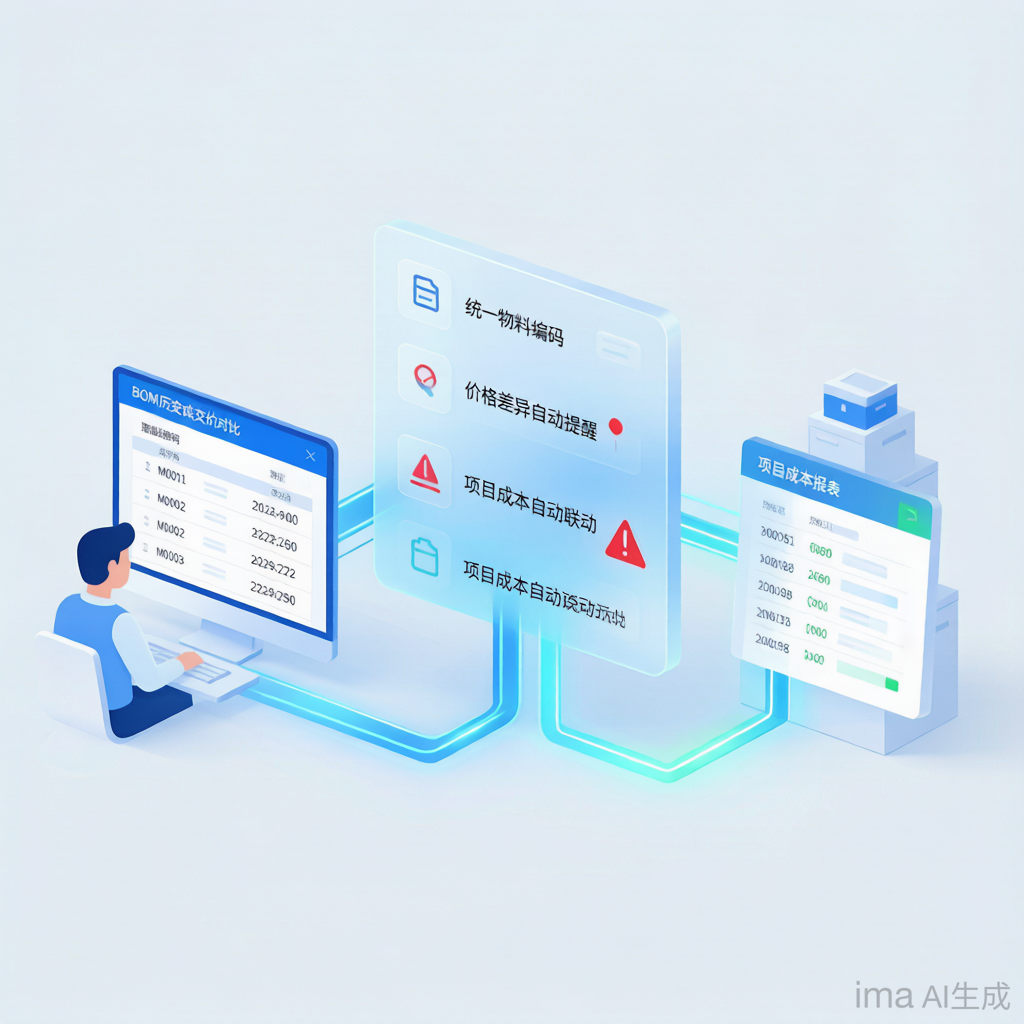
Detail One: Unify Material Codes First — the Foundation of All Price Management
The biggest problem in non-standard factories is non-standardized materials. The same specification of linear guide is called "HIWIN 15 slider," "15mm linear slider," and "HGR15 slider" by different designers, when they are actually the same item. The system simply cannot match historical prices, so comparison and alerts are naturally impossible.
In a proper procurement price management process, material records are unified first: standardized codes, specifications, categories, and units. No matter which designer puts the item into which project's BOM, the same material automatically matches all historical procurement prices and can be pulled up with one click.
Detail Two: Automatic Price Difference Alerts When Generating Purchase Orders
In the non-standard industry, after each project's BOM is split, standard parts automatically generate requisition details, and materials from the same supplier can be grouped in batches to generate purchase orders. Price comparison must be done at this step:
Each line of material automatically brings up the most recent historical transaction prices. If the current quote exceeds the preset floating range compared with the historical transaction price, the system automatically highlights it in red, and procurement can directly spot the problem — either renegotiate with the supplier or switch suppliers — without waiting until goods are received and paid for to discover the purchase was too expensive.
Detail Three: Price Data Automatically Linked to Project Cost Accounting
Procurement prices are not finished once stored; they must ultimately land in project costs. After procurement receiving and warehousing, actual procurement prices are automatically collected into the corresponding project's cost, without finance manually keeping accounts. The boss can see at any time how much procurement cost this project has actually spent, whether it is over or under budget, and which material went over — all clear at a glance, so the situation of only doing accounts after the project is finished and not knowing why there was a loss will not happen.
For example, Moges PMS9 is designed this way: price data is connected across the whole chain from BOM order placement to procurement warehousing to cost accounting. After each purchase is completed, the price automatically updates to the material record and is called directly next time, without manual maintenance.
Summary: Cost Reduction Is Not About Hard-Bargaining with Suppliers — First Get the Reasonable Prices You Deserve
Many non-standard factory owners always say "we are small, there is no need for a system to manage such details," or "our procurement staff are veterans and won't make mistakes." But in reality, veterans forget things and make oversights. However small the factory, dozens of projects a year accumulate small price differences into a considerable loss.
Cost reduction is never about hard-bargaining with suppliers; getting the reasonable prices you deserve is the most direct cost reduction.
| Traditional Approach | Professional Procurement Price Management Software |
|---|---|
| Same item at different prices, nobody notices | Automatic comparison with historical prices, with red alerts when the difference exceeds the limit |
| Historical data lost when procurement staff change | Unified material records with permanently retained price data |
| Only discovering a loss after the project is finished | Prices automatically collected into project cost, visible in real time |
| Excel price storage is slow to search and error-prone | The system automatically brings up historical prices, improving pricing efficiency by 70%+ |
In all your years in non-standard work, have you ever encountered profit being eaten because procurement prices were wrong?