Non-standard equipment cost accounting methods: Practical approaches to avoid pitfalls for small and medium-sized automation factories.
2026-08-11 08:01:57
Introduction: Why are we only generating 80,000 in profit from a million orders?
Last month, I had tea with a business owner specializing in customized automation. He told me that he had secured 6 million-dollar contracts this year, which sounded impressive. However, when he calculated the overall profit at the end of the year, he only made less than $80,000. He explained that two of the contracts resulted in a loss of over $100,000 after accounting for costs. When I asked him how he calculated the costs, he said he simply added up the materials and multiplied the result by 1.5 to determine the price. Surprisingly, he was able to significantly reduce the price, resulting in zero profit.
This isn't an isolated incident. Many small and medium-sized manufacturers specializing in custom equipment rely on "gut feeling" for cost calculations. They see promising profit margins when accepting orders, but only realize losses after production. The core problem isn't the market; it's the incorrect cost calculation method. This article will provide you with a comprehensive, practical method for cost calculation specifically tailored for small and medium-sized manufacturers, ensuring accurate and reliable results.
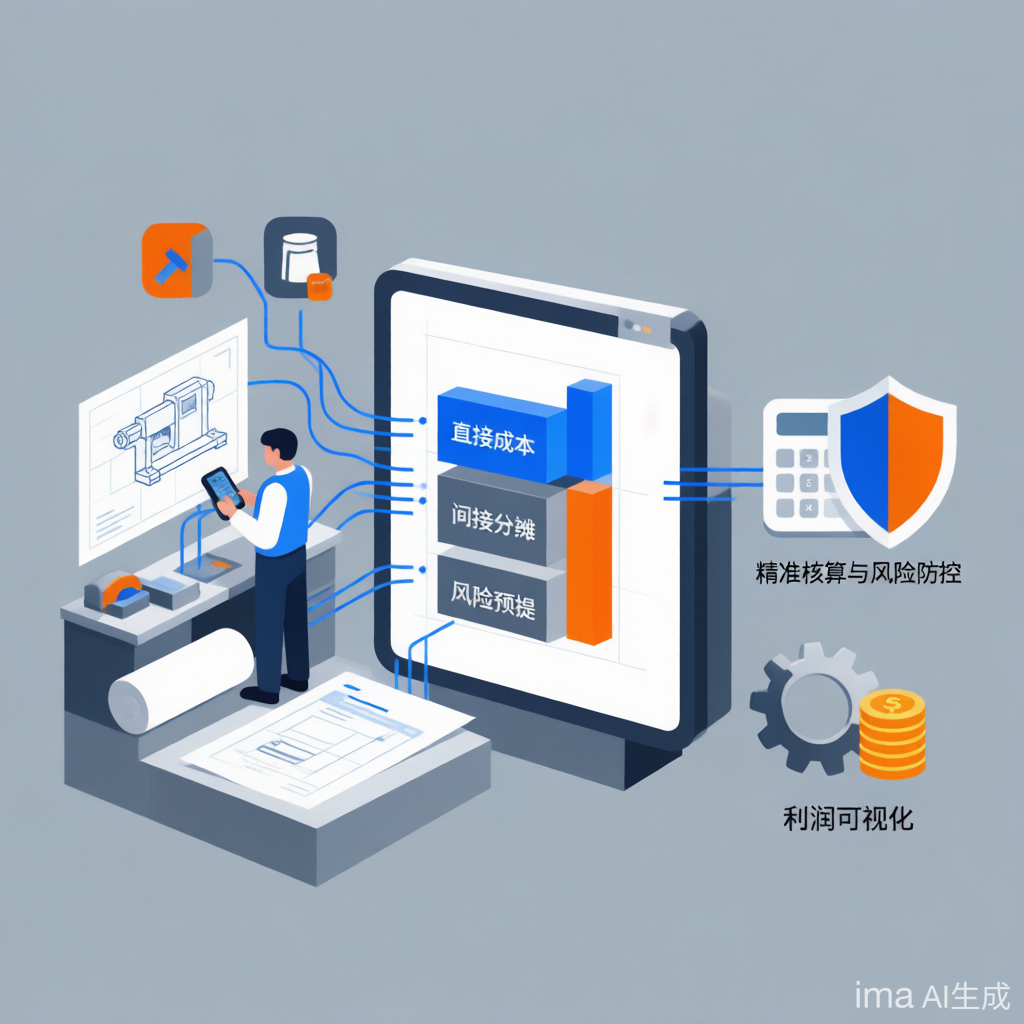
The 3 most common mistakes in non-standard equipment cost accounting
Many business owners calculate costs, only focusing on visible expenses, and overlooking significant hidden costs. Here are three common mistakes to consider:
Misconception 1: Only calculating direct materials, without allocating labor and indirect costs.
Non-standard equipment's raw materials and standard parts typically account for 40%-50% of the total cost, while the remaining 50% or more is comprised of design, assembly, and debugging labor, as well as factory rent, equipment depreciation, and administrative expenses. Many factories only include the cost of materials, and lump all labor costs as factory expenses, resulting in artificially low quotes.
The most extreme case I've seen: a non-standard order worth 120,000, with material costs reaching 500,000. The owner estimated a profit of 500,000, but the total cost of labor, outsourcing, and after-sales service amounted to 620,000, resulting in a net loss of 120,000.
Pitfall 2: Outsourcing costs are only calculated for parts, not including delays and rework.
Many non-standard equipment structures are outsourced for fabrication, and many only calculate the fabrication costs of the outsourced parts, forgetting that delayed delivery by the outsourcer will delay the overall equipment debugging. Late delivery will incur penalties from the client, and rework will also incur additional labor and transportation costs, which can range from tens of thousands to hundreds of thousands of yuan, and these costs are often not factored into the initial cost estimates.
Pitfall 3: Failing to anticipate after-sales and design change costs.
Customized equipment is inherently customized, and design modifications of a few times are common. Each modification requires additional design time and replacement parts, which all contribute to extra costs. Post-delivery on-site debugging and parts replacement also incur significant after-sales costs, and many business owners do not allocate sufficient budget for these expenses, resulting in the majority of profits being consumed by after-sales services.
| Common accounting misconceptions | Typical examples | The resulting consequences |
|---|---|---|
| Only direct materials are included. | Material x Coefficient = Price | Labor costs and depreciation have not been included. The quoted price is significantly lower than the actual cost. |
| Ignore external vendor risks | Only processing costs are considered. | Late payment penalties and rework costs erode profits. |
| Do not anticipate changes after sale. | Risk-free budgeting | Design modifications and after-sales service consume the entire gross profit. |
Practical methods for small and medium-sized factories: Three steps to accurately determine real costs.
Non-standard equipment is custom-built for individual projects, so the core accounting method is to allocate costs based on individual projects, ensuring full cost coverage. Unlike large companies, which use complex accounting systems, small and medium-sized enterprises can use a simple and accurate method. The specific steps are clear:
Step 1: Calculate all direct costs
Direct costs are all expenses directly associated with this project, including:
All raw material and standard component procurement costs
External component processing costs
The hourly wages for design, assembly, and debugging personnel are directly related to this project.
Travel expenses and transportation costs corresponding to the project.
All costs that can be directly attributed to a specific project should be classified as direct costs, and not allocated to the factory's general expenses.
Step 2: Appropriately allocate indirect costs.
Indirect costs are the factory's shared expenses, such as rent, utilities, equipment depreciation, and administrative personnel salaries. The most accurate method is to allocate these costs based on the total project hours.
For example, if the total number of working hours for all production and technical personnel in the factory is 1000 hours, and your project uses a total of 200 hours, then 20% of the total monthly indirect costs should be allocated. This method is more accurate than allocating based on output, as it prevents small projects from bearing excessive costs and ensures that all costs are properly allocated.
Step 3: Pre-emptive hidden costs
This is definitely something you shouldn't skimp on! According to industry standards:
Design changes and delays: A contingency of 3%-5% of the estimated contract value should be set aside.
After-sales costs: Allocate 3%-5%
If you are not confident in the maturity of this project, err on the side of caution and avoid taking unnecessary risks.
Calculating and summing the costs provides your true total cost. Add your desired profit margin when quoting. Moges previously helped a precision machining factory specializing in non-standard automation components to analyze their costs. Using this method, their initial estimate of a 20% profit margin resulted in an actual profit of only 8%. After adjusting their pricing, their profits increased by 15% that year. This demonstrates the benefits of accurately calculating costs.
How can we keep accounting errors below 5%?
Many people ask, "I calculated the cost when I placed the order, so why is it still incorrect after completion?" This is because cost accounting is not a one-time process. It's not enough to simply estimate the cost when placing the order and then ignore it afterward. Proper cost accounting requires ongoing monitoring and control, with each expense item directly corresponding to a specific project. This ensures that errors are minimized.
All expenses must be associated with a specific project: Whether it's purchasing materials or paying external vendors, the first step when an invoice arrives is to clearly identify which project it belongs to. The finance department will then directly allocate the expense to the corresponding project, rather than simply putting everything into the general "manufacturing expenses" category and then arbitrarily distributing it.
Track work hours by project, avoid mixing records: Accurately record the daily work hours of design personnel and assembly workers for each project. Many factories now use barcode scanning to record work hours, simply scanning the project QR code to complete the recording, which is very easy and does not burden frontline employees. All work hours are aggregated for each project, ensuring accurate labor costs.
It is essential to conduct a post-project review: After each non-standard equipment is delivered, compare the actual cost with the estimated cost to identify any discrepancies. Determine whether the cost overrun is due to design changes or material price increases. This information can be used to refine future cost estimates for similar projects, leading to more accurate predictions.
Previously, many small and medium-sized enterprises (SMEs) relied on manual accounting, combining multiple projects together and then calculating the total costs. This often resulted in errors, with discrepancies exceeding 20%, making it impossible to determine which project was profitable. However, by organizing costs by project and using a system to automatically consolidate the data, errors can be easily controlled within 5%. Moges' system automatically collects every cost by project after scanning, automatically consolidating labor, materials, and external expenses after clocking in, eliminating the need for manual accounting by finance departments. This is a highly practical solution for SMEs.
Summary: Customization does not necessarily mean an inability to perform precise accounting.
Many owners of specialized equipment companies say, "What I do is customization, and the costs are inherently unpredictable." However, this is not entirely accurate. Customization does not necessarily mean that costs cannot be accurately calculated. The problem is that many people are using the wrong methods, mixing all the costs together, which makes it impossible to calculate them accurately.
Many small, non-standard manufacturing companies, with teams ranging from five to fifteen people and operating for five to ten years, often experience inconsistent results. They might lose money on some projects while making a profit on others, and they struggle to achieve significant growth. The root of the problem often lies not in the technology itself, but in the inability to accurately track and manage costs.
You can start by applying this method to one or two projects you are currently working on. This will allow you to see if the actual profit margins match your expectations. Remember: factories that cannot accurately calculate costs and produce non-standard products are essentially working for others. By choosing the right method and using the right tools, you can ensure that you consistently achieve the profits you deserve.