Custom Cutting Tool Shop Management Software: Clear Costing and On-Time Delivery for SMB Factories
2026-08-27 08:08:35
Foreword: A Tool Factory With RMB 30,000,000 Annual Output - Why Is Making Money Still a Guessing Game?
At a precision machining industry meetup in Kunshan last week, the owner of a custom cutting tool shop talked with me for half an hour. His factory has over 20 workers and about ten machining centers, with annual output value of more than RMB 30,000,000, and every order is custom work - each cutter differs in specification, material and tolerance.
His biggest frustrations: over a hundred work orders pile up in the shop every day with progress tracked only in the supervisor's head; there is never a clear answer on when outsourced coating will come back; and at month-end, whether those dozens of cutters made or lost money is a muddled account. This is no isolated case - it is the common plight of small and mid-sized custom tool factories.
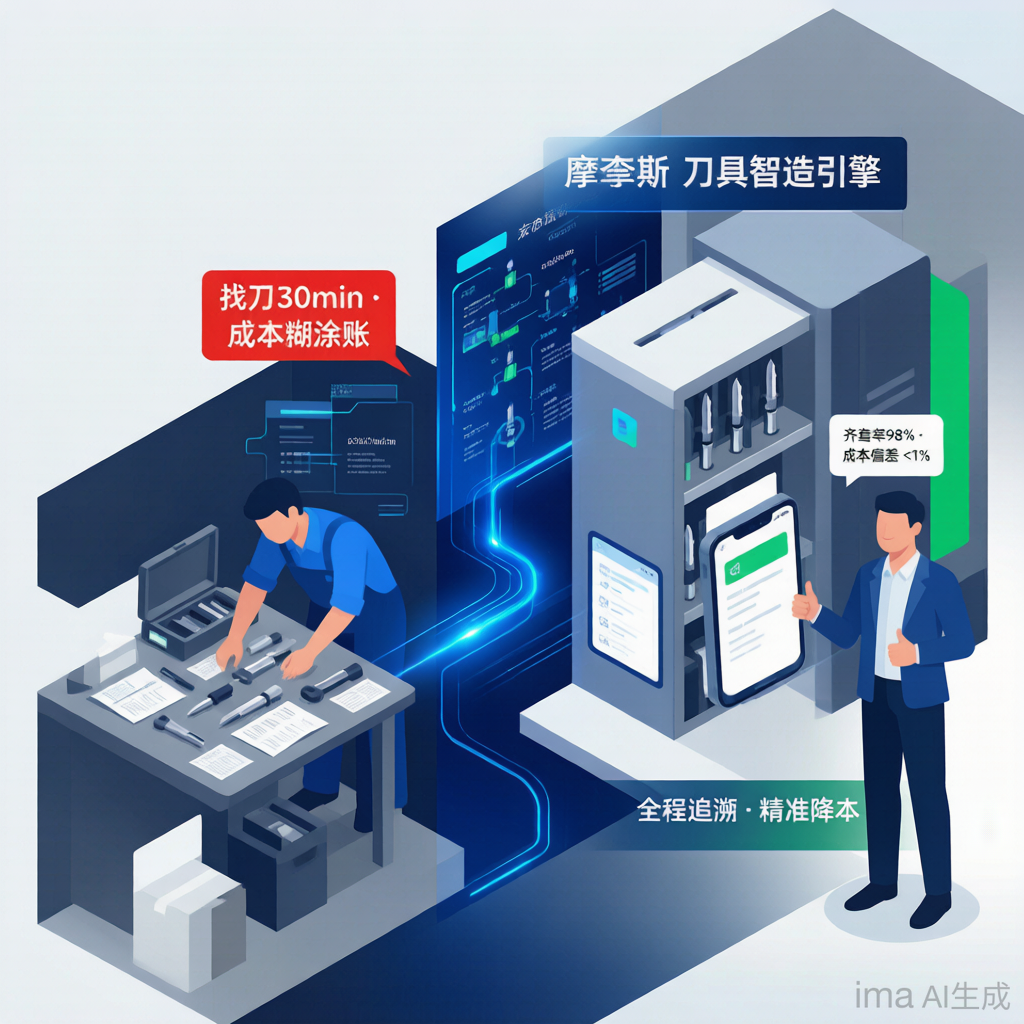
I. Three Built-In Pain Points of a Custom Tool Shop
The "multi-variety, small-batch, fully custom" production model of custom cutting tools means its management pain points are baked into its DNA. It is not that employees are not trying - manual management and Excel have simply reached their limits.
Pain Point 1: Progress Relies on Watchful Eyes, and Late Deliveries Become the Norm
With over a hundred open work orders, each job runs five or six to a dozen-plus steps from blanking, rough machining and heat treatment to coating, edge sharpening and inspection. When a step gets stuck, the owner has no idea unless he walks the shop floor, and it is usually only when a customer chases the order that an outsourced step is found to be a week late.
Pain Point 2: Costs Cannot Be Calculated Accurately, So Profit or Loss Is Guessed at Year-End
Every cutter differs in material, labor hours and outsourcing fees, and manual allocation easily misassigns costs. A seemingly well-quoted order can turn out to have overrun its outsourcing fees - a lot of work for a loss. Industry research shows that costing errors cost custom tool factories 5%-8% of revenue in lost profit every year on average.
Pain Point 3: Chaotic Outsourcing Management, with Reconciliation a Constant Tug-of-War
Special processes such as coating and heat treatment are widely outsourced, with dozens of outsourcing orders each month. How much went out and how much should be paid all depends on supplier statements. Skipping reconciliation invites overpayment; doing it properly takes two or three days and gives the finance team a monthly headache.
| Dimension | Traditional manual / Excel management | Custom tool shop management software |
|---|---|---|
| Progress tracking | Supervisor's memory plus running around; delays surface 3-7 days late | Scan-to-report gives real-time visibility; delay alerts trigger 24 hours in advance |
| Cost accounting | Manual month-end allocation with a 15%-30% error rate | Order-level automatic aggregation with ≥99% accuracy; profit shown at completion |
| Outsourcing reconciliation | Paper-based checking, 2-3 days per month | System-generated statements verified in 10 minutes |
| Quality traceability | Digging through notebooks for the cause, 4+ hours on average | Enter the order number to locate the problem step and responsible person in seconds |
| Delivery lead time | Frequent delays and a high customer complaint rate | Cut by 22% on average; on-time delivery raised to 95%+ |
II. Choosing Wisely: Three Common Mistakes That Leave Software Gathering Dust
Many owners realize they need a system, but choosing the wrong direction turns the investment into wasted money. These are the three most common traps for custom tool factories:
Mistake 1: Forcing Generic Machining Software onto a Custom Model
Generic software is designed for volume production; its underlying logic does not fit project-based custom work. One customization round costs tens of thousands of RMB and still fails to work. What custom tool shops need is a system that natively supports "one order, one BOM; one order, one tracker".
Mistake 2: Chasing an All-in-One Suite and Leaving 80% of Features Idle
Salespeople push supply-chain, HR and finance bundles, but small and mid-sized factories have no dedicated staff to run those complex modules, so they sit unused. In custom tooling, 80% of the value comes from 20% of the core features - progress, cost, outsourcing and quality. Solving these is enough.
Mistake 3: Believing Small Factories Do Not Need a System
Below roughly RMB 10,000,000 in annual output, Excel can still cope; past one or two times that, even tracking progress and costs needs a dedicated person and still breeds errors. One mishandled order can wipe out half a year of software fees. Digitalization is not a big-factory privilege - smaller factories need precise cost cutting even more.
III. Five Essential Cores of Good Custom Tool Shop Management Software
For custom tooling, good software does not need to be flashy, but these five cores must be solid:
1. Hybrid Production Mode: Custom and Batch in One System
Most shops take custom orders as well as repeat orders for standard cutters. Mature custom tool shop management software uses a dual-mode architecture, switching seamlessly between project mode and batch production within one system - no juggling two systems - saving 30% or more of IT spend.
2. Real-Time Progress Tracking: Zero-Burden Scan Reporting
Workers scan a code to report each completed step, an operation that takes no more than 3 seconds. Managers see each order's current step and delay status in real time on PC or phone, without camping on the shop floor.
3. Full-Cycle Outsourcing Loop: Reconciliation Down from 3 Days to 10 Minutes
From outsourcing dispatch, agreed lead times and machining fees to return, warehousing and reconciliation, all information flows with the order. At month-end, export statements with one click and verify quickly with suppliers, eliminating overpayments and wrong payments.
4. Per-Cutter Cost Accounting: Know Profit the Moment Work Completes
Materials, labor hours and outsourcing fees roll up automatically into each order, and gross margin shows the instant an order completes. Which cutter types make money and which lose it is plain to see, supporting precise quoting and product strategy adjustments.
5. End-to-End Quality Traceability: Closed Loops, No Repeat Mistakes
For any quality issue, enter the order number to trace the material batches used, the operators and the problem step. Lessons accumulate into a knowledge base, preventing repeat errors and steadily lifting the yield rate.
IV. Implementation Matters: Software Is 30%, Execution Is 70%
Industry veterans all know that even the best software ends up abandoned without proper implementation. Three points to note when implementing a custom tool shop system:
Pilot first, then roll out: start with the core modules to get the flow working, and go fully live within 3 months - long rollouts erode confidence. Moges' five-step implementation method has kept the implementation success rate above 95%.
On-site consultants are a must: small and mid-sized factories have no dedicated IT staff, so issues must be solved on the spot. Remote support is slow to respond; only on-site service gets the system truly running.
The owner must drive it personally: adopting a system is a "top-leader project". If the boss does not lead, frontline staff resist the new methods - nine out of ten such projects fail.
Summary: Do the Math and the Software Fee Has Already Paid for Itself
Many owners of custom tool factories with RMB 20,000,000-30,000,000 annual output ask: "We are so small - isn't buying software a waste?"
Do the math: the penalty payments for late deliveries, the profit lost to costing errors and the extra outsourcing fees paid at reconciliation usually add up to far more than the annual software fee. For a custom tool shop, adopting management software is not about chasing trends - it is about untangling the mess and winning back the money being needlessly lost.
Is your factory still tracking progress from memory and guessing costs in Excel? If the answer is yes, maybe it is time to talk to Moges.