How Much Does Machining Management Software Cost? A Low-Price Pitfall-Avoidance Guide for Non-Standard Factories
2026-08-31 10:01:23
Preface: A RMB 3,800 Piece of Software That Cost RMB 150,000
Last month I had tea with the owner of a non-standard factory in Suzhou making 3C testing devices. He pulled out his phone to show me an installation file lying in his installer folder: a machining management software bought for RMB 3,800 three months ago, now completely abandoned.
When I asked why, he said the shop has 8 machining centers machining core structural parts in-house, and they originally tracked processes in Excel, which kept going wrong — so he wanted to spend a little money to get things in order. But this software could only dispatch work orders: the BOM had to be entered line by line by hand, and after machining, stock-in still required manually updating inventory. Last month a wrongly entered aluminum ingot dimension scrapped an entire block of material, and with the project delay that followed, the total loss approached RMB 150,000 — enough to buy five copies of that software.
When many people look for a tool, their first question is "how much does machining management software cost?" Here is a counterintuitive conclusion: 90% of the low-priced machining management software on the market is essentially built for batch machining factories and fundamentally unsuited to the self-machining stage of non-standard automation enterprises — the money is simply wasted.
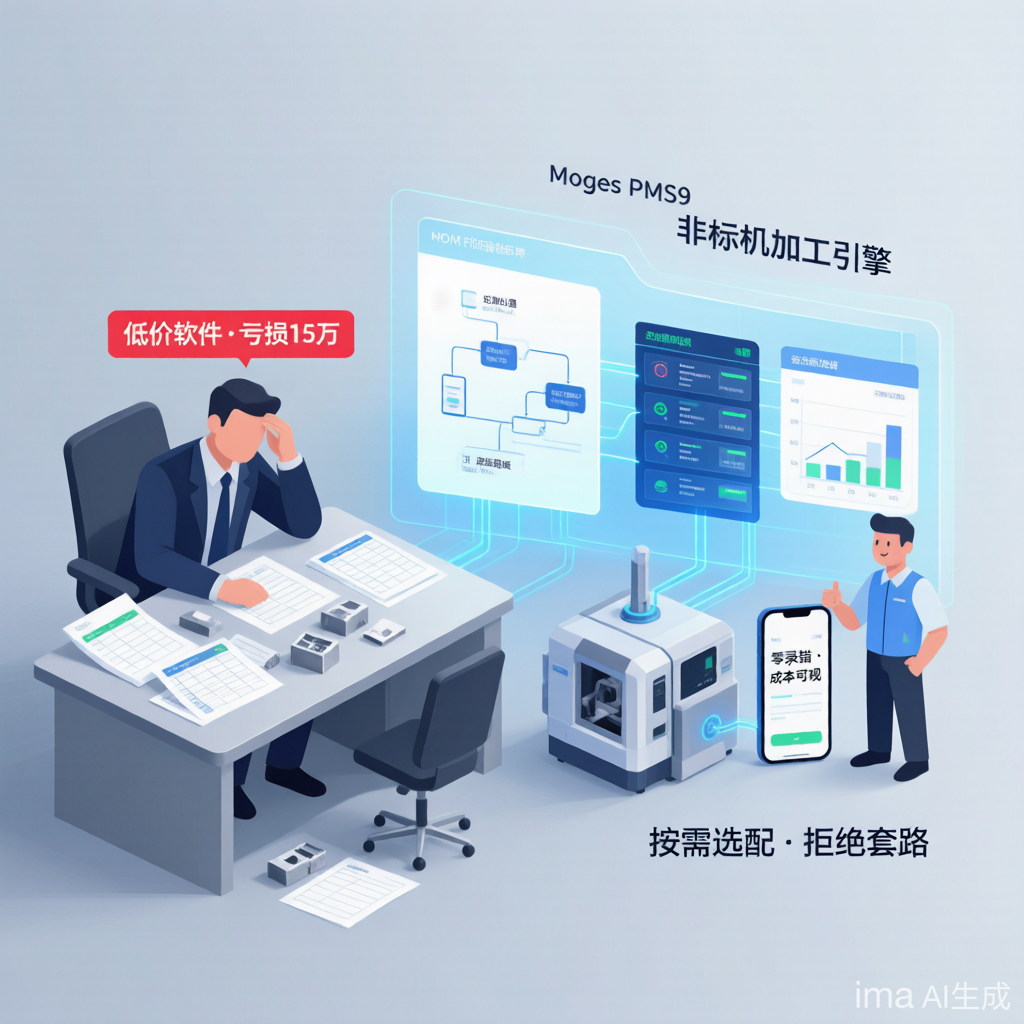
1. Why Cheap Generic Software Does Not Fit Non-Standard Factories
Batch machining and non-standard automation self-machining are two entirely different things. A batch factory makes hundreds or thousands of the same part in one run with fixed processes — managing capacity and delivery dates is enough — so its software is simple in function and cheap to sell.
But for a non-standard factory's self-machined parts, every project's parts are one of a kind: the BOM differs, and processes may change. You need more than dispatch — machining tasks must be chained to the whole project's progress, BOM, procurement, and inventory.
Trick 1: Isolated Functions — More Trouble Than Excel
Many cheap software products are single-function points with isolated machining tasks. After splitting the BOM you must manually export machining tasks; after machining you must manually notify the warehouse for stock-in; costs must be manually computed into the project — one extra procedure compared to Excel, and errors are even harder to trace.
Trick 2: Low-Price Bait with Unbundled Module Surcharges
Quite a few cheap software products sell by module: a low price of a few thousand to lure you in. Once you are using it, BOM integration costs extra, cost accounting costs extra, permission management costs extra — adding up to more than buying one complete full-flow system. This is an open industry routine.
| Comparison dimension | Low-price generic software | Non-standard-specific management software (e.g., Moges PMS9) |
|---|---|---|
| Applicable scenario | Batch production, fixed processes | Non-standard customization, one order one BOM |
| BOM linkage | Manual entry, error-prone | Automatically drives generation of machining tasks |
| Inventory sync | Manual inventory updates; records mismatch reality | Automatic stock-in on completion, automatic deduction on picking |
| Cost aggregation | Manual splitting, lagging and inaccurate | Auto-aggregated to the project, visible in real time |
| Hidden costs | Scrap from entry errors + delay compensation, hundreds of thousands a year on average | One investment, payback in 3-6 months |
2. Reasonable Price Ranges for Different Needs
Price is never fixed — it depends on your needs. For factories of different scales and needs, a tenfold reasonable price gap is normal. From my 10-plus years in this industry, the rough ranges are:
Lightweight: Workshop-Style Machining
Only 2-3 machines, needing only dispatch and piece-rate reporting, without project or inventory integration. Such lightweight tools generally run RMB 1,000-5,000 per year on annual payment, and perpetual licenses generally under RMB 20,000. Suited to small teams that need no full-flow integration at all.
Mid-Range: Non-Standard Factories with In-House Machining Shops
Machining tasks must connect to project BOMs, with process tracking, quality, and costs, linked to procurement and inventory. Such integrated modules generally charge by user count or project count, with annual fees of RMB 30,000-150,000, and perpetual licenses generally starting from RMB 100,000. This pricing matches the market level.
Heavyweight: Large-Scale Non-Standard Enterprises
Dozens of machines, needing integration with existing ERP systems, plus fine-grained permission control and custom reports. These require adaptation development, generally priced from RMB 200,000 to 500,000 depending on development volume.
Do not think this is expensive. Run the numbers: one scrap event a month, each costing several thousand — a year easily exceeds this. Many owners cannot calculate this account, look only at the software's sticker price, and end up losing far more.
3. To Judge Whether the Price Is Worth It, Check Five Core Functions
Regardless of price, for machining management built for non-standard factories, if any of the following is missing, however cheap, it is not worth it — money wasted:
1. Automatic BOM-Driven Generation of Machining Tasks
After BOM splitting, self-machined parts are automatically extracted into machining tasks — no manual second entry, preventing dimension/model entry errors at the root.
2. Process-Level Full-Chain Tracking
Every process's status is visible, tracked from waiting to completion, recording actual hours, operators, and qualified/scrapped quantities. When problems occur, you can directly locate which person and which process caused them — and piece-rate wage calculation no longer requires manual copying.
3. Automatic Inventory Linkage
After machining completion and acceptance, stock-in updates inventory automatically, and picking deducts automatically — no warehouse re-counting, avoiding records-versus-reality mismatches.
4. Machining Costs Auto-Aggregated to the Project
Material losses and actual hour costs aggregate automatically to the corresponding project — no manual splitting by finance. You can clearly see how much the project's machining stage spent and whether it makes money.
5. Full Records of Rework and Scrap
Record the cause, responsible person, and loss amount of every rework and scrap event. Over time you can summarize where problems tend to occur and improve targeted, reducing losses.
The Moges PMS9 I have dealt with designs the machining stage for the non-standard industry exactly this way: all these functions are included in the full-flow modules, with no separate unbundled surcharges.
4. Calculate the Hidden Costs First, Then Ask the Price
Many owners have a misconception at purchase: treating the software's purchase cost as the only cost, ignoring the hidden costs of not using software or using the wrong one.
For example, managing processes in Excel: one or two errors a month, one scrapped part costs several thousand; a delayed delivery incurs penalty compensation of tens of thousands; wrongly counted hours mean overpaid wages or demoralized workers hurting capacity... Added together, a year's losses of over a hundred thousand are quite normal.
Others say "I'll buy something cheap to make do, and switch later". In reality switching software costs even more: exporting and cleaning old data, retraining employees on the new software — one or two months at best, half a year at worst — and the delay in production progress costs far more than the software.
Summary: Calculate the Losses Before Asking the Price, and You Will Not Step into Pits
For non-standard factories, machining is the core stage controlling costs and delivery. First calculate how much your current monthly losses from management chaos are, then find software matching your needs, and finally ask "how much does machining management software cost" — only then will you avoid the pits.
Is your shop still tracking processes in Excel and entering BOMs by hand? If the answer is yes, perhaps it is time to talk with Moges.