I. The Three Most Common Pits in Choosing Automatic Scheduling Software
2026-09-18 08:02:35
Over the past six months I've dealt with nearly 20 small-mid mold factory owners, and almost half said they had previously adopted so-called automatic scheduling software — either the plans it produced were simply unusable, or frontline staff found it troublesome and refused — ending back on the old road of manual scheduling. Why spend money with no effect? Mostly they stepped in selection pits, never clarifying what mold factory automatic scheduling actually needs.
I. The Three Most Common Pits in Choosing Automatic Scheduling Software
Over eighty percent of domestic small-mid mold factories run mixed operations of "custom molds + batch machining": a custom mold is project-based; a batch of parts is batch production — two production modes with completely different scheduling logic. Many generic scheduling products support either project scheduling or batch scheduling only; on mixed mode they either omit operations or conflict machine capacity — the produced plans simply can't execute, ending messier than manual scheduling.
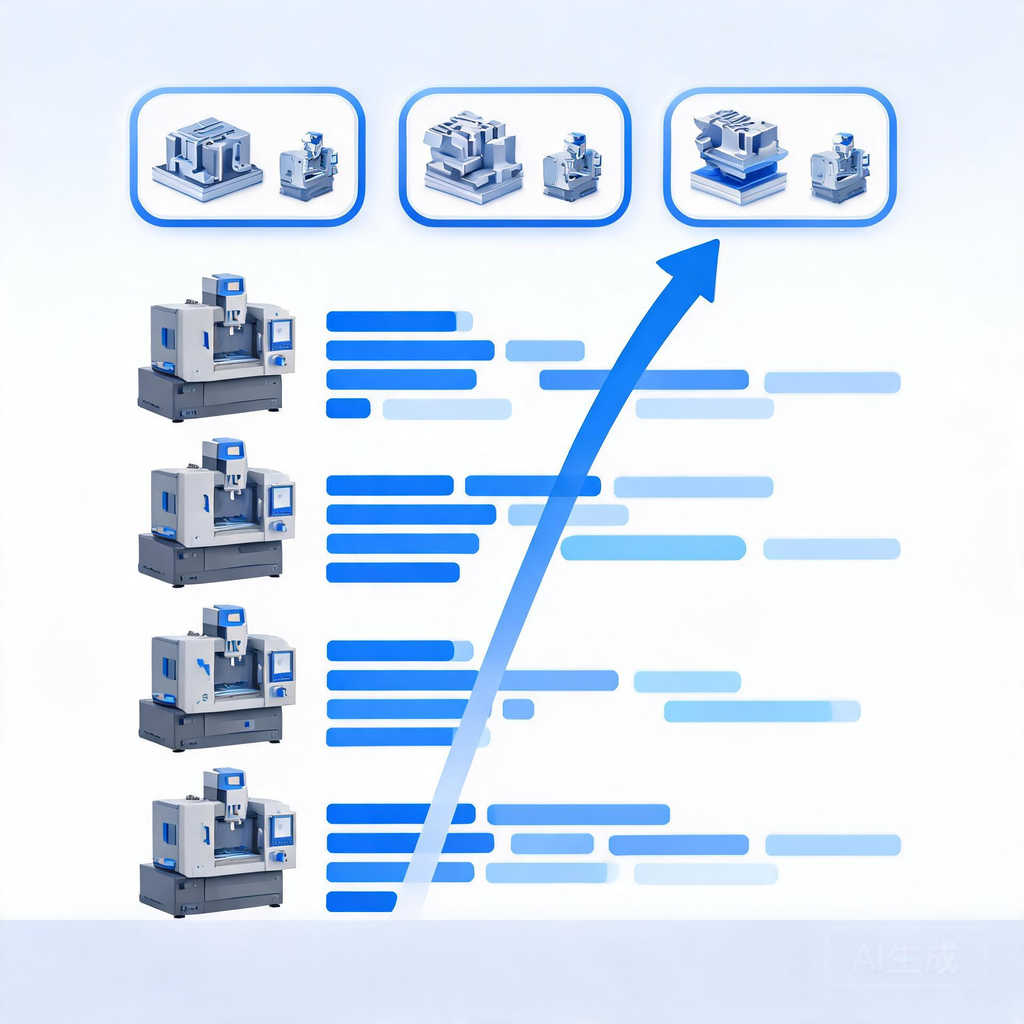
Some owners also blindly chase big-and-complete, believing pricier means better. Vendors tout a hundred-plus features covering every factory flow, opening at hundreds of thousands. Quite a few owners figure you get what you pay for — the expensive must beat the cheap — grit their teeth and buy, then find 80% of features never used and operations especially complex; frontline staff can't learn it and resist; the system ends up as a basic scheduling sheet. Over half the money spent, none of the matching effect gained.
Another pit: dismissing AI scheduling as a gimmick. Veteran owners of decades say, "I scheduled by hand fine — why AI?" But mold industry deadlines keep shrinking; customer inserts and changes are the norm. An experienced production supervisor spends at least 3-4 hours a day scheduling; an insert means a full teardown and re-schedule, with errors frequent. AI scheduling produces an optimized plan in seconds and adjusts dynamically — that's real efficiency gain, not a hollow concept.
All these pits, at bottom, come from never clarifying what mold factory automatic scheduling must solve.
II. What Must Mold Factory Automatic Scheduling Actually Solve?
The mold industry is inherently single-piece custom: every mold set is an independent project, from design to delivery taking three-five days at least, weeks at most, spanning a dozen-plus operations plus plenty of outsourced ones — with inserts and changes extremely frequent. Manual scheduling depends entirely on the supervisor's personal experience: newcomers can't hold it, veterans can't finish it. Some machines run non-stop fighting for capacity while others sit idle; deadlines slip unknown to the owner — discovered only when the customer chases and the job turns out stuck at some operation.
Mold factory automatic scheduling, plainly, hands repetitive planning to the system, solving three cores: free the production supervisor from daily repetitive scheduling — time saved for managing capacity and controlling quality; optimize machine utilization — no more idle-starving while others busy-to-death; respond dynamically to inserts and changes, adjusting plans anytime to keep delivery stable.
For small-mid mold factories, automatic scheduling can't be an isolated feature — it must link with production execution. Once the plan is set, frontline workers scan and report after each operation; the system updates progress in real time and auto-schedules the next operation — no manual re-checking. Owner on site or not, every mold's stage is visible anytime — that's automatic scheduling that can actually land.
III. Judgment Criteria for Choosing the Right Automatic Scheduling Software
We've spent 14 years building management systems only for the mold industry and dealt with 200-plus small-mid mold factories. Here are a few solid judgment criteria.
First: it must fit your production mode. For the custom-mold + batch-machining mixed mode, choose a system supporting both scheduling modes simultaneously — many generic products know only one and go blind on mixed production. Moges' system natively supports dual-mode architecture: one system handles both modes' scheduling, no buying two and switching back and forth.
Second: prefer a team that knows the mold industry — not a pure IT company. Automatic scheduling involves too many constraints: which operations must outsource, average outsourcing cycle times, which machines prioritize rush orders, which parts return for grinding only after heat treatment — rules precipitated over a decade-plus of mold industry practice. Pure IT companies have never touched mold production and simply don't know these; their scheduling logic defies reality. Only a team born of the mold industry, knowing the floor's pain points, produces scheduling logic that fits real production.
Third: pricier isn't better — what fits you is best. For small-mid mold factories with annual output of 10 million to 500 million, million-level big systems are simply unnecessary. Mold MES value is highly concentrated: solve the cores of accurate scheduling, clear progress, and optimized capacity, and you're already ahead of 80% of peers. Don't be talked into big-and-complete plans — plenty spent, system unusable, and factory digitalization confidence dented. Digitalization isn't a big-factory privilege; small-mid factories need lightweight, landable solutions even more.
Fourth: implementation matters more than the software itself. The trade saying — three parts software, seven parts implementation — finding an industry-savvy implementation team beats everything. Many vendors ship you an installer and leave you to struggle, unable to launch for half a year. Good implementation first sorts your base data, pilots core operations, proves them, then rolls out factory-wide — only the core modules you need, normally company-wide within three months, with implementation consultants following up on site, not sell-and-forget. Our statistics: with the owner leading and the right implementation team, success exceeds 95%; conversely, an inattentive owner and an industry-blind team — nine of ten fail.
Fifth: AI scheduling is mature — use it where it fits. AI isn't omnipotent; it won't win you orders. But facing a dozen-plus inserts a day that manual scheduling can't absorb, AI delivers the optimal plan in seconds — more reasonable than a veteran's manual effort — improving utilization and shortening deadlines. Real, tangible benefits. Pick the right entry point, start small, and the gains come.
Summary:
Many mold factory owners agonize over whether to adopt automatic scheduling. You needn't chase trends, nor reject new technology. First clarify whether your biggest pain today is chaotic scheduling, slipping deadlines, and low machine utilization. If so, start small: adopt the core automatic scheduling function first. Solving real problems beats everything.