I. Why Machining Workshops Need Real-Time Tracking
2026-09-21 08:23:59
The most common scene in a mold machining workshop: the customer asks "where's my mold at?" and the supervisor digs out a few scattered work orders and gives a rough date over the phone — but whether that date is accurate, which operation it's stuck at, how many days late — nobody can say.
Opaque progress isn't "poor management" — it's dictated by how information is collected. Traditional paper tickets, Excel sheets, and verbal reports are all essentially "recording after the fact" — real-time sync impossible.
I. Why Machining Workshops Need Real-Time Tracking
Real-time tracking's value isn't "looking smart" — it's solving three concrete pain points encountered daily.
1. Give Customers Accurate Delivery Commitments
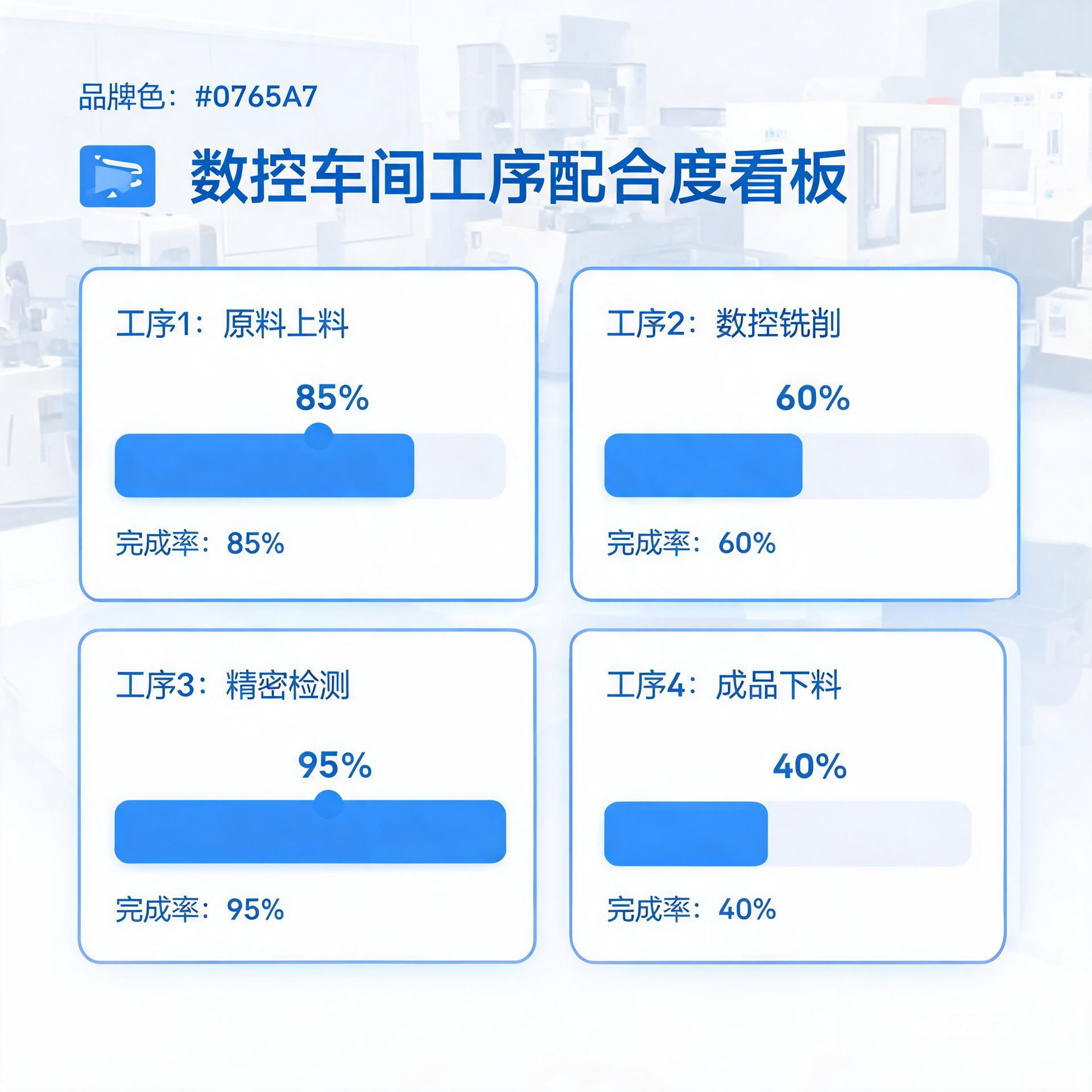
What customers can't accept isn't "delay" — it's "promised Friday, told Thursday it can't ship." With real-time tracking, sales or order followers open the board anytime and see each operation's actual completion time and current bottlenecks — the delivery date they give rests on real data, not gut feel.
2. Discover Bottleneck Operations Ahead of Time
A mold machining line typically passes seven-eight operations: CNC roughing, finishing, heat treatment, surface treatment, assembly and trial. If roughing runs 2 days slow, every downstream operation drags — but with a real-time board, the team lead spots roughing's queue backlog in the morning and can urgently coordinate extra machines or adjust scheduling, containing the impact to the minimum.
3. Cut the Workshop's Internal Communication Cost
In many workshops' WeChat groups, over half of daily messages are "where's part XX?" "Will it ship today?" — questions that essentially stem from having no unified view everyone can see. Once the real-time tracking board launches, 90% of these questions vanish automatically.
II. The Core Functions of a Real-Time Tracking System
A usable progress tracking system needn't be complex. Three core modules cover 80% of daily needs.
| Module | Problem Solved | Implementation |
|---|---|---|
| Production reporting | How operation data enters the system after completion | Scan code + mobile app — one scan before and after each job |
| Progress board | Owner/order follower/customer viewing real-time position | Operations expanded per mold number, green-yellow-red marking |
| Anomaly alerts | What to do when an operation times out | Set SLA thresholds; timeouts auto-push to team leads |
Production reporting is the foundation. The least-hassle way: stick a QR code at every machine station — the worker scans once at start to log the start time, scans again at completion for the end time. No computer per person — a phone suffices, 10 seconds done.
III. The Three Easiest Selection Pits
First, don't choose a generic ERP for "completeness." Mold machining is the most special class of discrete manufacturing: many operations, frequent changeovers, one machine cutting three-four different jobs a day. Generic ERP's reporting logic is designed for continuous production — adapting it to a mold workshop means too many changes.
Second, the reporting step can't be too complex. If workers must fill five fields, pick dropdowns, and take photos to report, the data will still be inaccurate three months after launch. The best reporting experience is "scan the code" — the system auto-records time, machine, and person; the worker only scans again at completion.
Third, customer-side progress queries must be lightweight. Don't make customers log into systems, open boards, read spreadsheets. The simplest way: generate a dedicated link per mold — click through and it's a progress bar showing each operation's status. Customers don't need raw data — only "when will I receive it."
Closing
Real-time tracking software isn't a high-flying gimmick — it installs a pair of "eyes" for the mold machining workshop. Let the owner see true progress, let sales give accurate commitments, let team leads spot bottlenecks early, let customers make fewer chasing calls — achieve all four and the system has paid for itself.