I. Why Scattered-Part Production Is Especially Delay-Prone
2026-09-21 08:25:07
In mold factory workshops, this exchange is heard constantly: "The scattered-parts order — the customer is asking about the delivery date again." "Have the supervisor go talk to them — even I don't know where it's stuck." "Last week you said it ships this week; this week it's next week — the customer is about to explode."
Scattered-part order progress goes wrong easily for reasons entirely different from batch mold orders: every scattered part has a different process route — today on a CNC, tomorrow to wire EDM, the day after across to a surface-treatment plant. Any link jammed, and the whole order's progress drifts with it.
I. Why Scattered-Part Production Is Especially Delay-Prone
Compared with batch mold orders, scattered parts carry three inherent handicaps — stacked together, they are the root of lost control.
1. Process Routes Aren't Fixed
A batch mold's route is fixed at order intake — dozens to hundreds of pieces travel the same path. Scattered parts differ: a customer wants a special-shaped insert — perhaps CNC rough-milling first, then EDM discharge, then off to the heat-treatment plant, then grinding and polishing on return — four-five operations spanning three workshops; a queue at any one affects the whole.
2. Deadline Pressure Is Asymmetric
Customers chase scattered-part deliveries even harder than batches — because scattered parts usually complete a missing component, catch a temporary order, or resolve a pressing line-side emergency. Half a day late, and the customer's line may stop.
3. Information Scatters Across Many Places
Scattered parts may be made in your own workshop or outsourced to outside machining plants. The CNC shop keeps a notebook, the wire-EDM shop another, the outsourcing shop its own system — consolidation rests entirely on the order follower phoning one by one.
II. The Core of Delay Management: Make the Data Transparent First
Managing scattered-part delays needs neither fancy AI algorithms nor complex scheduling systems. Get these three things right and 80% of the problem is solved.
| Action | How | What It Solves |
|---|---|---|
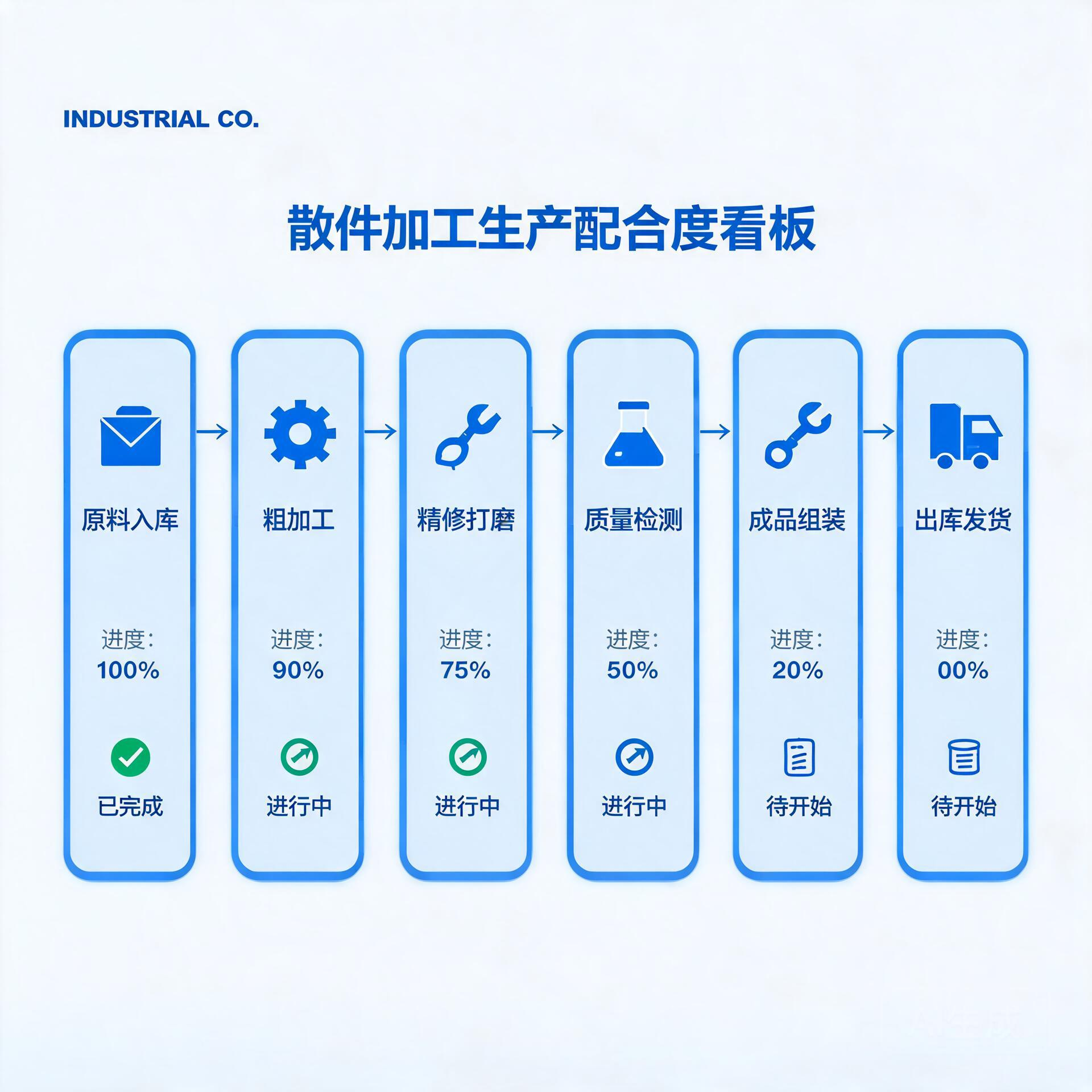
| Unified board | All scattered-part orders on one board, sorted by current operation and expected completion | Order followers no longer phone one by one |
| Operation SLA | Set time caps per operation; timeouts notify automatically | Bottlenecks surface early — no learning of them only when the customer asks |
| Anomaly registration | Workers log delay causes in the system (equipment down / awaiting material / process change) | Management sees delay root causes — not just "it's late" |
The unified board is the starting point. Whether your own workshop's operations or the outsourcing plant's, current status, current progress, and expected completion must be visible in one place. The outsourcing shop may not have your system — the simplest way is having them report once a day before end of shift in the lightweight app you provide.
III. Three Landing Tips for the Owner
First, start pushing from the two core operations, CNC and EDM. These two occupy over 60% of the scattered-part production cycle — get their reporting running and the board covers most orders. Don't demand all operations scan from day one — workers will resist.
Second, negotiate outsourcing cooperation in advance. Don't discover after launch that the outsourcing plant won't report. Say it clearly at contract signing: cooperating with progress tracking is a condition of taking orders — cooperative suppliers get scheduling priority.
Third, put a bit of pressure on order followers and supervisors. After launch, order followers hold a 10-minute board stand-up each morning reviewing at-risk orders; supervisors check before end of shift for any operation timed out and unhandled. With data transparent, everyone naturally pays attention.
Closing
Managing scattered-part production delays is essentially a problem of information transparency — not a technical problem, an organizational-process problem. Move the data out of each workshop's little notebooks, each outsourcing shop's WeChat messages, each order follower's head — onto one board everyone can see — and the root causes of delay surface automatically.