Machine Equipment Uptime Improvement Solution: A Practical Path from 50% to 85%
2026-09-21 08:32:13
Your newly purchased CNC machine is running constantly in your workshop, but when the boss reviews the reports, he finds that the "utilization rate" remains stuck around 50%. The workers say they are busy, and the machine seems to be constantly in use, but the output hasn't increased. This is a common hidden problem that many machining shops face.
Low Overall Equipment Effectiveness (OEE) is not a problem with a single machine, but rather a comprehensive symptom of the entire workshop management chain. Moges serves over 200 mold factories and precision machining plants, and on average helps customers increase their OEE from 45%-55% to 75%-85%, resulting in a cumulative capacity release of over 30%. This article breaks down our proven improvement solutions, which have been developed over 14 years of practical experience.
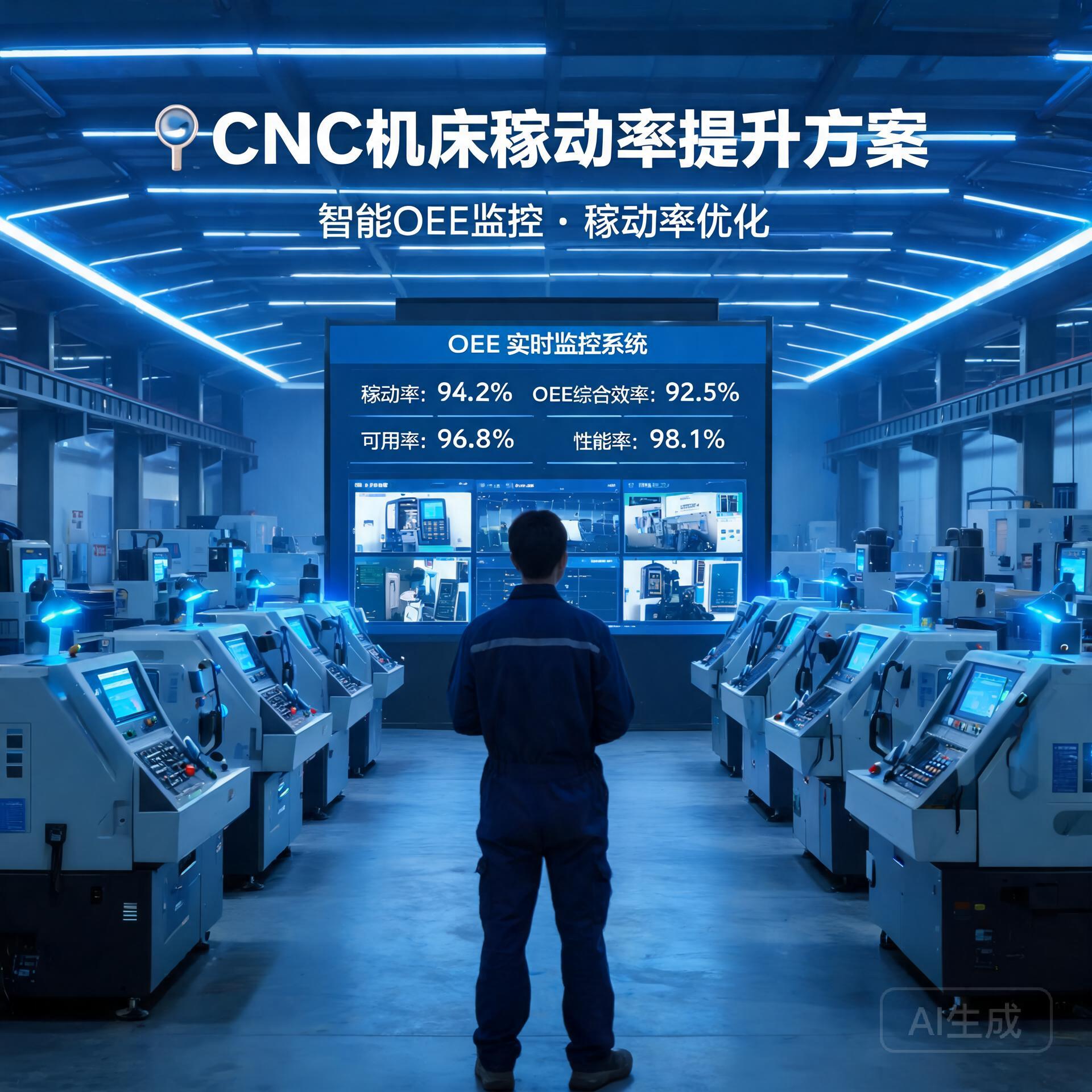
What is machine utilization rate? First, understand these three key indicators.
Many owners only focus on "how many hours the machine has been running," but the true overall equipment effectiveness (OEE) is the product of three key indicators:
- Availability = Actual operating time / Planned production time, excluding waiting time, downtime, and changeover time.
- Performance Utilization = Theoretical Cycle Time / Actual Cycle Time, indicating whether the equipment is operating at full capacity.
- Yield = Number of good products / Total number of products, reflecting the stability of quality.
For example, a workshop plans to operate for 8 hours, but actual downtime due to material waiting is 2 hours, changeovers are 1 hour, and equipment failures are 0.5 hours, resulting in a total of 4.5 hours of effective operation. Even if the machines operate at full capacity for these 4.5 hours with a 98% yield rate, the overall OEE (Overall Equipment Effectiveness) is calculated as (4.5/8) × 100% × 98% = 55%. This represents the typical reality for most small and medium-sized mold factories.
Key Insights: Low operational efficiency results in significant losses, with 70% stemming from "non-failure downtime." This includes waiting for materials, waiting for drawings, waiting for production decisions, and waiting for tool replacements. These invisible time sinks are the real problems that need to be addressed.
The three hidden killers that are causing your machine's low uptime.
Killer 1: Waiting time consumed 30%-40%
Most common scenario: After a machine completes processing one part, the operator goes to the whiteboard to check "which part is next." The drawing hasn't arrived? The rough material hasn't been picked up? The previous process hasn't been completed? Asking multiple times yields no clear answers. The entire process can take 5 minutes, or it can take up to half an hour. By the end of the day, it may seem like "waiting only a few times," but the cumulative downtime easily exceeds 2 hours.
Killer Two: Unpredictable breakdowns, technicians constantly firefighting.
Many workshops lack standardized maintenance procedures. Tools reach the end of their lifespan without being replaced, lubrication systems are not maintained, and abnormal spindle temperatures are only addressed based on "gut feeling." This results in sudden breakdowns, such as spindle damage and tool breakage, requiring 2-4 hours of repair. Over a month, these unplanned failures can consume 10-15% of production time.
Killer No. 3: Low changeover efficiency, a nightmare for multi-variety, small-batch production.
The common challenges faced by mold factories and precision machining factories are fragmented orders: today, aluminum alloy housings; tomorrow, stainless steel fixtures; and the next day, a change in processing methods. Each change requires a new mold, fixture, tooling, program, and parameter adjustments, which can take up to 40 minutes for experienced workers and over 1 hour for new employees. A change of 2-3 types per day results in 1.5-2.5 hours of downtime.
Moges Customer Success Story: A precision machining factory in Suzhou achieved a 48% to 83% improvement in efficiency within 48 days.
A precision automotive parts manufacturing plant in Suzhou, Wucheng District, contacted us in Q1 2025. Their average OEE for 12 CNC machines was only 48%, and the owner admitted, "We have insufficient capacity and cannot accept new orders, but our workers are working overtime every day." We implemented our Moges production management system plus device connectivity solution in four steps:
| Improvement Phase | Cycle | Core Actions | OEE Change |
|---|---|---|---|
| Stage 1: Data Collection | Previous 14 days | 12 machines equipped with gateways, real-time collection of operation/idle/failure signals. | 48% → Gain a clear understanding of problem distribution |
| Stage 2: Anomaly Alerting | 15-28 days | Tool change countdown, tool life warning, and immediate push notifications to mobile devices for equipment temperature anomalies. | 48% → 62% |
| Stage 3: Intelligent Scheduling | 29-42 days | The APS module optimizes order placement based on the shortest changeover path, reducing waiting times and changeover durations. | 62% → 76% |
| Stage 4: Continuous Optimization | 43-48 days | Weekly OEE analysis meetings to address the top 3 bottlenecks specifically. | 76% → 83% |
48 days, without replacing a single piece of equipment or laying off any employees, we achieved a 73% increase in capacity solely through digital management. In Q2 of this year, this factory proactively increased prices by 15%, resulting in a 40% increase in order volume. This was due to a reduction in lead times from 45 days to 28 days, which incentivized customers to place orders.
Five Common Mistakes That Lead to Lower Machine Equipment Uptime
Option 1: Device connectivity, enabling full traceability of every minute.
The first step to improving overall equipment effectiveness (OEE) is always "identifying the problems." By using the Moges equipment networking gateway, each CNC machine, machining center, and injection molding machine can report its status in real-time: is it currently running, idle, or experiencing a fault, or is it undergoing a changeover? How much time was it idle each day over the past 7 days? Which shift has the highest/lowest OEE?
These data do not require additional system installation. The Moges production management system includes an OEE dashboard, which can be accessed on the boss's mobile device at any time. The large screen in the workshop displays real-time data. Most importantly: data is automatically collected, eliminating the need for workers to submit reports, thereby reducing the burden on the front-line staff.
Option 2: Predictive Maintenance: Eliminate failures before they occur.
The Moges system automatically records the maintenance cycle, tool life, and historical failure patterns for each device. The system proactively sends a warning 12 hours in advance to the maintenance personnel when the spindle temperature exceeds the threshold for 3 consecutive times, or when the number of parts processed by the tool approaches the maximum lifespan.
Based on data from our 200+ customers, predictive maintenance can reduce unexpected failures by 60%-70%. A mold factory in Kunshan used our solution for one year, and the maintenance team transitioned from "constant firefighting" to "planned maintenance." Downtime due to failures decreased from 40 hours per month to 8 hours per month.
Option 3: Intelligent Scheduling: Using algorithms to replace human judgment.
Many workshops use a "gut feeling" approach to production scheduling, simply adding orders haphazardly, leading to increased changeover frequency and explosive waiting times. The Moges APS intelligent scheduling module, based on Google OR-Tools, considers hundreds of constraints, including equipment capacity, tool status, changeover costs, and delivery priority, to generate optimized schedules in minutes.
The most noticeable results are seen in scenarios involving multiple small batches: our customers have experienced an average reduction of 35% in changeover times, and a 60% reduction in delivery delays caused by urgent orders.
Option 4: Tool Lifespan Management, Reducing Unexpected Downtime
"Blade failure" is a common "silent killer" that can lead to significant problems. A single blade failure can result in rework, or in severe cases, damage to parts and the spindle. The Moges tool management module records the installation time, number of parts processed, and total cutting length for each blade, and automatically generates warnings based on the blade manufacturer's recommended lifespan.
The tool room can be accessed by scanning, allowing for both borrowing and returning. The system automatically matches "which machine's tool is nearing its lifespan," enabling proactive replacement during downtime, thereby avoiding disruption to normal production.
Option 5: Factory-wide dashboard + mobile push notifications for immediate response to anomalies.
Moges offers two methods for handling undelivered packages:
- Shop Floor Dashboard: Real-time display of the status of each device on a TV/large screen. Red = Fault, Yellow = In Maintenance, Green = Normal Production. Easily identify any issues at a glance.
- Mobile Push: Automatic notifications to technicians and workshop supervisors via mobile phone for issues exceeding 5 minutes, type replacement timeouts, and tool warnings, resulting in an average response time reduced from 30 minutes to less than 8 minutes.
Summary: Improving uptime is not about replacing equipment, but about changing management practices.
Many owners' initial reaction is to "buy a few new machines," but when new equipment is purchased, the same old problems persist: scheduling remains chaotic, waiting times remain long, breakdowns still occur without warning, and OEE may still be stuck around 55%.
Moges's experience shows that 80% of operational losses stem from management, not hardware. We have seen countless workshops where, through digitalization of production, device connectivity, and predictive maintenance, OEE has been successfully increased from 50% to over 75%, without any investment in new equipment. The true return on investment lies in management, not equipment.
- Analyze the downtime reasons for each machine over the past 30 days, categorized as "Waiting/Failure/Changeover," and you will find that 70% of the issues are concentrated in one or two specific stages.
- Schedule a free Moges diagnostic. Our implementation consultants will visit your site with the device gateway, and within 2 hours, you will receive a real OEE status report and improvement plan.
Moges, specializing in mold and machining since 2014, with over 200 customers, achieving a 95% implementation success rate. Empowering professional mold makers with professional systems.