How to improve mold workshop management that is chaotic? 5 steps to transform a chaotic workshop into an organized one.
2026-09-21 08:33:30
When you visit some mold workshops, you will often see a scene like this: whiteboards covered with order notes, piles of raw materials stacked high in the corners of the workshop, and technicians using their phones and wrenches while tracking progress in WeChat groups. The owner's desk is piled with half-meter-high Excel spreadsheets and paper reports. "Busy" but "chaotic" – this is a common management bottleneck that many growing mold factories encounter.
Moges, a service provider specializing in manufacturing production management systems for the mold industry since 2014, has served over 200 mold factories in the Yangtze River Delta region. We have firsthand experience witnessing the transformation of many workshops from "a chaotic mess" to "well-organized." This article shares our summarized "5-step improvement method," which, without changing hardware or personnel, can increase your workshop's operational efficiency by more than 30% through digitalization.
First, self-diagnose: Do your workshops exhibit these "problems"?
Before implementing any improvements, first assess yourself by checking if you exhibit any of the following three most common symptoms:
Symptom 1: Progress is entirely dependent on chasing, with the boss constantly acting as a "task enforcer."
Customer pressure for expedited delivery: The boss rushed to the workshop, demanding, "What's the status of that mold?" The production manager reviewed the paper work order, asked the team leader, who in turn asked the technician. After half an hour, they received a vague response: "It's coming along, just wait another two days." The situation worsened when the "expected completion" date arrived, bringing new problems: casting delays, broken tools, and missing outsourced components. Everything had to be re-started from scratch.
Core Issue: Lack of transparency in progress information. No one, nor any system, can provide real-time information on "each set of molds, each part, and the current stage of completion, as well as any bottlenecks."
Symptom 2: The entire operation relies solely on manual stacking, and the 5S implementation has resulted in further disorganization.
Many mold factories have engaged external consultants to implement 5S management. While the workshops were clean for two weeks, they quickly reverted to their original state: raw materials were piled up in the aisles, tools were scattered in the tool cabinets, and drawings were stuck in the gaps of the machines. More seriously, "not being able to find" became the norm: it was common to spend half an hour searching for the standard parts of a specific mold, the customer's historical drawings, or the materials sent out for external processing.
Core Issue: Lack of systematic tracking of on-site materials. The 5S initiative is merely "cleaning," but the in-and-out flow, movement, and storage locations of materials are not digitally recorded, leading to increasing chaos and inefficiency.
Symptom 3: Relies entirely on guesswork, accounting at the end of the month results in calculations until the early hours of the morning.
At the beginning of the month, we received an order for 10 sets, with a price of 80,000 per set. When calculating profits at the end of the month, we found that the material costs and labor costs exceeded the estimates. Additionally, the costs for 3 sets increased due to mold modifications. It's unclear whether we made a profit or incurred a loss. Finance uses Excel to manually track everything, while the production department relies on memory to estimate costs. The owner makes decisions based on gut feeling. Cost accounting takes a week and is often inaccurate.
Core Issue: Cost data is retrospectively collected, lacking real-time labor time collection, material usage records, and an external reconciliation system. This results in "post-mortem" accounting, meaning that the losses are only identified after they have already occurred, leaving no time to take corrective action.
Root Cause Analysis: Why does increased activity lead to more chaos?
The three symptoms mentioned above are essentially caused by the same underlying issue: information degradation and distortion during transmission.
The traditional management process works as follows: Customer information → Sales (verbal/email) → Production Supervisor (creates work orders) → Team Leader (assigns verbally) → Skilled Workers (execute based on experience) → Team Leader reports completion → Supervisor summarizes → Boss understands the situation. In this chain, information is lost with each transfer: unclear process requirements on the work order, skilled workers forgetting to report anomalies, team leaders omitting details... By the time the boss understands, the situation is "approximately, roughly, possibly".
Worse still, the mold manufacturing process itself isFrequent order changes, complex processes, and numerous operations.In the manufacturing industry, changes in customer specifications mid-process, delays in previous stages affecting subsequent stages, and the simultaneous processing of multiple sets of parts on a single machine all contribute to increased complexity. This complexity, combined with inaccuracies in information flow, makes it extremely challenging to maintain control and avoid errors.
Moges Customer Success Story: 3-Month Improvement Record for a Precision Mold Factory in Kunshan
A precision machining factory in Kunshan Huahu, specializing in automotive cover molds, is a long-standing client of ours. Their annual turnover is over 30 million, with 60+ skilled workers. Their workshop has been operating inefficiently for nearly 5 years. In 2025, when the owner, Q2, found us, he sighed: "This year, our orders have doubled, but our profits have actually decreased. The workshop is becoming increasingly busy, and lead times are getting longer."
We implemented the Moges production management system in three phases. The following are real improvement data:
| Metrics | Previous state | 3 months later | Improvement achieved |
|---|---|---|---|
| On-time delivery rate | 62% | 91% | +29% |
| Average Work-in-Progress (WIP) Quantity | 87 sets | 52 sets | -40% |
| Cost accounting cycle | 7 days/month | 0.5 per day/month | -93% |
| Customer complaint rate | 12 times per month | 2 times per month | -83% |
| Workshop personnel overtime hours | 38 hours/person/month | 15 hours/person/month | -61% |
Interestingly, the improvement process did not involve any layoffs or the purchase of new equipment; it relied solely on digital management. The owner stated: "I initially thought it would cost tens of thousands of dollars and require a large system, but it only cost 150,000 in the first three months. In the first month, we were able to eliminate overtime."
5-Step Improvement Plan (From Easy to Difficult, Recommended to Implement in Order)
Step 1: Achieve full visibility of production progress, transforming "tracking progress" into "observing progress."
This is the first step in improvement, and it is the most direct way to achieve results. Within the Moges system, each mold and each part has a unique work order code:
- When the worker starts work, they scan a code to record their time, and the start time of each operation is automatically recorded.
- Scan the code upon completion, and record the number of manufactured parts and working hours.
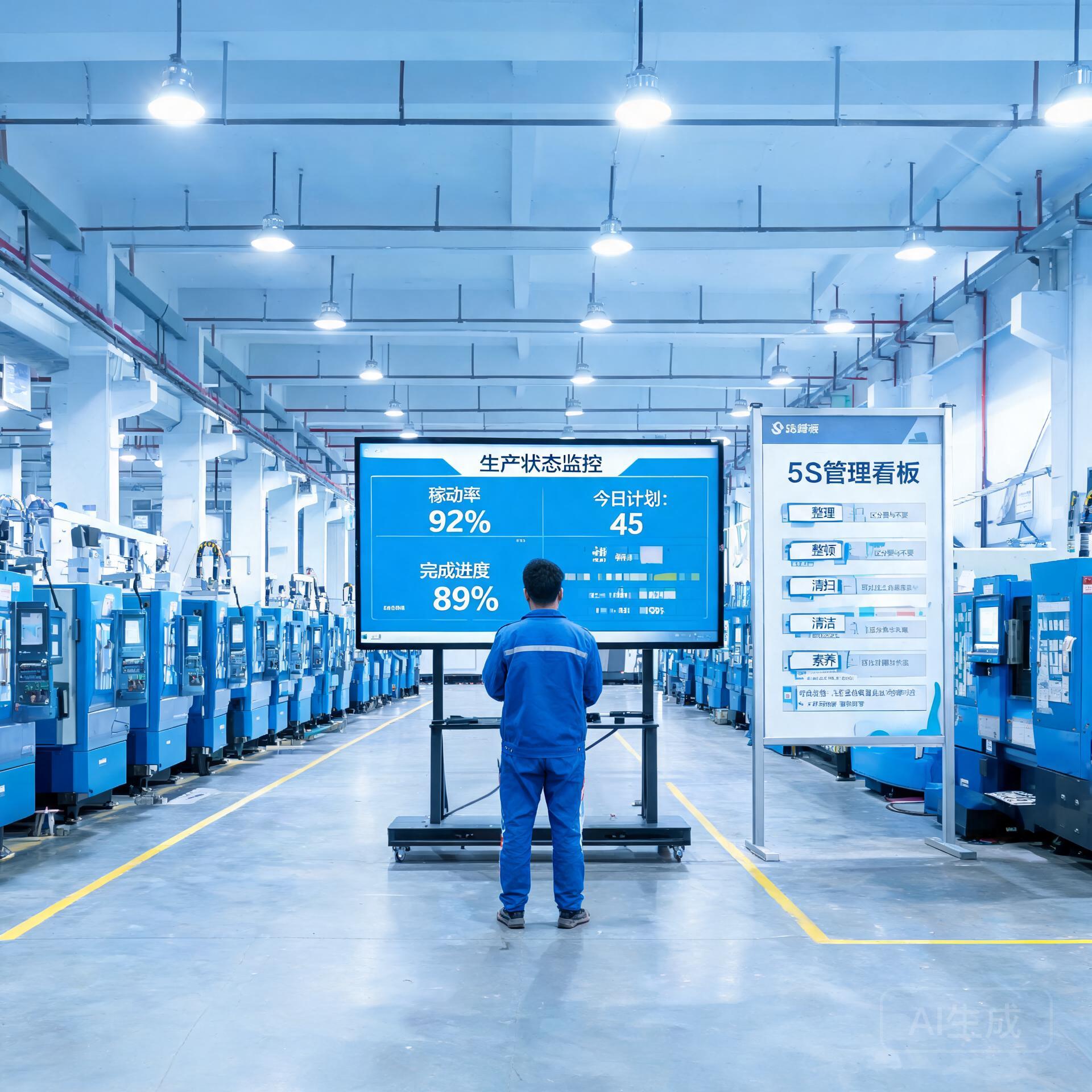
- All progress is consolidated in real-time on a large display and the manager's mobile phone.
The boss no longer needs to run to the workshop to check progress; he can simply open his phone to see: which molds are being processed, which are waiting for materials, which are nearing expiration, and which have anomalies. In the first week of implementation at the mold factory in Suzhou, the number of calls from the workshop requesting progress updates decreased by 70%.
Step 2: Digitalize orders and scheduling, making "scheduling" no longer a mystery.
Traditional scheduling relies on the experience of senior staff, leading to issues with handling a mix of single and multiple orders, handling intermittent orders, and staff being overloaded. Moges APS intelligent scheduling module:
- After importing an order, the system automatically generates a schedule based on equipment capabilities, personnel configuration, and the production process route.
- When placing an urgent order, simply click "Re-schedule" and the system will automatically find the optimal adjustment solution.
- Production results are synchronized to the large display and the mobile phones of workers at each workstation.
Our customers have seen an average production cycle time reduced from 2-3 hours to less than 15 minutes, and production accuracy has increased from 60% to over 90%.
Step 3: Organize materials in the workshop to make "finding things" a simple "scan".
The material management module offered by Moges covers three main categories: raw materials, standard parts, and outsourced parts.
- Rough Material Management: Scan and record material/dimensions/supplier upon receiving, scan and associate with specific work orders upon issuing, and automatically return remaining rough materials to the warehouse.
- Standard Parts Management: Automatic inventory alerts with purchase reminders, and barcode scanning for recording usage to mold costs.
- External Management: Automatically generate external processing orders, automatically receive and inspect, and automatically reconcile and summarize.
A customer in Kunshan reported that after implementing the system, the average time to "find raw materials/find standard parts/find external vendors" was reduced by 80%. Previously, they spent 1-2 hours each day on this task, but now they can complete it in just 10 minutes.
Step 4: Traceability is fully auditable, transforming "problem occurrence" into "problem investigation"
In mold manufacturing, tracing quality issues is a major challenge: If a mold has a problem, is it due to the material, incorrect process, or machining errors? Moges' quality traceability features:
- The quality inspector for each operation scans a code to record the inspection results (pass/fail/reason for rework).
- Automatically associate problematic parts with specific operators, specific equipment, and specific material batches.
- Automatically archive historical quality data, and conduct monthly analysis to identify frequently occurring issues.
After implementation, customers experienced an average reduction of 35% in rework rates, and the same issues did not recur because the system had recorded the causes and solutions.
Step 5: Leverage data to continuously optimize, transforming "experience management" into "data management".
The final step, and a key to continuous improvement. The Moges system's built-in statistical reports cover all the data that owners care about:
- Equipment uptime, failure records, and maintenance costs per device.
- Actual working hours per mold vs. standard working hours, Actual cost vs. budgeted cost
- Profit margin analysis for each order, customer repurchase rate statistics.
Every Monday morning, the owner and production manager hold a 15-minute data review meeting, focusing only on Top3 issues and resolving them promptly. Data from the Kunshan customer shows that this "weekly 15-minute" habit has increased overall efficiency by 25% within six months.
Summary: The core of workshop management is "the orderly flow of information."
Many business owners mistakenly believe that "management chaos" is a problem of people or equipment. In reality, the core of workshop management is ensuring that the correct information reaches the right people at the right time.
The operator needs to know "what to do next," and the system will tell them, without waiting for the workshop supervisor to provide instructions. Managers need to know "which molds have risks today," and the system automatically alerts them, eliminating the need to run around. The boss needs to know "how much was earned this month," and the system provides real-time summaries, eliminating the need for the finance department to work overtime at the end of the month.
Moges' 14 years of experience have taught us that the system is not about "following trends," but about solving real, practical problems. A good production management system should be "lightweight, easy to use, and focused on solving your core pain points." Don't aim for something overly complex and comprehensive; 80% of the problems can be solved with 20% of the functionality.
- Use the above three symptoms to self-diagnose and identify the 1-2 most critical issues in your workshop.
- Schedule a free Moges diagnostic. Our implementation consultants will visit your site with real-world case studies, providing you with a tailored improvement plan within 2 hours.
Moges, focused on the mold industry since 2014, with over 200 customers, achieving a 95% implementation success rate. Provide professional systems to achieve professional mold manufacturing.