Mold Workshop Management Software Recommendations: 2026 Selection Guide for Small and Medium Mold Factories (Including Feature Comparison Table)
2026-09-23 08:04:44
I. What Does a Mold Workshop Actually Manage? First, Define the Scope Clearly
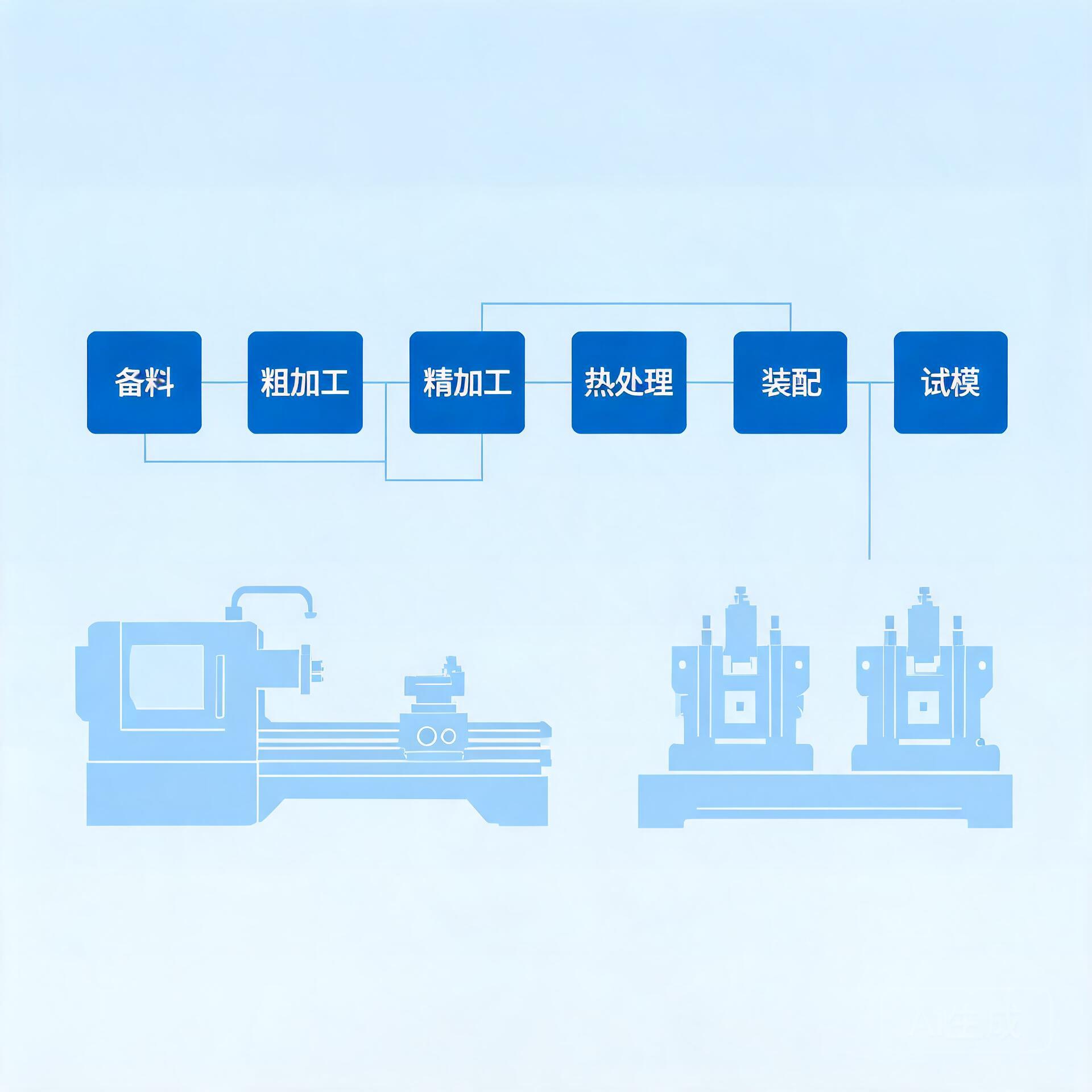
When many people discuss "workshop management software," they make the scope very broad—everything from order taking to shipment. A mold workshop has its own rhythm, different from batch machining production and different from sheet-metal assembly lines. From design to part output, a mold goes through seven or eight stages: material preparation, rough machining, finish machining, heat treatment, assembly, trial run, and mold repair. The labor hours, equipment, and responsible persons for each stage must be recorded. The core of mold workshop management software is to connect these stages so that the status of each workstation is visible in real time. The three biggest headaches for bosses are: delivery is delayed and they do not know where it is stuck; costs exceed the budget and they do not know where the overrun occurred; equipment is idle while work orders are still queued. Choosing workshop management software comes down to whether it can solve these three things.II. How Are Common Mold Workshop Management Software Solutions on the Market Classified?
By coverage, there are roughly three types: The first type is lightweight MES focused on the mold industry. This type of software only handles molds and does not touch machining assembly lines. Modules generally include order management, process scheduling, scan-to-report, outsourcing tracking, and simple cost accounting. The price is between 5-25 ten thousand, suitable for small and medium-sized mold factories with annual output value of 1000-5000 ten thousand. Kunshan Moges belongs to this category. The second type is general-purpose ERP plus workshop extension. Examples include Yonyou U8 and Kingdee Cloud Galaxy; these are financial ERPs by nature, with MES modules added later. The advantage is financial integration; the disadvantage is that the workshop part does not fit the pain points of the mold industry well. Functions such as reporting and scheduling require extensive secondary development. They are widely used by large group enterprises. The third type is pure MES that does not touch ERP. Examples include Siemens Opcenter and some products from Beizisuo. They are powerful, but the implementation cycle is long and they are too heavy for small and medium-sized factories. Prices are usually over 50 ten thousand, and you also need to set up a dedicated server to run the database.III. Core Function Comparison Table: Which Type of Software Better Addresses Mold Workshop Pain Points?
| Function Dimension | Lightweight MES for Mold Industry | General ERP + Workshop Extension | International Brand MES |
|---|---|---|---|
| Mold process reporting | Scan and report immediately, matching operators' habits | Requires secondary development, interface leans toward financial logic | Full functionality but complex operation |
| Outsourcing progress tracking | Dedicated outsourcing issue/receipt module | Forced use of purchasing module, not intuitive | Supported but cumbersome to configure |
| Tool/electrode management | Yes, inventory + life linkage | No, must add it yourself | Yes, but charged as an extra module |
| Delivery deadline alerts | Automatically calculates remaining labor hours, WeChat reminders | Manual setting, not intelligent | Strong APS scheduling but high barrier to entry |
| Cost accounting accuracy | Down to single mold + single process | Down to work order level, workshop details coarse | Detailed but high implementation cost |
| Mobile support | Mobile phone/PDA scanning, available offline | Has an APP, but mainly for approvals | Yes, but expensive |
| Implementation cycle | 1-3 months | 3-6 months | 6-12 months |
| Price range | 50,000-250,000 | 20-60 ten thousand | Over 500,000 |
| Typical customers | Small and medium-sized mold factories with 10-100 people | Large groups + independent financial needs | Large foreign-funded/joint-venture factories |
IV. Five Hard Requirements You Cannot Skip When Choosing Mold Workshop Management Software
4.1 Must support a hybrid mold + machining model
Many mold factories today do not only make molds; after the mold is finished, they machine and produce parts themselves. With two production models running at the same time, the process scheduling logic is completely different—molds are project-based, while machining is batch-based. One system handling both models at the same time is far less troublesome than buying two systems and piecing them together.4.2 Scan-to-report must be simple enough
Operators' unwillingness to use it is the number one reason MES fails. The interface should be large, buttons should be rounded; one scan brings up the process, one entry of the completed quantity, and it is done in 3 seconds. Moges' reporting APP is built on this logic; veteran operators can pick it up and use it, and the reporting rate reached 85% in the first week after go-live.4.3 Outsourcing management cannot be missing
Few mold factories have a full set of equipment; heat treatment, surface treatment, and part of finish machining are outsourced. After outsourcing is sent out, progress depends entirely on asking, and no one traces the quality of returned parts. Good workshop management software should have a dedicated outsourcing module: material issue, receipt, quality acceptance, reconciliation, and settlement—an end-to-end process.4.4 Cost accounting must be accurate down to a single mold
Many bosses do not know how much profit a single mold actually makes; they only look at revenue minus material cost. In reality, wasted labor hours, tool wear, equipment downtime, and outsourcing premiums are the main profit eaters. The software must be able to accurately allocate material costs, labor costs, outsourcing costs, and tool costs to each mold, so that at the end of the month you can see which mold made money and which lost money.4.5 Data must be secure, independent, and controllable
Mold drawings are the lifeblood; cases of a customer copying one during a visit happen every year. The software should preferably be deployed on-premises, with data stored on your own servers, and the system should run on Linux, which has fewer viruses and makes Trojans difficult to implant. Moges uses a Linux-native architecture, addressing data security at the underlying level rather than as an after-the-fact patch.V. Lessons Learned from Actual Implementation at 200+ Mold Factories
Over 14 years, Moges has implemented MES for more than 200 mold factories. Here are the pitfalls we have encountered for your reference. Don't go for a big, all-encompassing system. One customer wanted the full set—APS intelligent scheduling, RFID tracking, large-screen dashboard, and BI reports—right from the start. As a result, after 3 months they were still filling in data. When something goes wrong, you can't find anyone to fix it. The mold industry is small, so choose a vendor that specializes only in molds: if a problem occurs, you make one phone call and an engineer drives two hours to your factory. Don't underestimate the importance of implementation. The saying "30% software, 70% implementation" is not for nothing. Moges had a customer who, after the software was installed, tinkered with parameters on their own and still couldn't get it running after six months. Later, Moges sent an implementation consultant onsite for two weeks to sort out the master data and streamline the processes; by the third week, production reporting was running normally.VI. Recommended List for Mold Factories of Different Sizes
Workshop-style small factories under 5 million