What to Do About Chaotic Mold Order Management? A 5-Step Sorting Method for Small and Medium Mold Factories
2026-09-24 09:00:00
1. Typical Symptoms of Chaotic Mold Order Management
Eight out of ten mold factory owners have faced this scenario: the customer presses for delivery; you call the shop supervisor, who says material has not arrived; you ask procurement, who says the supplier is fully booked; you chase sales, who says the delivery date promised to the customer was a gut-feel number. A full circle and nobody is at fault — yet the order is just stuck there.
This state of "everyone innocent but orders out of control" is the most common and most troubling management ailment of mold factories. More orders bring chaos; more customers bring forgetfulness; prices, delivery dates, and technical requirements all rely on WeChat records and Excel spreadsheets — and when they cannot be found, memory takes over, and a wrong memory becomes a complaint.
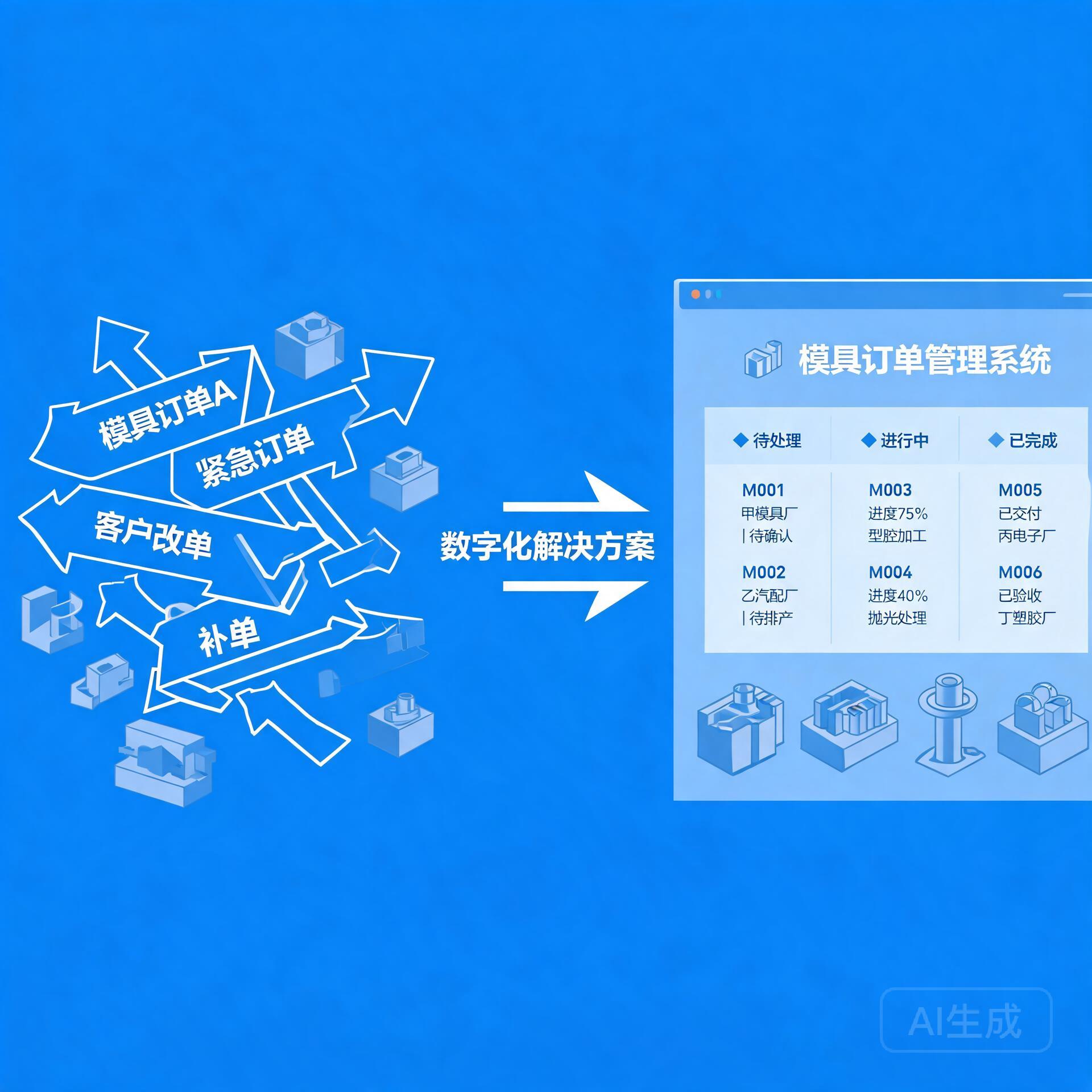
The specific symptoms concentrate on these matters:
- Progress tracking by asking, not seeing. The boss makes three or four calls a day chasing the shop; sales @ production in the group chat daily, and the answers are still two days stale. When customers ask about delivery dates, nobody dares guarantee a firm answer.
- Prices and costs a total muddle. The same mold quoted at RMB 120,000 to Customer A and RMB 150,000 to Customer B — whether it lost or made money is known only at year-end accounting. How much material the mid-way modifications added and how many process adjustments were made — no records at all.
- Order priority decided by whoever speaks loudest. Sales says this customer matters and must jump the queue; the boss says this payment must be collected first; the shop supervisor says scheduling is full and cannot move — everyone has a point, and the loudest voice wins.
- Technical documents lost with the order. The customer's drawing went through three revisions, but the shop still holds the first-version PDF; machined dimensions are wrong, three days of rework delay delivery. Who changed it, what changed, whether downstream was notified — untraceable.
2. Dissecting the Root of Chaos: Not Lazy People, but Misaligned Flows
Many owners' first reaction is hiring: add a sales tracker, a production coordinator, a clerk entering orders — three months later, the chaos is essentially unchanged. The problem is not headcount but how information flows.
In traditional mold factories, order information typically flows like this: sales records one copy in Excel for customer follow-up; the office clerk copies another onto the shop whiteboard or production schedule; procurement prepares goods per verbal notice; finance learns the order's budget only when the invoice arrives. One order's information, four independent copies, no automatic sync — any link missed or wrong, and everything downstream falls apart.
More critically, the special nature of mold orders is never considered. Unlike ordinary machined parts, molds go from design to trial to volume production, with many stages, high modification frequency, and deep customer involvement. One order may go through three mold trials, five process adjustments, and eight drawing revisions; if every step requires manual syncing, errors are the expected outcome.
Another common misconception: treating order management as sales' business — sales takes the order and tosses it to production, production finishes and passes to finance. Orders actually run through the complete chain of quotation, intake, design, procurement, production, trial, delivery, and payment collection; every node's status change affects other departments. Splitting it apart means dismantling your own information chain.
3. Comparing Three Types of Solutions
With the root causes clear, the next step is choosing a solution. Order management solutions for small and medium mold factories roughly fall into three types, each with its applicable scenario. A direct comparison:
| Solution type | Typical tool | Applicable scale | Core advantages | Main limitations | Investment reference |
|---|---|---|---|---|---|
| Lightweight reporting + dashboard | Moges mold reporting system (lightweight) | Under 50 people, annual output of RMB 10,000,000-30,000,000 | Scan-code reporting ready to use; real-time production dashboard; live within a week | Deep order management and cost accounting require later expansion | RMB 50,000-100,000 license; annual fee extra |
| Mold MES core edition | Moges production management system PMS series | 50-200 people, annual output RMB 30 million-200 million | Full-chain order tracking, automatic scheduling, accurate cost accounting, mobile owner dashboard | Base data cleanup needed; implementation about 2-3 months | RMB 150,000-350,000 license |
| Full-flow mold ERP | Moges mold ERP + MES integrated | 200+ people, annual output RMB 200 million-500 million, multi-plant | From CRM quotation to financial costs in one net; supports hybrid mold project + batch machining mode | Many modules, on-site consultants required, 3-6 month cycle | RMB 500,000-1,200,000 license |
The core criterion of choice is not which has more features, but which shows you change within 3 months. For small and medium factories newly troubled by order chaos, start with lightweight MES: use production progress tracking and process reporting to solve the most painful points first, then gradually expand to order priority management, cost accounting, outsourcing control, and other modules.
4. A Pragmatic Improvement Path for Small and Medium Mold Factories
No great leap forward — start with three small things and turn the order chaos around.
Step 1: Unify the order entry and eliminate Excel silos. However sales takes orders, they must ultimately be entered into the one system: who took the order, who the customer is, mold model, delivery requirements, special technical notes — one order's information stored in exactly one place. Other departments pull from this system and stop building their own tables. Moges's system supports sales entering directly on mobile or desktop — the office clerk no longer re-enters, reducing human errors.
Step 2: Digitize progress status — let the boss see instead of ask. Traditional shop boards only write "designing" or "producing" — too coarse. Use a reporting system to split orders into seven stages: design, material preparation, rough machining, finish machining, trial, rework, and volume production; masters scan-code report at each stage's completion, and the system updates status and actual hours automatically. In the morning the owner opens the phone and sees at a glance which stage every order is stuck at — no more phone chasing.
Step 3: Build a mold-modification trail mechanism. Modifications are the norm in the mold industry — the customer temporarily changes a wall thickness or a material parameter; without systematic records, nobody can say clearly later. The good practice: each modification generates a change order linked to the original order number, change reason, affected processes and hours, and the customer's confirmation signature, automatically pushed to design, production, and procurement — preventing drawing version chaos.
5. Selection Pitfall-Avoidance Guide
Finally, a few easy pits. Many mold factories spend money on a system that sits unused within half a year — not because the system is bad, but because selection hit mines.
Do not buy generic MES. Many MES products on the market claim to fit all manufacturing, but the mold industry's peculiarities — single-piece customization, high-frequency modifications, long-cycle project mode, strong design-production coupling — determine that generic systems do not fit. When choosing, find one dedicated to molds: ask how many mold factories they have served and whether there are similar cases to visit.
Do not chase big and all-inclusive. Wanting CRM, ERP, MES, and finance all at once has a 90% chance of stalling at implementation. Moges's advice: 80% of order chaos can be solved with 20% of the core functions — production progress tracking, reporting, and order status dashboards. Use these three well first, then add cost accounting, outsourcing management, and scheduling optimization.
Do not ignore frontline acceptance. Before launch, pull two or three shop masters in to trial it and listen to their opinions. If reporting requires filling a dozen fields or three-plus steps, masters will surely find it troublesome and quietly bypass the system. Good design: the master picks up the PDA, scans a barcode, taps twice, reporting done — learning cost under half a day.
Do not compare prices only — look at the implementation team. Mold MES is 30% software and 70% implementation. An implementation consultant who knows mold processes can help you decompose orders clearly in a week on site; a pure-IT implementation may need to look up what a parting surface even is. When choosing, be sure to ask whether the implementation consultant previously worked in a mold factory and how many days they can stay on site.
Conclusion
Order management chaos is not incurable, but neither is it solved by installing software with one click. Essentially it is an information flow problem: move the order data scattered across departments and Excel files into one unified system, so sales, production, procurement, and finance see the same order's real-time status. This process needs the boss to lead and time for the frontline to adapt — but with the right direction, tangible change appears in three to five months: fewer delivery-chasing calls, higher on-time delivery rates, fewer customer complaints, and clear year-end accounts.
Moges has focused on mold industry management for 14 years, serving 200+ mold factories, and knows that small and medium factories' pain is not lacking a system but lacking a pragmatic solution truly fitted to mold business. If order chaos is troubling you too, let us talk about which links can start moving first.