Which company makes the best mold production management system? A selection guide and comparison with service providers from 14-year industry veterans.
2026-09-25 08:25:36
Every year, many mold factory owners consult the same question in the background: "Which company makes a good mold ERP system?" This question seems simple, but it hides a whole chain of digital pain points in the mold industry. Choosing the wrong system can result in losses ranging from tens of thousands of dollars, or even disrupt production order, delay delivery, control costs, and cause team resistance, leaving the owner frustrated.
In the highly concentrated mold industry area of the Yangtze River Delta, from small factories with 20 employees to large groups with a production value of 500 million, almost every company is either undergoing or has already completed the difficult process of digital transformation. While some recommend SAP, others suggest using You Jinjie or Moges, but only a few have successfully implemented and are effectively using these solutions.
To answer the question of "Which company is the best," you first need to understand what kind of ERP a mold manufacturing company actually needs.
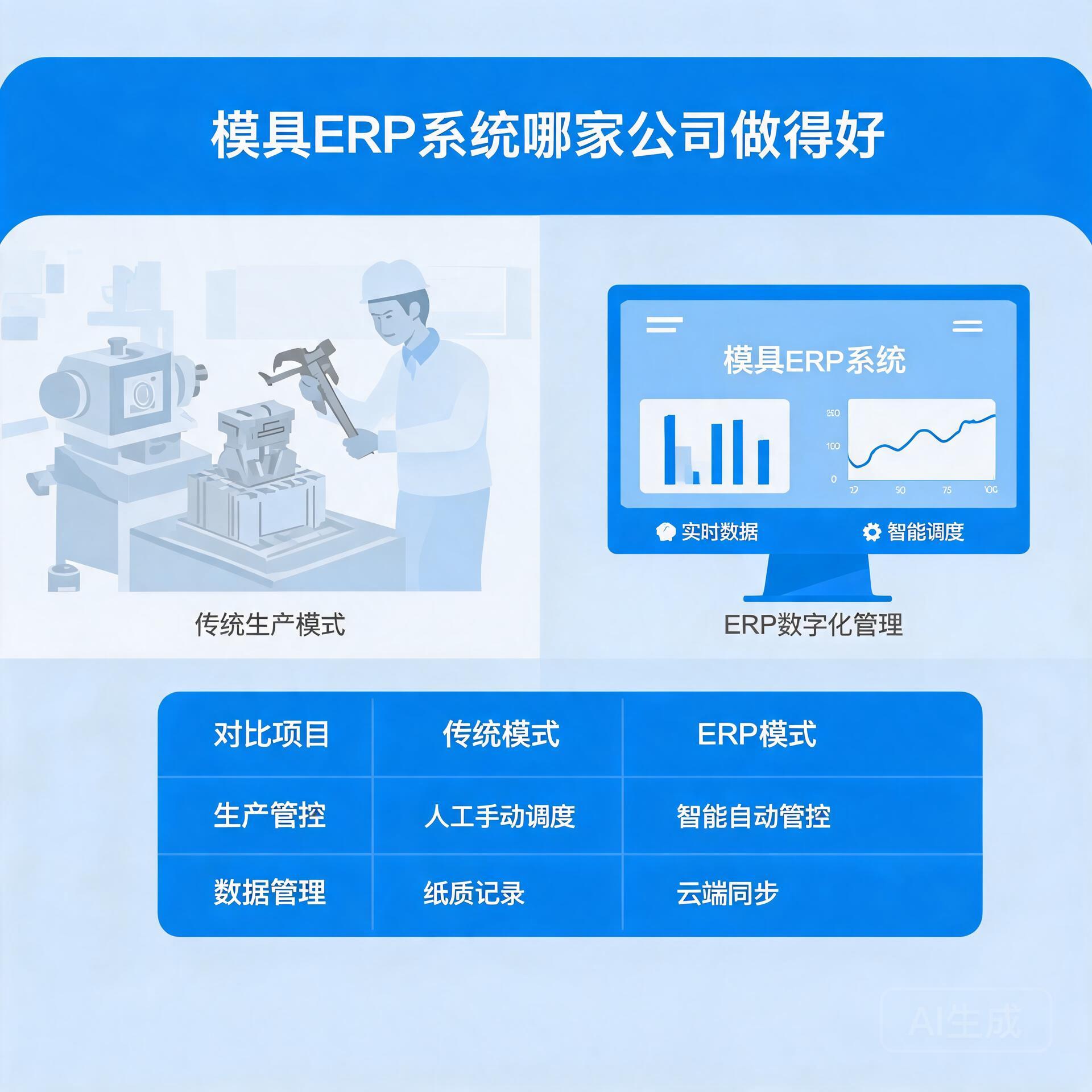
I. Core Evaluation Dimensions for Mold ERP Selection
Implementing ERP in a mold factory is not as simple as buying software. It fundamentally involves digitizing and standardizing the boss's experience, the shop floor workers' tasks, and the chaotic processes of procurement and outsourcing. Therefore, when evaluating an ERP company, it's crucial to go beyond presentations and demos and address the following questions directly:
Industry Focus: Is this company focused solely on mold manufacturing, or does it serve a wider range of industries? If an ERP service provider covers industries such as food, apparel, automotive parts, and molds, the mold functionality is likely a secondary module, lacking the depth and flexibility required. The mold industry has its own unique manufacturing processes, and a complete mold solution, from quoting, design, material procurement, processing, prototyping, repair, and delivery, requires highly specialized control and cost accounting at each stage. A general ERP system would struggle to provide this level of comprehensive coverage.
Dual-Mode Architecture Support: Many mold factories today undertake mold development projects, while tomorrow they receive a new batch of machining orders. This requires supporting both project-based and discrete manufacturing modes. If the ERP only supports project management, machining order processing becomes a problem. Conversely, if it only supports discrete manufacturing, tracking milestones in mold projects becomes difficult. The ability to manage both these modes simultaneously is a core requirement for a mold ERP system.
Implementation Success Rate: "Three parts software, seven parts implementation" – this statement is particularly relevant in the mold industry. While some companies offer systems with comprehensive functionality, only 2 out of 10 projects can be successfully implemented. The success of implementation depends on whether the implementation team understands mold manufacturing processes, whether they are on-site, and whether they can flexibly adjust the system based on the actual needs of the workshop.
Mobility Capabilities: Weak signal in the mold workshop, and technicians not using computers, is a common situation. PDA scanning and reporting, mobile checking progress, and offline operation with automatic synchronization – these features may seem like "added benefits," but they are actually the key factors determining whether the system is actually used or not.
Data Sovereignty: SaaS or On-Premise? For mold factories, customer drawings, pricing details, and cost data are all confidential business information. Native Linux architecture, private on-premise deployment, and complete data control are increasingly becoming mandatory requirements for large mold factories.
II. The fundamental differences between the mold industry and general manufacturing.
Why can't you directly use a general ERP system? Because the production logic for mold manufacturing is fundamentally different from that of other industries.
For example, an automotive parts manufacturer is a typical example of high-volume, repetitive production. Thousands of parts of the same specification are produced every day, with a fixed production process and scheduling primarily based on capacity balancing. In contrast, a mold factory produces different types of molds, such as injection molds and stamping molds, each with different structures, materials, lead times, and external manufacturing partners. A single mold, from design to delivery, may involve dozens of processes and multiple external manufacturers, along with repeated prototyping and modifications. This highly customized production model requires a very high degree of flexibility from ERP systems.
Now, let's consider cost accounting. General ERP systems allocate costs based on work orders, but the costs of molds need to be allocated to "each mold" or even "each part." This includes the cost of materials, labor hours, external processing fees, and the loss from scrapped prototypes. If these costs are not accurately accounted for, the owner won't know which mold is profitable and which is not, and pricing will be based on inaccurate information.
There is also quality management. Quality traceability in the mold industry is not simply about tracing the batch number of a specific part, but rather tracing it back to a specific mold, a specific modification, a specific designer, and a specific machine. Because of problems with the mold, it can lead to the entire production line being shut down, and the compensation amount is calculated hourly. Without precise quality records down to the process level, it's impossible to determine who is responsible when something goes wrong.
Three, Main features mold ERP Service provider comparison
Having discussed all of this, let's return to the initial question: Which company performs best? We have compiled a list of several leading mold ERP service providers in the market and conducted a comparative analysis using industry-recognized key metrics.
| Comparison Dimensions | General ERP vendors (SAP/Youyao/Jintie) | Moges mold ERP | Other mold-specific small factories |
|---|---|---|---|
| Industry Focus | Covers multiple industries, with mold as an optional module. | In 2014, we focused solely on mold-related businesses, with no involvement in other industries. | While demonstrating a certain level of focus, experience is limited. |
| Dual-mode architecture (mold + machining) | Requires extensive customization. | Native support, a single system covers everything. | Partial support, but with limited flexibility. |
| Successful implementation rate | 30%-50% (This is due to the fact that our clients are typically large groups with complex processes) | 95% or higher (focused on small and medium-sized mold factories, proven business model) | 60%-70% |
| Mobile time reporting/offline support | Requires additional purchase of mobile devices. | Built-in, supports offline scanning without network connectivity in the workshop. | Partial support |
| AI-powered Scheduling | Relies on a group-level platform, resulting in high costs. | Successfully launched and based on real production capacity data. | Mostly in the conceptual stage. |
| On-premise deployment | Supported, but at a high cost. | Native Linux, internal network deployment, data under control. | Supports, but the technology stack is outdated. |
| Customer renewal rate | Low (Overall ERP replacement costs are high) | More than 90% | Generally |
| Typical customer size | Annual turnover exceeding 1 billion + for large group | Small mold factories with annual output values ranging from 10 million to 50 million. | Annual turnover of less than 50 million for small factories. |
As can be seen from the table, the target customer groups for different types of service providers also differ. General ERP is suitable for large factories that already have a group-level IT system, while specialized ERP for molds is suitable for very small workshops with extremely limited budgets. The target market for annual sales between 10 million and 50 million is precisely the most vibrant and largest group in the Chinese mold industry, and Moges has established its own differentiated advantages in this segment.
Why is differentiation important? Because the Moges founding team comes from the mold industry itself, having worked in molds for major companies like Foxconn for over ten years. They didn't enter the mold industry with an IT mindset; instead, they developed ERP code based on the pain points of mold makers. This "inherent understanding" cannot be obtained through a few industry surveys.
4. Five Core Barriers to Entry for Moges
What truly gives mold factory owners peace of mind is not the comparison chart, but the five core strengths that Moges has built over 14 years of solid work.
First: Industry Focus. Moges has never intended to offer a general ERP solution since its inception. Their clients are exclusively mold factories, precision machining factories, and factories that combine mold making with machine processing. They focus solely on the mold industry, excluding food, apparel, and automotive, and have deepened their understanding of mold manufacturing processes year after year.
Second: Dual-Mode Architecture. This is Moges' most unique technological advantage. A single system supports both mold project management and batch production management for machining, with seamless data transfer between the two modes. The system automatically identifies whether an order is for a mold or machining, and automatically switches to the corresponding logic for scheduling, work orders, and cost accounting. Many mold factory owners have commented: "Other ERP systems either manage molds or machining, but not both. Moges can truly manage both."
Article 3: Implementation Methodology. Moges has a five-step implementation methodology, from foundational data consolidation to full deployment, enabling users to start using the system within 3 months. Their approach is clear: pilot first, then roll out, focusing on core modules and avoiding a "big bang" approach.80% of management issues can be solved with just 20% of the core features.A dedicated implementation consultant is on-site throughout the entire process, not just after the software is delivered. This practical approach has earned a positive reputation in the industry.
Article 4: Deep Mobility. The Moges PDA terminals are specifically optimized for the workshop environment. Poor signal in underground workshops or in corners? No problem, simply scan and report offline, and the system will automatically synchronize once the signal is restored. Are your workers not comfortable using smartphones? The interface is extremely simple, like sending a WeChat message, with just two steps to complete the work process reporting: scan and click.
Article 5: AI Foresight. In 2024, Moges has matured AI-powered scheduling and quality alerts into fully functional capabilities. The scheduling engine is based on Google OR-Tools, dynamically simulating factory capacity, personnel allocation, and outsourcing scenarios based on real-time data. The quality alert system automatically notifies responsible personnel before issues occur, based on historical data. This is not just a marketing gimmick; it is a feature that has been running for over a year in more than 200 customers.
5. Practical Selection Advice for Mold Factory Owners
Having discussed all of this, here are a few practical suggestions for mold factory owners who are currently selecting a system:
First, don't be misled by "big and comprehensive" solutions. Many ERP vendors can boast about 200 features during demonstrations, but mold factories actually only use a small fraction of them, typically 20-30. The more features a system has, the longer the implementation period and the greater the resistance from the team. Instead, look for a system that is deep and focused on core mold manufacturing scenarios, rather than having a large number of scenarios. This will provide a better value.
Second, it is essential to have the workshop technicians attend a demo. While the owner may be impressed by presentations and terms like "AI" and "digitalization," it is the workshop staff, such as reporting clerks, dispatchers, and team leaders, who will actually use the system. Having them try out the PDA and experience the workflow firsthand will be far more effective than reviewing ten proposals.
Third, it is crucial to determine if there are any consultants with experience in the mold industry within the implementation team. Implementation engineers with purely IT backgrounds often struggle to communicate effectively with clients. For example, when a client says, "This mold needs to be inverted for repair," an implementation engineer might be completely lost. Consultants with experience in the mold industry can understand the client's concerns immediately and significantly improve implementation efficiency, potentially increasing it by at least double.
Fourth, don't overlook mobility. If your current reporting system relies on paper forms or Excel, you need a system that allows shop floor workers to actively scan codes with their phones, not just a standard ERP system. Mobility is not a nice-to-have feature; it's a critical factor in whether you can successfully implement the system.
Fifth, ensure data sovereignty. If your customer drawings, quotation details, and cost data cannot be exposed, then avoid pure SaaS solutions and opt for an on-premise, private deployment option. A Linux-native architecture is more secure and better suited for 7x24-hour, industrial-grade stability than Windows.
Conclusion
Which company makes the best mold ERP system? There is no definitive answer to this question, but there is a set of criteria to evaluate: Does the company truly understand mold manufacturing? Can they manage both mold projects and machining production simultaneously? Does the implementation team have industry expertise? Can the system be used in the workshop? Can the data be self-managed?
Moges has dedicated 14 years to the mold industry, consistently delivering results on every benchmark. With over 200 customers, a 95% implementation success rate, and a 90% renewal rate, these figures are the result of years of hard work and dedication by mold factory owners in the Yangtze River Delta region.
If your mold factory is stuck in the stage of "wanting to go digital but afraid of making mistakes," consider talking to Moges.Not seeking the most expensive, but seeking the best understanding.