How to choose a mold workshop equipment failure warning system? A comprehensive breakdown of the technical architecture, failure characteristics, and implementation roadmap.
2026-10-03 12:38:48
I. Why Mold Workshops Need Equipment Failure Early Warning
The core assets in a mold workshop are high-value equipment such as CNC machines, EDM machines, injection molding machines, and stamping machines. A single precision CNC machining center can cost hundreds of thousands of dollars, and the loss of production capacity and pressure to deliver orders due to downtime can far exceed the depreciation cost of the equipment itself. However, traditional equipment management practices often suffer from a contradiction: either "repair only when broken" or "over-maintenance due to regular maintenance." The former leads to frequent unplanned downtime, disrupting the production rhythm, while the latter consumes a large amount of time that could otherwise be used for production.
The data from a mid-sized mold factory in the Pearl River Delta region is highly representative. The factory has 32 CNC machines and 18 EDM machines. According to statistics for the first half of 2025, a total of 127 machine-hours were lost due to typical failures such as spindle overheating, lead screw wear, and hydraulic system leaks, directly impacting the delivery of 14 orders. Of these failures, 68% occurred within 72 hours prior, exhibiting observable signals such as temperature anomalies, high vibration values, and fluctuating currents. However, at that time, the workshop lacked a systematic early warning mechanism. These scattered data points were scattered across the control screens of each machine, and no one was continuously tracking them.
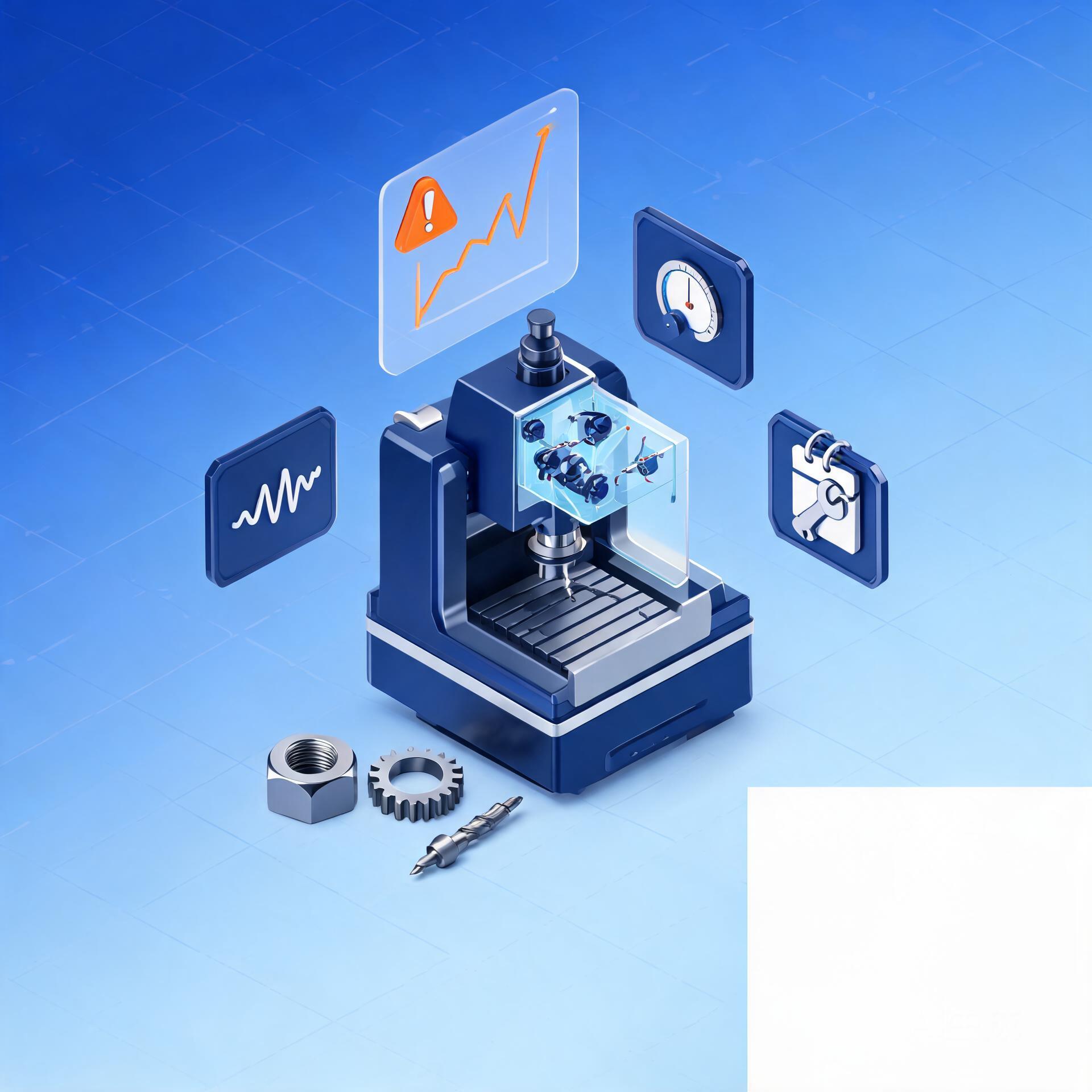
The core value of the equipment failure warning system is to collect these previously overlooked early signals, and through algorithms, determine whether they are in the critical range of "normal degradation" or "imminent failure." This allows for intervention before a real problem occurs. This is not an option, but rather the necessary step for mold workshops to transition from "experience-based management" to "data-driven" management.
II. Technical Architecture Breakdown of the Fault Warning System
A complete mold shop equipment fault warning system typically consists of three parts: the perception layer, the edge computing layer, and the platform service layer. The perception layer is responsible for collecting raw data from the equipment, including spindle temperature, vibration acceleration, motor current, hydraulic system pressure, and cooling liquid flow, among other key parameters. There are two methods of data collection: one is to directly read data from the controller using OPC UA, Modbus, or MTConnect protocols provided by the equipment manufacturer, which is highly accurate and non-intrusive; the other is to install external sensors, such as temperature patches on the spindle bearing seat or vibration sensors on the machine seat, which is suitable for older equipment or situations where the protocol is not open.
The edge computing layer is deployed on industrial gateways or edge servers located on the shop floor. Its function is to perform initial data cleaning and feature extraction on the raw data collected. For example, converting 100 samples per second of vibration data into spectral features, or calculating the temperature rate of change from a temperature time series. This step reduces the bandwidth pressure – if each device sends all raw data every second, the entire factory network would quickly become congested. The edge layer also performs simple threshold alarms, such as triggering a level 1 warning if the spindle temperature exceeds 85°C. These rules, which do not require complex reasoning, are processed locally for the fastest response.
The platform layer is the system's "brain," running on the factory's private cloud or MES server. It stores all historical operational data for equipment, and trained predictive models perform real-time analysis on the feature vectors received from the edge layer. The models output not just a simple "good/bad" determination, but also specific probabilities of failure types and estimated remaining lifespans. For example, "78% probability of main shaft bearing degradation, estimated remaining lifespan of 120 hours." Maintenance engineers can use this information to schedule proactive replacements during weekend shifts, without disrupting normal production.
3. Typical Failure Modes and Warning Characteristics in the Mold Workshop
Different types of equipment exhibit different failure patterns, and the warning system needs to establish feature libraries specifically tailored to each type. The table below lists the four most common types of equipment failures in the mold workshop, along with the corresponding observable warning signals.
| Fault Type | Typical equipment | Warning signal | Lead time |
|---|---|---|---|
| Spindle bearing degradation | CNC Machining Center | The high-frequency components in the vibration spectrum are continuously increasing; the current fluctuation under no load is increasing; and the main shaft temperature is slowly rising. | 48–120 hours |
| Lead screw wear | CNC, EDM | Compensation for extremely poor positioning accuracy exhibits linear growth; servo current is abnormally amplified at the peak of switching. | 72–168 hours |
| Hydraulic system leakage | Injection molding machines, stamping machines | The rate of oil tank level decrease exceeds the baseline; the rate of pressure drop during the holding phase accelerates. | 24–72 hours |
| Discharge gap anomaly | EDM Spindle Motor | Average discharge current decreases; short circuit rate exceeds 5%; surface roughness (Ra) values begin to deteriorate. | 12–36 hours |
Here's an often overlooked detail: The "lead time" provided by the warning system is not an absolute value, but an estimate of "the time that would pass without any maintenance actions." If you promptly inspect and adjust after the warning triggers, such as pre-tightening the main shaft bearings and lubricating the lead screw, the actual failure time can be significantly delayed, or even avoided altogether. This is the advantage of the warning system over traditional periodic maintenance – it allows for maintenance actions to be performed precisely and promptly, rather than being carried out blindly according to time intervals.
IV. Comparison of Mainstream Solutions on the Market: In-house Development vs. Procurement vs. MES Integration
Many mold factories considering fault prediction systems face three options: developing the system in-house, purchasing independent industrial internet products, or having their existing MES vendor expand the system. Each of these options has its own advantages and disadvantages, making them suitable for factories of different sizes and levels of technical expertise.
| Solution | Initial investment | Implementation Cycle | Maintenance Costs | Adaptable for mold shop environments |
|---|---|---|---|---|
| Developed in-house (built by the IT team) | 6–12 months | High (requires ongoing investment in algorithm engineers) | The highest level, fully tailored to actual workshop conditions. | |
| Independent Industrial Internet Platform for Procurement | 2–4 months | (Annual subscription fee) | In general, a universal solution requires secondary development and adaptation for mold manufacturing processes. | |
| Supplier Expansion Module for MES | 1–3 months | Low (when bundled with MES maintenance) | Lower, limited by the data access capabilities of the existing MES. |
For most small mold workshops, the MES integration route offers the best value. Moges' mold industry management system already includes device data acquisition interfaces, allowing direct connection to mainstream CNC systems using the OPC UA protocol. This eliminates the need to install a large number of additional hardware sensors. Furthermore, by adding a fault prediction module, which essentially overlays an intelligent analysis layer on the existing data pipeline, the implementation cycle and cost remain within acceptable limits. For large mold enterprises with over 100 precision machines and strong IT capabilities, while developing a custom solution requires a significant initial investment, it can ultimately accumulate unique fault feature models, creating a competitive advantage over the long term.
V. Key considerations for implementing the early warning system
The first important consideration is to avoid "warning fatigue." If the system generates dozens of irrelevant alerts every day, maintenance engineers will quickly become accustomed to ignoring them. Therefore, the thresholds and grading mechanisms for the models need to be repeatedly adjusted in collaboration with the maintenance team. The first three months should be dedicated to fine-tuning, and it is better to issue fewer alerts than to issue false ones. An effective approach is to categorize alerts into three levels: yellow alerts are simply warnings and do not require immediate action; orange alerts require investigation within 24 hours; and only red alerts will trigger automatic work order generation.
The second important consideration is data security. While equipment runtime data is not as sensitive as customer data, if it falls into the hands of competitors, it can be used to reverse-engineer the factory's capacity layout and equipment status. Therefore, data collection and transmission must be performed within the factory, and only processed feature summaries should be sent to the platform from the edge layer. Raw waveform data should be retained locally and not transmitted to the external network.
The third important consideration is the human factor. No matter how intelligent the system is, it ultimately requires people to perform maintenance tasks. During implementation, it is essential to involve the maintenance team fully – not just providing them with a new tool, but working together to review existing maintenance SOPs and identify which processes can be assisted or replaced by the system. For the system's recommendations to be effective, the frontline engineers must recognize and approve them.
6. Actual Results: A case study of a mold factory's transformation.
Established in 2012, this precision mold manufacturing plant in Suzhou has 42 CNC machines, 12 EDM machines, and 8 injection molding machines. After introducing the fault warning system in 2025, the Q3, the plant experienced a significant change within three months. Unplanned downtime decreased from an average of 41 hours per month to 14 hours.Over time, the reduction was 66%. The number of failures for main shaft bearings decreased from an average of 3.2 per machine per year to 0.8. Most importantly, the on-time delivery rate increased significantly, while the total maintenance time was also significantly reduced – because frequent preventive disassembly checks were no longer necessary, and all maintenance actions were focused on the actual problem areas.On the equipment.
According to the factory's technical manager, "The early warning system is not a panacea, but it allows us to focus our limited maintenance resources on the most critical areas. Previously, our experienced technicians relied on their experience to listen for sounds and check temperatures. Now, the system provides quantifiable data, allowing new engineers to quickly learn and make accurate judgments." This perspective is widely applicable in the mold industry – experience is invaluable, but data makes experience replicable.
In general, the equipment fault warning system has moved from being a "nice-to-have" to an "essential" component in mold workshops. As peers are leveraging data to improve equipment utilization, workshops that rely solely on experience-based management are increasingly struggling to keep pace. Choosing a suitable implementation path, starting with a pilot on one or two machines and gradually expanding to the entire factory, is a safe and effective approach.