Mold Predictive Maintenance Software: Say goodbye to unexpected downtime, and let your machines speak for themselves.
2026-10-04 17:01:06
One. The Invisible Killer of Equipment Management in Mold Factories: Unplanned Downtime
Mr. Wang, the owner of a precision mold manufacturing plant in Kunshan, is currently under a great deal of pressure. Last month, he invested 400,000 RMB in a five-axis machining center, hoping to reduce delivery times by 20%. However, the machine malfunctioned within three weeks – the main shaft bearings were abnormally worn, causing the entire machine to lock up. The repair shop spent a total of six days on-site inspection and replacement parts. This directly delayed the order, resulting in a 20,000 RMB penalty from the customer, and also caused three other CNC machines in the workshop to come to a standstill while waiting for parts.
This is not an isolated incident. In the mold manufacturing industry, a sudden failure of a single core machine can often impact the entire workshop's throughput. The processing cycle for a set of precision molds typically takes two to three weeks, and any delay in any process will cause subsequent processes to be queued. Furthermore, mold orders usually have strict delivery deadlines, and even a single-day delay can result in significant financial losses.
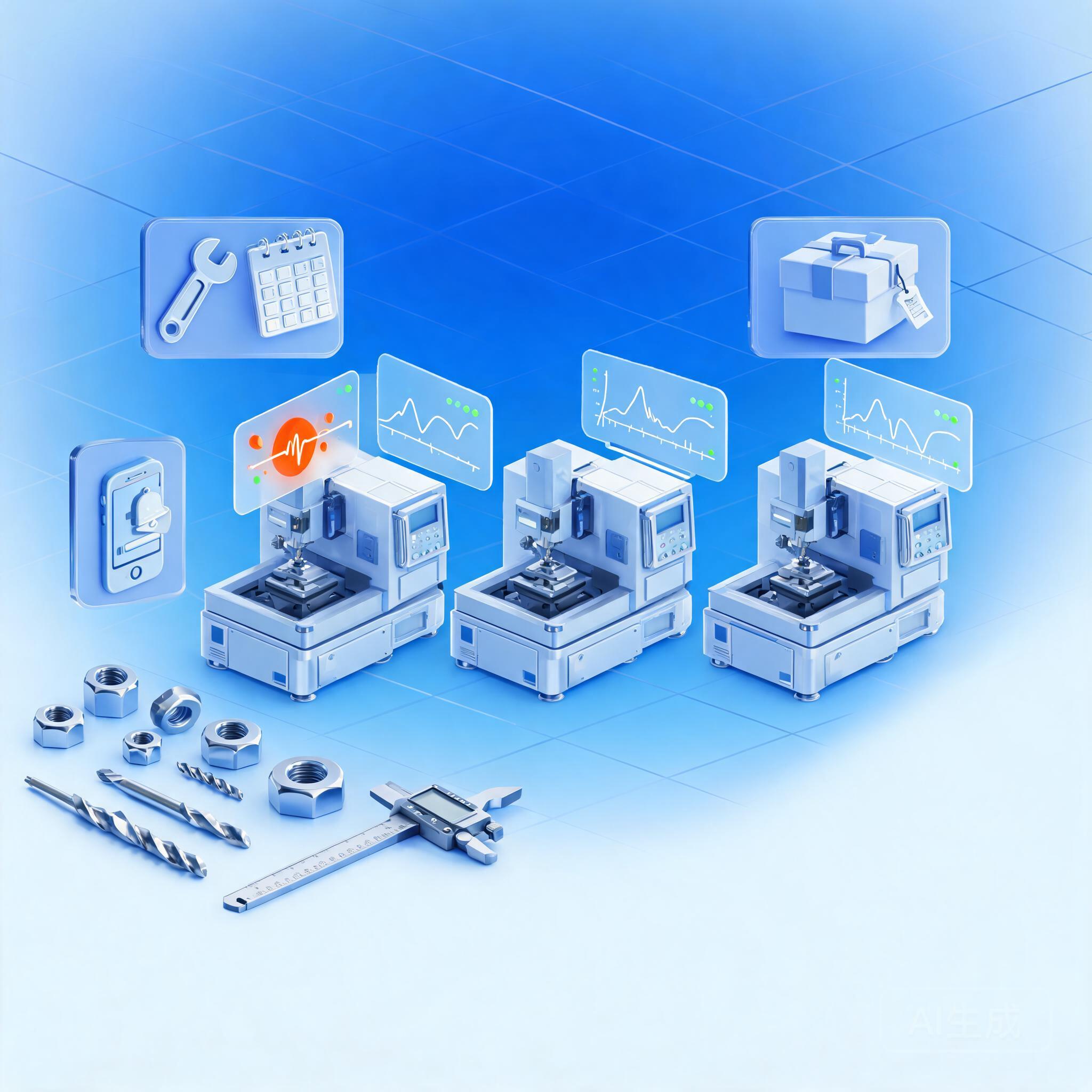
Traditional equipment maintenance models have two main approaches: "fix it when it breaks" – maintenance only occurs when equipment fails, leading to reactive responses; and "regular maintenance" – scheduled shutdowns based on calendar or time-based intervals for inspections, regardless of the equipment's condition. Both models have significant drawbacks: the former only reacts after a failure has occurred, resulting in already incurred losses; and the latter can lead to either excessive or insufficient maintenance – good equipment is unnecessarily shut down, while poor equipment may fail before the next scheduled maintenance.
According to a survey conducted by the China Mold Industry Association in 2025, among the 120 small mold factories surveyed, the average annual loss caused by sudden equipment breakdowns accounted for 3.7% of their revenue. For factories with an annual turnover of 30-50 million, this translates to an additional "hidden cost" of over 1 million per year. If the fault warning can be advanced by 3 to 7 days, this figure can be reduced to below 0.8%.
Two, What is predictive maintenance? The core difference from traditional models
Predictive Maintenance (PdM), in essence, involves continuously collecting equipment operating data and using algorithms to analyze it, providing early warnings before equipment failures occur, rather than waiting for failures to happen before responding. Its core logic is based on "the actual health status of the equipment," rather than "time-based" approaches.
This approach is not new. Industries such as aerospace, nuclear power, and high-speed rail have been implementing predictive maintenance for over a decade. For example, each Boeing 787 engine generates over 1TB of operational data per year, and ground engineers can use real-time monitoring to determine whether a specific component of an engine needs to be replaced proactively. However, until the last three to four years, the widespread adoption of similar solutions has been limited to larger manufacturing factories due to the high cost of sensors and the lack of edge computing infrastructure.
| Comparison Dimensions | After-sales repair (Reactive) | Regular maintenance (Preventive) | Predictive Maintenance |
|---|---|---|---|
| Maintenance Timing | When equipment breaks down | Based on calendar/work cycle | Based on real-time status data |
| Data Source | None | Maintenance records, asset tracking | Vibration, temperature, current, and oil pressure sensors, along with other multi-dimensional sensors. |
| Downtime losses | High (Sudden line stoppage + emergency repair) | (Planned downtime, but potentially excessive) | Low (proactive scheduling and coordination with production planning) |
| Spare Parts Management | Emergency procurement, high premiums. | Large-scale inventory management, significant inventory tied up. | On-demand inventory and precise procurement. |
| Technical Barriers | Extremely low | Low (relying on manual experience) | (Requires a software platform) |
| Return on Investment (ROI) | Worst | Generally | Optimal, ROI typically achieved within 12-18 months. |
As illustrated in this comparison table, the advantages of predictive maintenance in cost control and production stability are very clear. However, there is a crucial prerequisite that is often overlooked: you must first have a system that can continuously collect equipment data and that can interpret this data. Simply installing a few vibration sensors on the machine is not enough. Once the data is collected, how do you analyze it? Who interprets it? And how do you trigger a repair order once an anomaly is detected? If this entire chain is not established, the sensors are simply expensive decorations.
III. The Unique Characteristics of Equipment in the Mold Industry: Why Generic Solutions Are Insufficient
Many mold factory owners have experienced this: they purchased a so-called "industrial 4.0" equipment monitoring system for a significant price, but after using it for six months, they found that most of the features were unusable. The system's alerts were either too vague ("Please monitor the spindle temperature") or generated too many false alarms (constantly displaying warnings even when there was no problem, which led to the operators not trusting the system), ultimately rendering it useless.
The core reason behind this is that equipment in the mold industry has its own specific characteristics, and generic solutions are not tailored to these needs.
The equipment composition and other aspects of mold manufacturing differ significantly from other manufacturing industries.A typical mold workshop consists of equipment divided into three main categories: CNC machining centers, EDM spark machines, and wire/tube cutting machines. Each type of equipment has different "health signal" monitoring priorities: CNC machining centers monitor vibration spectra and temperature curves, EDM machines monitor spark gap stability and pulse current fluctuations, and wire/tube cutting machines monitor cutting wheel wear and tension changes. Generic solutions typically only monitor the most superficial temperature or current, failing to capture the core fault characteristics of mold equipment.
Mold production is characterized by low-volume, multi-product manufacturing, with significant fluctuations in equipment utilization.Today, a CNC machine is performing precision machining on a complex cavity (light load, high speed), and tomorrow it will be used for rough machining of a workpiece (heavy load, fast feed). The next day, it may be used for surface milling. The drastic fluctuations in load make the commonly used method of "setting fixed threshold alarms" completely ineffective in a production line factory – for example, the spindle temperature of 65 degrees is normal during rough machining, but it may be a warning signal during precision machining. This means that the warning system must be able to distinguish between "normal load variations" and "abnormal degradation trends," and it must make dynamic judgments based on the current machining type.
Mould factories typically have limited repair resources.For a 50-person mold workshop, maintenance personnel typically consist of only one or two experienced technicians. If a predictive maintenance system provides overly technical alerts (e.g., "abnormal vibration spectrum at 120Hz"), the maintenance technicians may not understand them. A good system should translate these alerts into actionable maintenance recommendations – "Recommend disassembling the spindle and inspecting the bearings during the next shift change," and directly push these recommendations to the maintenance personnel's mobile phones, while also creating a maintenance work order in the production management system.
4. Moges' Predictive Maintenance Solution: A Complete Closed-Loop System from Data to Action
Thanks to 14 years of experience in the mold industry, Moges has forged a unique path in equipment maintenance. We don't start by creating a generic sensor platform and then adapting it for the industry. Instead, we begin with real failure cases from mold workshops, working backward to determine which data needs to be collected, how to interpret it, and ultimately, how to trigger the necessary repair actions.
Step 1: Lightweight data integration, enabling even older equipment to "speak."Many mold factories have equipment that is five to ten years old, or even older, with a mix of models and brands, some of which lack PLCs. Moges utilizes a non-invasive integration solution: for equipment with data interfaces (such as Fanuc, Mitsubishi, and Siemens mainstream models), data is directly collected via OPC UA or Modbus protocols; for older equipment without interfaces, low-cost vibration and temperature composite sensors are installed in key areas, and data is uploaded through an edge gateway. The entire process does not require equipment disassembly and does not affect production. The integration time for a single CNC machine is controlled within two hours.
Step 2: Dedicated mold warning models, reducing false alarms and improving accuracy.Moges's predictive model is not based on generic thresholds, but rather on thousands of historical failure data from the mold industry. Taking a CNC spindle as an example, the model analyzes five dimensions simultaneously: total vibration, vibration spectral characteristics, spindle temperature rise rate, current machining type (obtained from the MES work order), and cumulative operating hours. An alert is triggered only when multiple dimensions deviate from the normal range simultaneously, rather than when a single indicator exceeds a threshold. In actual tests, this combined judgment reduced the false alarm rate from 30%-40% in generic solutions to less than 8%.
Step 3: Integrate with the Production Management System to directly trigger work orders based on alerts.This is a critical aspect that many solutions overlook. The predictive maintenance module from Moges is deeply integrated with both MES and ERP systems. When the system detects an abnormal vibration trend in a CNC spindle, it will: automatically assess the spindle's workload for the next 72 hours, determine if there is a suitable window for maintenance, automatically create a maintenance work order and assign it to the on-duty maintenance technician, and automatically update the equipment's health record upon completion of the repair. The entire process, from alert generation to repair completion, requires no manual system switching or data entry.
Step 4: Capture and preserve repair knowledge, enabling the experience of skilled technicians to be replicated.Each time a repair is completed, the system automatically records the type of fault, the replacement parts, the repair time, and a snapshot of the equipment data at that time. These records, when accumulated, can be used to train a predictive model – for example, if the system detects the combination of "increasing 120Hz axial vibration component + temperature rise exceeding 3 degrees under light cutting load" occurring five times, with four of those instances ultimately resulting in bearing wear, the system can use this combination as a new warning rule. This is particularly important in workshops with high staff turnover, such as those with retiring technicians.
V. Practical Implementation: Real-world case studies from two mold factories
A precision mold factory in Suzhou, with an annual turnover of 20 million, introduced Moges' predictive maintenance solution in the first half of 2024. Before implementation, the average monthly unplanned equipment downtime was 4.2 times, resulting in an average loss of approximately 8,000 yuan per incident. After three months of implementation, this number decreased to 0.8 times per month. One particularly notable incident occurred when the system detected a slow upward trend in the main axis vibration on a five-axis CNC machine over a continuous five days. The system's analysis identified early wear of the bearings. The maintenance technician, taking advantage of a weekend, disassembled and inspected the machine, confirming the presence of fine wear on the bearing's outer ring. This allowed for timely replacement, preventing the main axis from seizing. Had this not been detected, the machine would have been in the middle of a precision connector mold finishing process, resulting in a loss of at least 50,000 yuan.
In another automotive interior parts mold factory in Wuxi, the situation was slightly different. Their problem was not frequent unplanned shutdowns, but excessive maintenance leading to wasted capacity – three CNC machines required mandatory 8-hour maintenance every three months, but in reality, 80% of the maintenance was redundant. After implementing predictive maintenance, the system dynamically adjusted the maintenance cycle based on the actual health status of each machine: machines in good condition were maintained every five months, machines in average condition every three months, and machines in poor condition every two months. As a result, the factory's annual effective operating hours increased by approximately 6%, equivalent to the capacity of half a CNC machine.
The common thread in these two cases is that predictive maintenance is not a standalone "equipment monitoring" function. It must be integrated with modules such as production planning, work order management, and spare parts inventory to deliver real value. Simply installing sensors and viewing data is no different than having a temperature display on the shop floor.
Six, Selection Recommendations: Three Key Decisions for Predictive Maintenance in Small to Medium-Sized Mold Factories
First decision: When to implement? Not all factories need to immediately implement predictive maintenance. A simple criterion is: if the value of a single core piece of equipment in your workshop exceeds $200,000, and the equipment experiences unplanned downtime more than 3 times per year, then the return on investment for predictive maintenance is clear. Conversely, if the equipment is relatively inexpensive and easy to replace, it may be more cost-effective to focus on solidifying regular maintenance.
The second decision: Build your own solution or choose a ready-made one? The market offers two types of predictive maintenance solutions: one is for heavy industrial platforms (such as Siemens MindSphere and GE Predix), which offer comprehensive functionality but are expensive and complex to implement, suitable for large groups; the other is a lightweight industry-specific solution, which is cost-effective and quick to deploy. For small mold factories, the latter is clearly a better choice. Moges' solutions typically complete core equipment integration in 3 to 5 days, and you can see the first round of warning data within 2 weeks. The total project investment is controlled within the range of 100,000 to 200,000, which is far lower than the cost of building your own team.
Third Decision: Who will manage it? After the predictive maintenance system is launched, someone needs to monitor alerts, handle work orders, and evaluate the results. Ideally, this role should be held by the equipment supervisor or the maintenance team leader. Do not rely on the IT department – they do not understand the failure modes of molds. The system should have a sufficiently simple user interface: alerts should be directly pushed to WeChat or Enterprise WeChat. Clicking on an alert will display the fault location, recommended actions, and historical repair records, and a repair work order can be created with a single click.
Finally, I want to emphasize that predictive maintenance is not a silver bullet. It cannot replace the professional judgment of the maintenance team, nor can it revive outdated equipment. However, it can transform the question of "when will the equipment fail" from "unknown" to "approximately when, where, and how much will it cost to repair." In the mold industry, where the production cycle is a critical lifeline, this level of certainty is itself a valuable asset.