Digital Tools for Machining Equipment Maintenance Records: A Shop Management Upgrade That Retires the Paper Logbook
2026-10-05 08:38:13
How are equipment maintenance records stored in your shop today?
The three most typical answers I have heard are these: one is a loose-leaf binder in the corner, most of which left with the veteran technician when he retired; another is an Excel file nobody updates, with large blank stretches when you page back to last year's dates; and the most blunt one is that maintenance is not recorded at all, because keeping it in mind is enough.
All three practices share one consequence: when something really goes wrong, you cannot explain it. If a customer asks whether a batch of parts was machined on equipment that was not maintained as required, you have no evidence to offer; if the boss wants to know whether this year's maintenance budget was well spent, all you have is a pile of invoices. Maintenance records look unremarkable, yet they are the most fundamental, most basic and most easily overlooked link in equipment management.
1. Why Maintenance Records Must Go Digital
Start with a small calculation: for one CNC machine under a four-level maintenance scheme, with 300 daily checks, 52 weekly services, 12 monthly services and 1 annual overhaul, each machine generates at least 365 maintenance records a year. Ten machines means 3,650 records. Each record involves time, the person who performed it, the items checked, problems found and how they were resolved. If this information lives only on paper and in Excel, within three months it becomes an incomprehensible mess.
Paper records have three fatal weaknesses. The first is loss: loose-leaf binders get dropped, pages get out of order and coffee stains soak through, and spending twenty minutes hunting for a record from six months ago is normal. The second is falsification: backfilling records to pass inspections happens in many shops, and backfilled records are inherently untrustworthy. The third is deadness: information on paper cannot be automatically summarized into statistical reports or analyzed against equipment failures, so once written it sleeps in a cabinet.
Excel is a little better, but only a little. Excel can calculate, filter and chart, but only if someone maintains the data every day. In reality, operators find it a hassle and do not want to fill it in, team leaders cannot push it through checks, and after a month the real data in Excel may be under 40%. Worse, Excel files live on a local computer: the computer is replaced, the hard drive fails or the file is deleted, and the data is gone in an instant, with no one even knowing where the backup is.
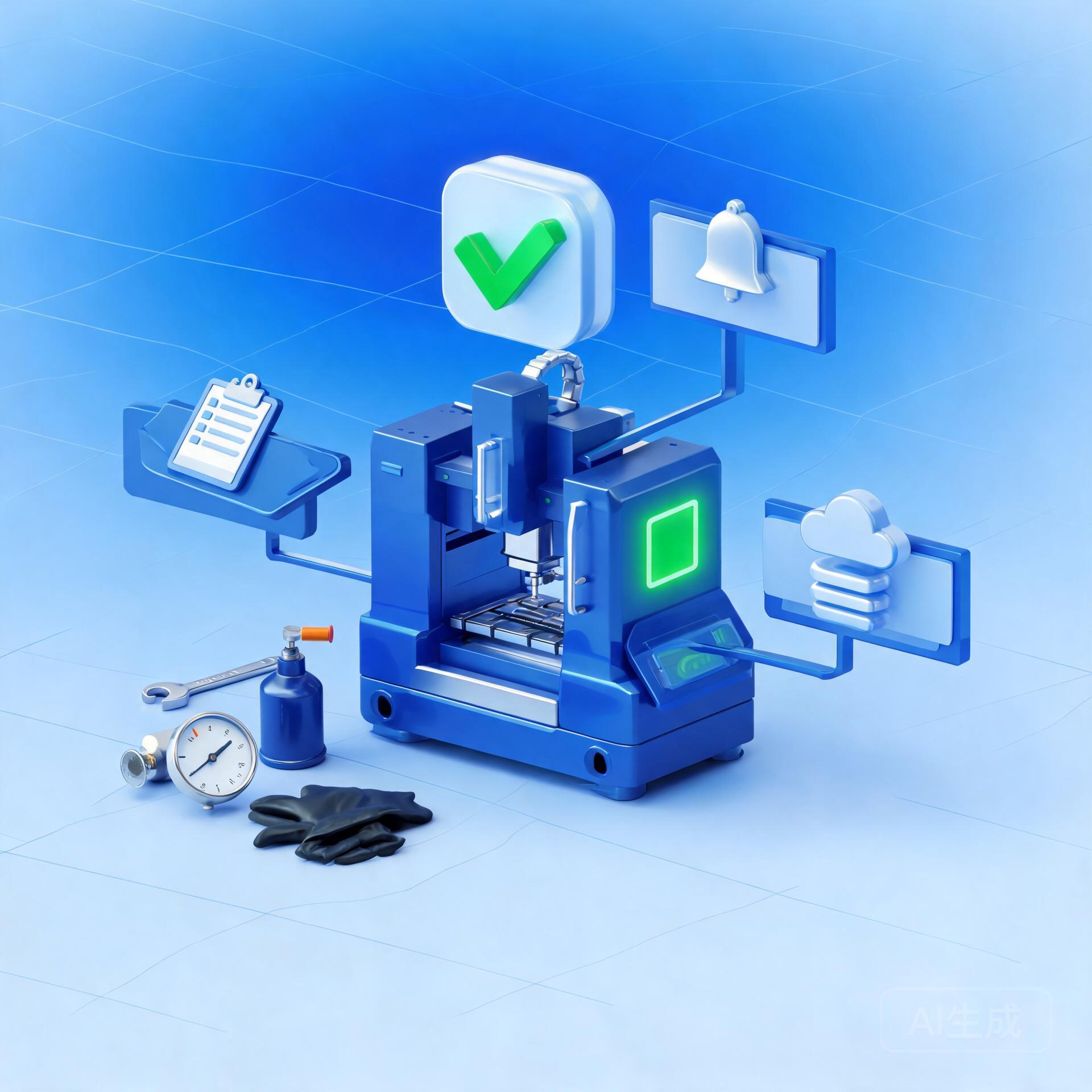
Digital tools solve these three problems: mobile scanning replaces handwriting, automatic system reminders replace relying on conscientiousness, and cloud storage replaces local files. Recording is no longer a separate task but part of the maintenance process itself: when the work is done you scan and tick, ticking archives automatically, and archived records can be looked up at any time.
2. What a Digital Maintenance Record Tool Can Actually Do
Do not overcomplicate it. A useful maintenance record tool really needs only five core functions, and that is enough.
| Function module | Core value | Compared with the traditional approach |
|---|---|---|
| Mobile maintenance checklist | Operator scans the equipment label, preset maintenance items pop up, they tick and confirm, and records archive automatically | Handwritten in a paper logbook, with scrawled writing that is hard to read |
| Automatic reminders and escalation on overdue | A maintenance task is pushed 1 day before it is due, and if it is not completed on time it is escalated to the team leader | Passed on verbally, with a miss rate above 50% |
| Fast reporting of anomalies | When an anomaly is found during maintenance, such as a low oil level or abnormal noise, a photo taken with a phone generates an anomaly work order directly | Calling the maintenance technician, where vague descriptions delay the fix |
| Automatic maintenance data statistics | Monthly and quarterly maintenance completion rates, maintenance cost per machine, and the top 5 frequent anomalies | Manually summarizing Excel; producing one report takes at least 2 days |
| Linkage with breakdown repair | A maintenance record is automatically linked to a later breakdown to trace whether inadequate maintenance caused it | Maintenance and repair are two separate worlds, and cause and effect cannot be explained |
Together, these five functions essentially concentrate information that was scattered across every link into one place. Operators no longer face three separate information sources, the paper logbook, Excel and WeChat groups; one phone carries the entire maintenance process. Team leaders no longer have to chase people about maintenance every day, because the system automatically surfaces unfinished tasks.
3. Three Typical Scenarios in Small and Medium Mold Shops
Digital maintenance records sound impressive, but what do they look like in a specific shop? Take three customers Moges implemented recently: they differ considerably, but the gains were all tangible.
Scenario one: a precision machining shop of about twenty people. The owner's greatest fear was being unable to produce complete maintenance records when a customer came to audit. They supply automotive parts, and the OEM requires maintenance records for every key machine to be retained for at least three years. Previously, with paper logbooks, staff stayed up until the early hours before an audit backfilling records. With digital tools, all records live in the cloud in real time and exporting a PDF takes one click at audit time. In last year's OEM annual audit, they had the most complete documentation of any audited shop.
Scenario two: a mold manufacturing shop of fifty people. Its maintenance execution rate had been only 35%, mainly because operator turnover was high and newcomers did not know when or how to perform maintenance. In the digital tool, each machine's maintenance checklist was turned into illustrated steps: how to wipe the spindle, how to read the oil dipstick and what the normal range on the pressure gauge is, all with pictures and explanations. Newcomers got up to speed quickly, and the execution rate rose to 92% within three months.
Scenario three: a 100-person MES pilot shop. It had already adopted Moges's production scheduling and job reporting systems; after adding the maintenance record module, equipment maintenance data automatically links with production scheduling: when a machine is under maintenance, the scheduling system automatically shifts the task to another machine of the same type, so the awkward situation of discovering mid-schedule that a machine is under maintenance no longer occurs.
4. Four Criteria for Choosing a Digital Tool
There are many tools on the market for equipment maintenance, from standalone mini-programs to large MES modules. When selecting, mold shops should look beyond the feature list at four practical questions.
First, will operators actually use it on their own? This is the most central criterion. Make a veteran technician in his forties or fifties fill in forms on a complex interface every day, and no management rule will make it stick. A good tool should make him willing to take out his phone: scan a code, tap a few checkboxes, take a photo, done in thirty seconds. Moges's experience is that once a maintenance checklist exceeds 15 items, operators' willingness to comply drops noticeably.
Second, can it connect to existing systems? For a factory already using ERP, scheduling and job reporting systems, can the new maintenance tool feed data back? If maintenance data still sits isolated in a new system, you are back to the old problem of more and more systems and more and more exhausted people. When selecting, confirm the integration capability and at least ensure that maintenance completion and machine downtime events can sync to the scheduling system.
Third, can the data really help you make decisions? If three years of maintenance data can only be exported to Excel for you to pivot yourself, its value is discounted. A good tool should automatically produce a monthly report: which machine's maintenance frequency correlates with its breakdown count, which shop team has the lowest maintenance completion rate, which maintenance items are most often flagged as anomalous. These analyses point directly at where to invest.
Fourth, is the pricing structure acceptable? A standalone mini-program may cost a few thousand a year, while a full MES process may cost hundreds of thousands. For small and medium factories still evaluating, we recommend starting with a lightweight SaaS: pay by number of machines or users, run the core functions for just over RMB 10,000 a year, and consider upgrading to MES after half a year if it proves worthwhile.
5. From Paper Logbooks to Digital: Landing Smoothly Through the Transition
Many factories worry that they are used to paper logbooks and switching straight to phones will create chaos. Moges's implementation experience is that a transition period of two to three weeks, in three steps, keeps things orderly.
The first step is the parallel period: run the paper logbook and the digital tool side by side for two weeks. After operators tick off maintenance on their phones, they also sign the paper logbook. The point is not to make them do it twice but to connect the new system with old habits and make it easier for team leaders to cross-check data.
The second step is performance-driven guidance: from the third week, the paper logbook no longer records new maintenance, and system records become the sole basis. At the same time, maintenance completion rate is included in the monthly performance assessment. Team leaders name and praise operators with a 100% execution rate at the morning meeting, and the effect is immediate.
The third step is the data review: after one full month, hold a shop meeting and show everyone the maintenance statistics the system generates automatically. Which machine is best maintained, which technician is most prompt, which anomaly occurs most often. With the data laid out, operators feel for themselves that something really is being managed.
This transition plan sounds simple, yet in practice 90% of shops complete it smoothly. The key is not how complex the technology is but whether a reliable implementation team is on hand to watch over it: in the first month, someone promptly teaches operators when they get stuck on the phone, and someone promptly adjusts checklist items that turn out to be unreasonable.
Conclusion
Put grandly, digital maintenance records are called equipment lifecycle management; put simply, they mean an operator who has just changed the oil no longer has to wonder whether the job was recorded. It is not a major project requiring a million-level budget, nor does it require hiring an IT team to maintain it. A lightweight SaaS, a gateway and a shop supervisor willing to drive change are enough to move maintenance from relying on conscience to relying on a system.
Among Moges customers in 2025, one shop supervisor said something very down to earth: he used to dread customers checking maintenance records, backfilling until midnight, but now he exports the PDF in the afternoon and sends it over. This is the most plain-spoken value of digitalization: it may not make you much money, but it will certainly let you worry a lot less.