Is Tracking Outsourced Mold Progress Hard? A Full Breakdown of Moges' 2026 Outsourcing Management Solution
2026-10-13 08:05:45
There's a universal phenomenon in the mold industry: your own machines are booked solid, so complex parts must go out. CNC precision machining, EDM, surface treatment, assembly and debugging — splitting one full process chain across three to five outsourcing vendors is routine. And with that come the questions: the workpiece has been sent out — when will it come back? Which operation is it stuck at right now? How much work does the vendor have queued?
Many mold factories' outsourcing management is still at the Excel ledger plus WeChat group stage. Buyers phone around weekly to chase progress, the workshop supervisor estimates delivery dates by experience, and if the boss wants a global view, he waits for the month-end consolidated report. Small-batch projects get by, but once orders get dense, which vendor owes work and which is about to slip becomes a question mark in everyone's head.
I. Typical Outsourcing Scenarios in Mold Making and Why Progress Tracking Is Hard
Outsourcing isn't simply "send it out, get it back." From blank to finished mold, seven or eight stages may be involved, and every one of them can jam. Among the Yangtze Delta mold factories we've worked with, the causes of failed outsourcing progress tracking concentrate in the following categories.
Opaque Operation Flow
Once an outsourcing order is issued, the real machining status sits with the supplier. You send out a batch of CNC precision parts; the supplier says "in queue" — you don't know which operation it's queued for, how much work is ahead of it, or when it's expected to go on the machine. Call too often and the vendor gets annoyed; don't call and you fear being cut in line.
Rework Loops Never Close
An outsourced part comes back and fails inspection — rework it or scrap it outright? If rework, does the original vendor handle it or do you switch vendors? This process is hard to record clearly in Excel. The next time similar work goes out, the vendor's historical quality record can't be retrieved, and the evaluation starts from zero again.
Reconciliation Disconnected from Progress
Many factories reconcile outsourcing once, at month-end. This creates an awkward situation: a supplier has already completed three batches of work, but the reconciliation sheet isn't out, so the buyer has no complete progress detail at hand. When the boss wants the overall outsourcing picture, he can only wait for finance's report — a one-to-two-week blind window in between.
II. Why Traditional Tracking Methods Don't Work
| Method | Information Timeliness | Traceability | Suitable Scenario |
|---|---|---|---|
| Excel ledger | Low; requires manual updates | Poor; hard to query after month-end archiving | Tiny shops with minimal outsourcing (under 10 orders/month) |
| WeChat group communication | Medium; depends on supplier initiative | Very poor; messages drown and are hard to trace back | Urgent ad-hoc supplementary orders |
| Supplier's own system | High, but suppliers may not cooperate | Medium | Long-term, high-volume core suppliers |
| Moges outsourcing management module | Real-time; updates on scan | Complete; full-process traceability | Mold factories averaging 20+ outsourcing orders/month |
Many factories have tried getting suppliers to fill in progress sheets. The first time, the supplier fills it in earnestly; by the second week entries start slipping; by the third week the sheet stops updating. This isn't the supplier being uncooperative — it's that the extra workload carries no clear incentive. A supplier serving ten customers cannot afford to fill in a progress sheet for each of them.
So the key isn't making suppliers do more work — it's pulling the information back to your own side.
III. The Core Capabilities of Moges' Outsourcing Progress Tracking Solution
Moges' approach to outsourcing management is direct: treat outsourcing orders like internal production tasks, but without force-fitting internal scheduling logic. After all, suppliers have their own scheduling logic; you can't manage their machines — only the batch of workpieces relevant to you, when they go in and when they come out.
Full Life-Cycle Tracking of Outsourcing Orders
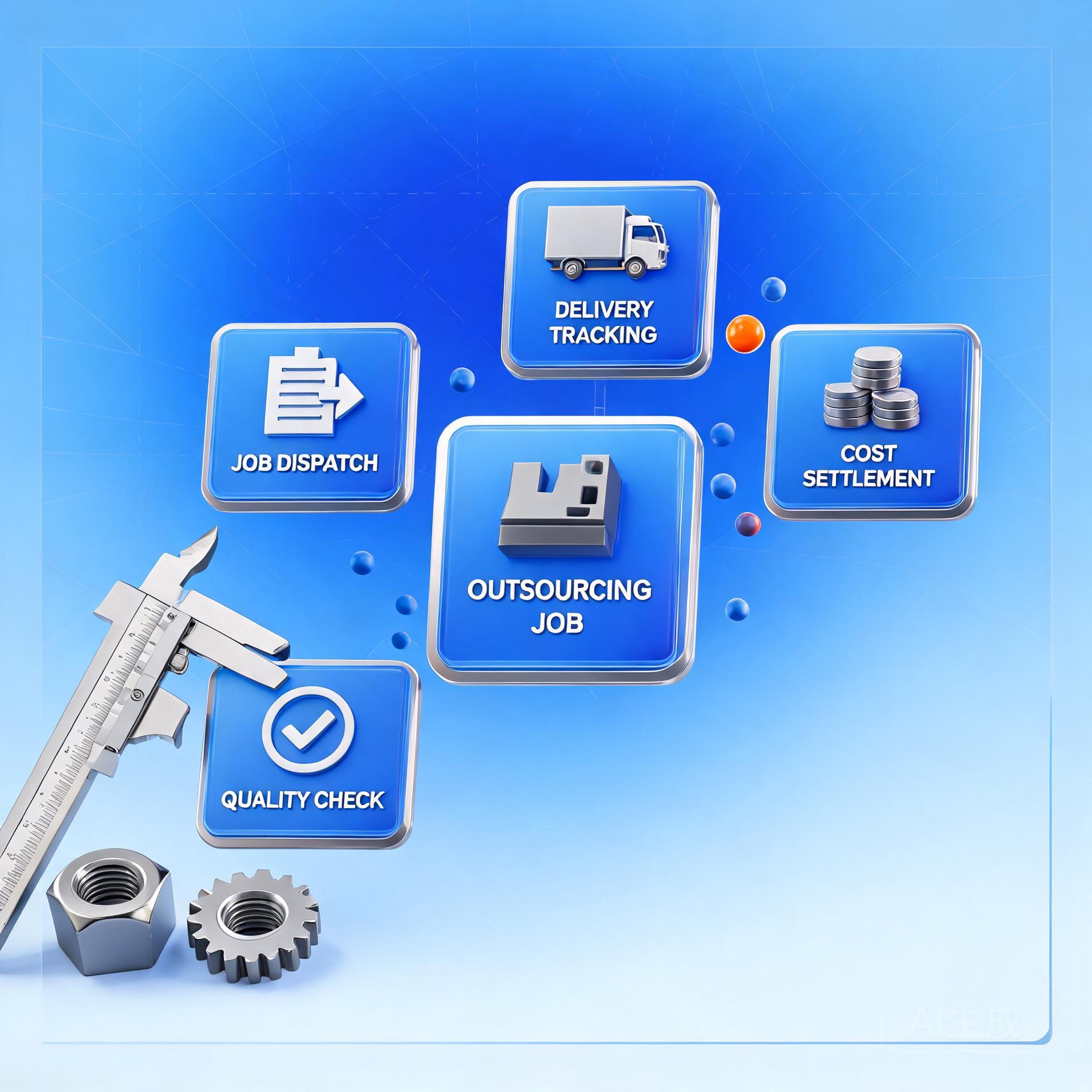
Every outsourced batch generates an outsourcing order card containing the workpiece list, process requirements, and planned return date. Once issued, the order automatically enters "awaiting receipt" status. After the supplier signs for it, status changes to "in machining." At each subsequent key operation milestone — rough machining complete, precision machining complete, inspection passed — the responsible person taps once on a PDA and the progress syncs back to the system.
No software installation is required on the supplier's side. When issuing the order, you can attach a process flow card; the vendor's team leader ticks the corresponding milestones on the card by hand, snaps a photo, and sends it back. Moges' system supports uploading the photo receipt directly; the buyer taps "confirm milestone received" in the system and it's done — the whole loop takes under 30 seconds.
Automatic Delivery-Date Warnings
The system automatically estimates the actual return date from each outsourcing order's current milestone and remaining operations. Once the estimated date crosses the threshold against the planned return date (default: warn 2 days early, adjustable), it sends a WeChat reminder to the buyer and the workshop supervisor simultaneously.
The warning isn't a bare "overdue notice." It tells you: which order, which operation it's stuck at, how many days off plan, and which customer's mold project is affected. Armed with the alert, the buyer can first check that supplier's current average delivery cycle and historical overdue rate in the system, then decide whether to make a chasing call or line up a backup supplier.
Automatic Outsourcing Cost Collection
Each outsourcing order's fees are entered at creation. At month-end reconciliation, the system automatically aggregates each supplier's monthly outsourcing total, costs grouped by mold project, and supplier quality deductions. For the boss, outsourcing cost is no longer a muddled account — how much each mold project spent on outsourcing, which operation type has the highest outsourcing share, which supplier gives the best value — all visible the moment the report opens.
One customer of ours used to pin outsourcing costs only down to "about 800,000 yuan spent on outsourcing this month." After adopting Moges, they can pinpoint "mold A's EDM cost 12,400 yuan, CNC precision machining 38,200 yuan, surface treatment 6,800 yuan." Data precision jumped from "ten-thousand-yuan level" to "hundred-yuan level," and the granularity of cost control changed completely.
Check Progress Anytime on Mobile
While the workshop supervisor is inspecting the floor, he pulls out his phone and sees the real-time status of every outsourcing order. The boss on a business trip, wanting to know how a key project's outsourcing is going, opens the app and sees: which batches have come back, which are still at the vendor, and when they're expected to return.
IV. Selection Advice and Implementation Path
If you're evaluating outsourcing progress tracking solutions, we recommend first clarifying three questions: roughly how much outsourcing volume per month, how many types of outsourced operations, and whether your priority is delivery dates or cost.
Small factories with under 10 outsourcing orders a month can keep using Excel — no need for a system yet. At 20+ orders a month, especially with three or more suppliers and multiple operations going out, the system's value starts to show. Mold factories at this volume usually have annual revenue between 15,000,000 and 50,000,000 yuan — Moges' typical customer profile.
For implementation, start from "the most painful point" — don't switch everything at once. For example, get the two core functions of outsourcing order tracking and delivery-date warnings running first; cost collection and supplier scoring can be phase two. Moges has a 3-month pilot-to-go-live implementation methodology, from master data preparation to full switchover, with an implementation consultant on site — no big-bang everything-at-once.
Also, for factories already running Moges' internal MES, the outsourcing module is fully integrated and needs no separate purchase. When an internal work order reaches an outsourced stage, the system automatically generates the outsourcing order; when the outsourced part comes back and passes inspection, it automatically flows back into internal production operations. Once this chain is connected, internal production and external outsourcing progress appear on the same dashboard.
Plainly put, the difficulty of tracking outsourced progress in mold factories is essentially information asymmetry — you don't know what's happening on the supplier's side. The solution isn't more people watching; it's using a system to pull back information at key milestones so progress stays clearly visible. Which tool to choose, how to get suppliers to cooperate, whether to connect the system to internal processes — decide these based on your factory's scale and actual pain points, but the core goal doesn't change: every outsourced batch, from dispatch to return, fully accounted for.