Mold Production Management Software: The Core Tool for Mold Enterprises to Cut Costs and Improve Efficiency
2017-08-02 00:00:00
1. Introduction: The Digital Revolution in Mold Enterprise Management
In today's fiercely competitive manufacturing environment, mold enterprises are facing unprecedented challenges. As the "Mother of Industry", the mold industry has distinctive characteristics such as one-off customization, complex processes, and make-to-order production; the traditional manual management model can no longer meet modern enterprises' strict requirements for efficiency, quality, and cost. The emergence of mold production management software (mold ERP/MES) has brought a management revolution to mold enterprises and has become the core tool for achieving scientific management, cost reduction, and efficiency improvement.
Analysis of the industry status: Most Chinese mold enterprises have grown rapidly in the past decade or so. Many busy themselves every day with taking orders, producing, and building, chasing superficial scale and image, while neglecting or ignoring the importance of enterprise informatization management. This development model of "emphasizing hardware while underweighting software" has left enterprises under great pressure in delivery management, cost control, quality assurance, and other aspects.
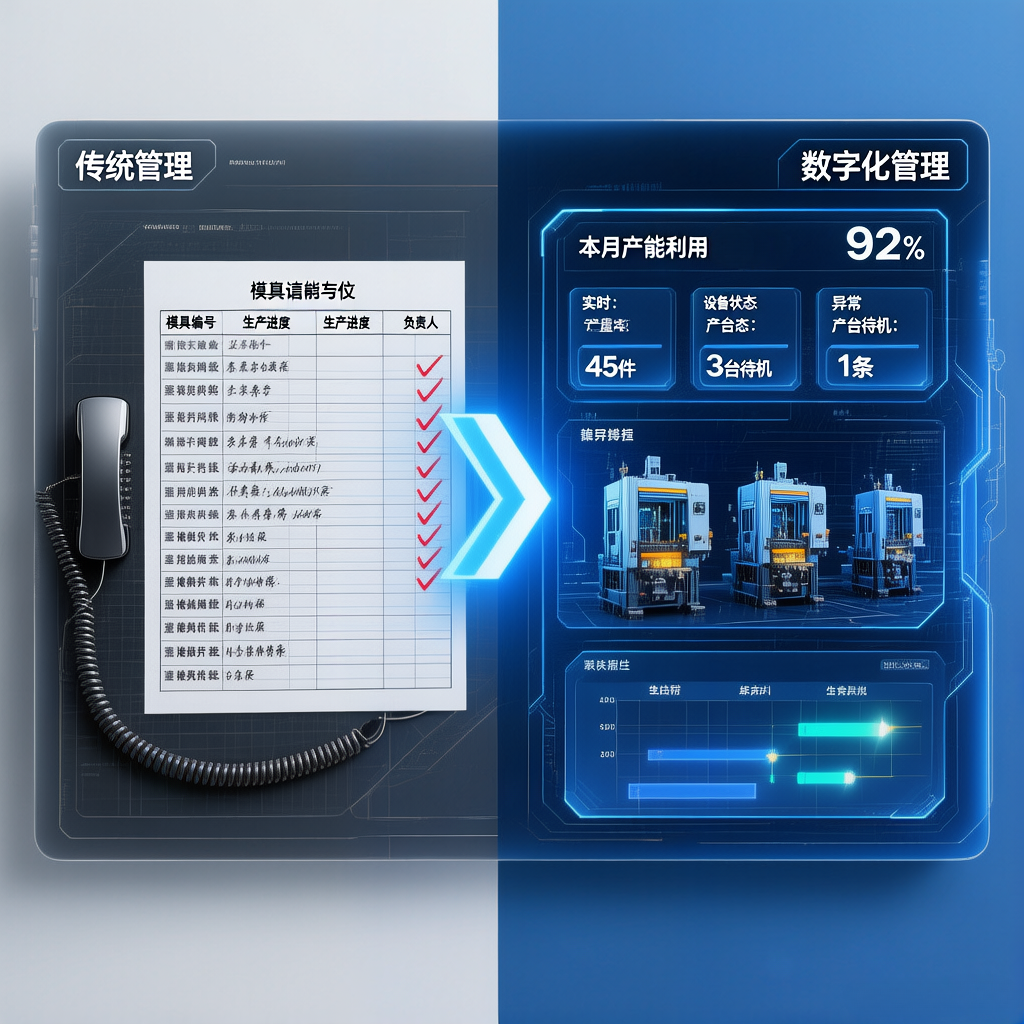
2. Characteristics of the Mold Industry and Management Challenges
1. Typical Industry Characteristics
As a typical precision manufacturing industry, the mold industry has the following core characteristics:
One-off, non-repetitive production: every mold order is a unique customized product and cannot be standardized for mass production
Machine capacity as the dominant factor: the utilization and efficiency of production equipment directly affect the profitability of the enterprise
High manual content in processes: high demands on technician skills and great difficulty in quality control
Make-to-order model: production planning depends entirely on customer orders, requiring high flexibility
Heavy delivery pressure: downstream industries impose increasingly strict requirements on mold delivery cycles
2. Pain Points of the Traditional Management Model
In the absence of informatized management tools, mold enterprises commonly face the following management difficulties:
Delayed information transmission: design changes and process adjustments cannot be synchronized in time, leading to rework and delays
Opaque production progress: management cannot grasp the production status of every order and every machine in real time
Difficult cost control: raw material loss, labor costs, equipment depreciation, etc. are hard to account for accurately
Missing quality traceability: when quality problems occur, the root cause cannot be located quickly and responsibilities are divided unclearly
Decisions lacking data support: management relies on experience and intuition for decisions, lacking scientific basis
3. The Core Value of Mold Production Management Software
1. What Is Mold Production Management Software?
Mold production management software (also called mold ERP or mold MES) is an enterprise management information system tailored specifically to the mold industry. It integrates core functional modules such as quotation management, order management, design management, production scheduling, quality control, and cost accounting, covering the full-process management needs of mold enterprises from order intake to delivery.
System positioning: mold management software is not a simple tool replacement but an upgrade of the enterprise management model. Through digital means, it systematically integrates the elements of people, machines, materials, methods, and environment, achieving optimal resource allocation and standardized management of business processes.
2. Details of the Core Functional Modules
A complete set of mold production management software usually contains the following functional modules:
Quotation management module: quickly generates accurate quotations based on historical data and cost models, improving quotation efficiency and accuracy
Order and project management: manages customer orders and project progress in a unified way, achieving full-lifecycle order tracking
Master planning management: formulates scientific production plans based on order priority, equipment capability, and resource status
Design management: manages design drawings and process documents, achieving version control and traceability of design changes
Process preparation management: standardizes process flows and builds a process knowledge base, improving process design efficiency
Shop production optimization and dispatching: monitors production progress in real time, intelligently adjusts production plans, and responds quickly to emergencies
Shop real-time monitoring: grasps equipment status, production progress, and quality data in real time through data collection devices
Material management: precisely manages raw material inventory, achieving accurate material distribution and cost control
Statistical analysis and decision support: multi-dimensional data analysis and visual reports provide data support for management decisions
3. The Core Value Delivered by Management Software
Implementing mold production management software can bring the following significant value to enterprises:
Improved on-time delivery rate: scientific production planning and real-time monitoring significantly reduce delivery delays
Lower production costs: optimizes resource allocation, reduces waste, and improves equipment utilization
Higher product quality: standardizes process flows and builds a quality traceability system, reducing the defect rate
Enhanced management transparency: real-time grasp of business operations improves the scientific quality of decisions
Promoted knowledge accumulation: converts enterprise experience into standardized processes and knowledge bases, reducing dependence on individuals
4. Modular Deployment: Suited to Enterprises at Different Stages
1. Flexible Deployment Strategy
Mold enterprises can choose and configure the functional module list that suits them according to their different development stages, management levels, production characteristics, and staff quality. This modular deployment strategy has the following advantages:
Lower initial investment: enterprises can start from basic modules, reducing one-time investment pressure
Quick results: the most urgent management problems are solved first, showing returns on investment quickly
Progressive upgrade: as the enterprise develops, it can seamlessly upgrade step by step from the starter version to the full version
Reduced implementation risk: phased implementation reduces the impact on existing business
2. Selection Suggestions for Enterprises of Different Sizes
Small mold factories (fewer than 20 people): it is recommended to start from basic modules such as order management, production scheduling, and material management, focusing on solving delivery management and cost control problems.
Medium-sized mold factories (20-100 people): consider implementing a complete MES system covering full-process management from quotation to delivery, and also consider integration with the financial system.
Large mold enterprises (more than 100 people): it is recommended to implement an integrated ERP+MES solution, achieving digital management of the entire business process and building an enterprise-level data platform.
5. Key Factors for Successful Implementation
1. Choosing the Right Software Vendor
When choosing a mold production management software vendor, you should focus on the following factors:
Industry experience: whether the vendor has deep roots in the mold industry and understands industry characteristics and pain points
Technical strength: whether the software's technical architecture is advanced and can meet future development needs
Service capability: whether localized services are provided and how fast the response is
Success cases: whether there are successful implementation cases of enterprises of the same scale and type
Cost performance: whether the software price is reasonable and the total cost of ownership is controllable
2. Points of Attention During Implementation
To ensure successful implementation of the management software, enterprises need to pay attention to the following key points:
Top-level commitment: enterprise management must attach great importance to it and personally drive project implementation
Full participation: from management to frontline employees, everyone should actively participate in system implementation
Process optimization: take the opportunity of system implementation to optimize and standardize existing business processes
Proper training: ensure every user can skillfully use the system so the system's value is realized
Continuous improvement: after the system goes live, continuously optimize and improve according to actual usage
6. Future Trends of Mold Enterprise Management
1. Intelligent Upgrade
With the development of artificial intelligence, big data, the Internet of Things, and other technologies, mold production management software is developing toward intelligence:
AI intelligent scheduling: automatically generates optimal production plans based on machine learning algorithms
Predictive maintenance: predicts equipment failures through equipment data analysis and performs maintenance in advance
Intelligent quality inspection: uses machine vision technology to achieve automatic product quality inspection
Digital twin: builds a virtual factory to achieve simulation and optimization of the production process
2. Cloud Deployment
More and more mold enterprises are beginning to adopt cloud deployment and enjoy the following advantages:
Lower IT investment: no need to purchase servers or other hardware equipment; pay on demand
Rapid deployment: the system deployment cycle is short and it can be put into use quickly
Elastic scaling: system resources can be adjusted flexibly according to business needs
Data security: professional cloud service providers provide higher-level data security guarantees
3. Industry Chain Collaboration
Future mold production management software will pay more attention to industry chain collaboration:
Integration with customer systems: achieving real-time sharing of order, design, and progress information
Collaboration with suppliers: optimizing supply chain management and improving material distribution efficiency
Connection with equipment manufacturers: achieving automatic collection and analysis of equipment data
Industry data platforms: participating in industry data sharing to gain market insights and best practices
7. Conclusion: Management Software Is an Inevitable Choice for Mold Enterprises
Facing increasingly fierce market competition and constantly upgrading customer demands, mold enterprises must enhance their core competitiveness through management innovation. As a digital tool of enterprise management, mold production management software can not only help enterprises solve current management difficulties but also lay a solid foundation for the sustainable development of the enterprise.
As Lao Tzu said: "If you would take, you must first give." Only by doing the basic management work well and providing employees with a good working environment and development platform can enterprises retain talent and stimulate employees' enthusiasm and creativity. At the same time, management software can remedy the defects of manual management, help enterprises achieve scientific informatized management, and increase enterprise benefits.
For the future of mold factories, mold production management software is indispensable. Whether a small workshop or a large enterprise, each should choose suitable management software according to its own actual situation, improve management through digital means, achieve cost reduction and efficiency improvement, and win competitive advantage in market competition.
As a digital service provider focused on the mold industry for 14 years, Kunshan Moges Information Technology Co., Ltd. is committed to building world-class management models for numerous mold enterprises and helping mold enterprises flourish. We believe that through scientific management and advanced technology, China's mold industry will surely embrace an even more brilliant tomorrow!