A Pragmatic Solution to the Mold Industry's Scheduling Dilemma: the Efficient Combination of Manual Gantt Charts and Barcode Tracking
2020-03-04 00:00:00
The Special Nature of Mold Production: Why "Fully Automatic Scheduling" Fails to Fit?
Mold manufacturing differs from batch assembly lines. Its typical characteristics are single-item small batches, highly customized processes, frequent design changes, and complex resource constraints. In such an environment, forcibly introducing a fully automatic APS scheduling system often falls into the dilemma of "endless rules to set, anomalies that cannot be handled, and untrustworthy results." For this very reason, after serving in depth more than 100 mold factories, Moges chose a more pragmatic technical path — centered on the manual Gantt chart, supplemented by barcode-based production execution — preserving human judgment while strengthening data accuracy.
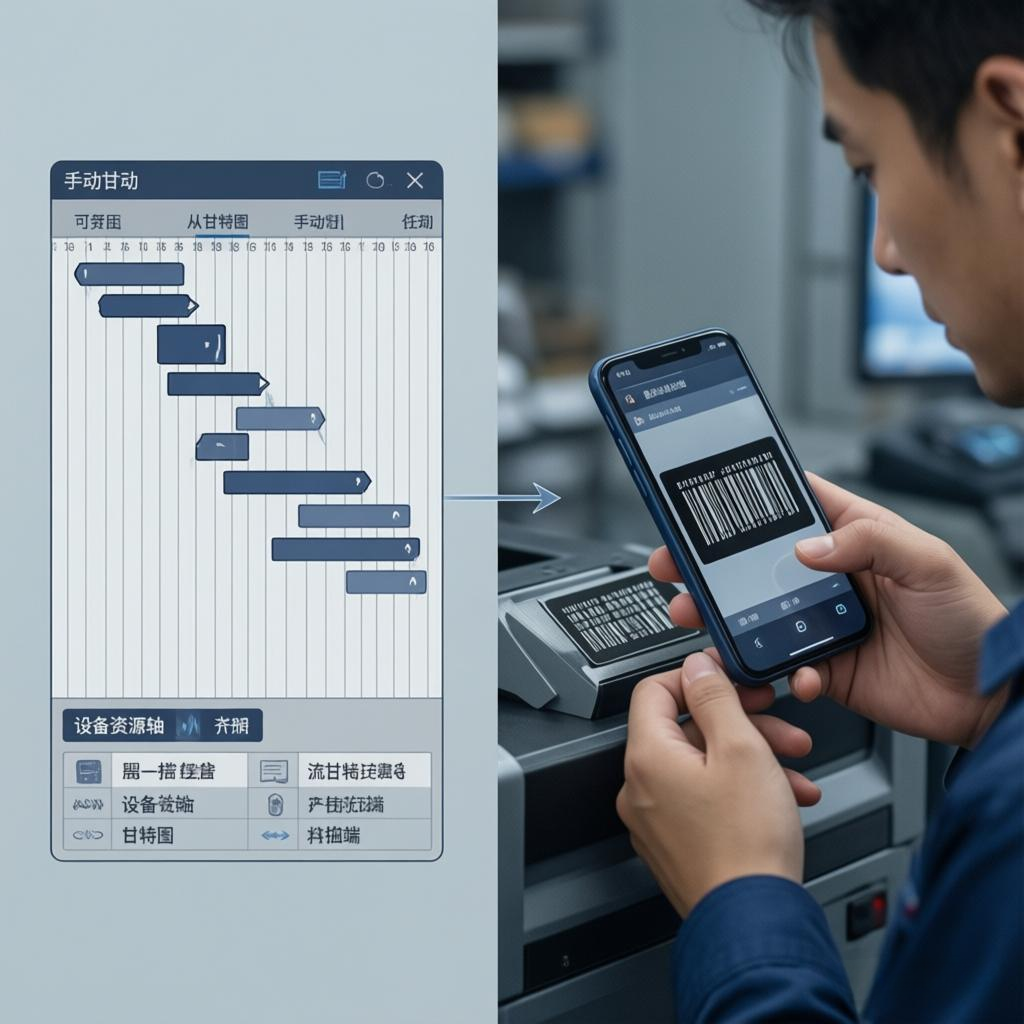
Manual Gantt Chart Scheduling: The Production Controller's "Visual Battle Map"
Moges' scheduling module uses an intuitive Gantt chart interface, where production controllers can directly drag task bars and assign them to specific equipment, teams, or outsourcing units. The system displays in real time:
A load heat map of each machine for the next 7 days;
The current progress and remaining labor hours of key molds;
The expected return time of outsourced tasks.
This "human-machine collaboration" model lets production controllers quickly judge, before accepting an order: Is the current capacity sufficient? Does work need to be sent out early? Can the delivery date be guaranteed? One Taiwan-funded mold factory has used the system for three years; its order evaluation efficiency improved by 60%, and the shop-floor chaos caused by rush orders decreased by 80%.
Barcode Production Management: From "Experience-Based Reporting" to "Data-Driven"
However precise the scheduling, if execution is not under control it remains a castle in the air. Moges uses unique barcodes to bridge the last mile of production execution:
Receiving: the warehouse scans codes to confirm the entry of materials/semi-finished products;
Starting work: operators scan codes to claim tasks, and the system records the start time;
Completion: after passing quality inspection, workers scan codes to report work, automatically triggering the next process.
As a result, managers can query at any time the real-time location, dwell duration, and responsible person of any part, completely saying goodbye to the traditional mode of "finding materials by shouting and guessing progress."
Beyond Tracking: In-Depth Analysis of Cost, Performance, and Utilization
All barcode operation data automatically accumulates into management assets:
Machining cost accounting: labor, equipment, materials, and outsourcing fees are collected by work order, producing a detailed cost breakdown per mold;
Employee performance reports: statistics on individual daily completions, yield rates, and overtime hours, incentivizing high-output employees;
Equipment utilization: comparing planned labor hours with actual running time to identify idle or bottleneck equipment.
This data is used not only for review, but also feeds back into the next round of scheduling decisions, forming a closed loop of "plan → execute → analyze → optimize."
Pragmatic Implementation: Get It Right First, Then Get It Strong
We have always believed that system effectiveness = software functionality × the enterprise's management level. Therefore, Moges recommends that customers implement the "barcode production management" module first — it has a low entry threshold, shows quick results, and is easy for employees to accept. Once the data flow is stable, scheduling applications can be deepened step by step. This "execution first, scheduling later" strategy has already helped many small and medium-sized mold factories achieve production transparency within 3 months, laying a solid foundation for subsequent digital upgrades.
If you are troubled by delayed deliveries, unclear costs, and out-of-control progress, why not experience this mold management solution born of practice and faithful to reality — because true intelligent manufacturing begins with respect for the essence of the industry.