From "Paper-Based Operations" to "Global Visibility": How Nantong Yanyang Shipyard Solved Ship Repair Management Challenges with the Moges Production Management System
2026-02-03 07:45:49
Customer Background: A single ship represents a complex project.
Nantong Yanyang Ship Building Co., Ltd.It is a well-known private ship repair company in the Yangtze River Delta region, handling over 50 repair projects annually for various types of cargo ships, oil tankers, and special-purpose vessels. Each vessel entering the dock initiates a separate project, involving dozens of specialized trades, including hull, engine, electrical, and outfitting, and requires coordination with over 10 external subcontractors, such as painting, non-destructive testing, and specialized equipment.
However, its traditional "Excel + paper-based work order" management model has become unsustainable:
Plan based on experience: The project manager relies on memory to schedule tasks, leading to frequent conflicts between equipment and facilities.
Outsourcing is like opening a blind box.: Progress with external factories is tracked via phone calls, resulting in a high rework rate of up to 20%.
Cost calculation is not possible.: Materials, labor, and external service costs are only summarized at the end of the month, making process control impossible.
Shipowners often complain about"Where is my vessel currently in the repair process?" - No one can provide a real-time answer.
"Ship repair is not about fixing machines; it's about racing against time, weather, and sea conditions. We need to be more precise and have greater control." – According to Mr. Chen, Production Director, the company.
Key to overcoming challenges: Choosing a digital partner who understands "ship repair logic"
After evaluating several general ERP vendors, Nantong Yanyang ultimately choseKunshan Moges Information Technology Co., Ltd..The core reason lies in:
Industry-specific customization: Moges Ship Repair ERP is specifically designed for the "one vessel, one project" model. It includes features such as ship inspection standards, dry dock constraints, and safety compliance rules.
Lightweight and rapid implementation: No need to modify existing processes, completion in 6 weeks, workers can simply scan codes with their phones to report work.
In August 2025, the system will be officially launched, initially covering 3 ship repair projects.
Four core scenarios, reshaping the entire shipbuilding management process.
1. Intelligent Scheduling: Maximize efficiency every minute.
The system automatically generates a Gantt chart-based maintenance plan based on the ship's arrival date, the list of maintenance items, and the availability of resources (dock, cranes, welders). When a task is delayed (e.g., due to a delay in non-destructive testing results), the AI engine automatically re-sequences subsequent tasks to ensure that the critical path is not affected.
2. External Collaboration Online: Building a Transparent Supply Chain
All external partners can access the system through their dedicated accounts:
Receive electronic work orders and drawings;
Update progress daily and upload quality inspection reports.
The system automatically alerts to potential delays.
"Currently, external manufacturing partners are moving faster than we are, as payment and evaluation processes are now all online." - According to Wang Manager, Procurement Manager.
3. Real-time cost allocation: Say goodbye to "post-mortem accounting"
The system automatically collects data for each vessel, including:
Consumption of main materials such as steel plates and paint.
Labor hours per job type;
External service fees.
The project manager can view cost variances daily on their mobile device and make timely adjustments to the strategy.
4. Real-time progress visibility for all employees: Shipowners can also "watch live"
Through enterprise WeChat or a dedicated link, ship owners can monitor in real-time:
Current maintenance stage:
Completed/Pending Tasks;
Key milestone photos and videos.
Customer satisfaction has increased from 82% to 96%, with "trust" becoming a key competitive advantage.
Significant Results: Data proves the value of the transformation.
As of November 2025, the system has been running for 3 months, and key indicators have been comprehensively improved:
| Metrics | Before going live | After going live | Improve |
|---|---|---|---|
| Average repair cycle | 28 days | 23 days | ↓18% |
| External rework rate | 20% | 7% | ↓65% |
| Cost accounting timeliness | End-of-month summary | Real-time data collection | ↑100% |
| Shipowner satisfaction | 82% | 96% | ↑14% |
A more significant impact is that the company began to take on more high-value LNG and chemical tanker repair orders – because "we can finally confidently guarantee delivery."
Customer Testimonials
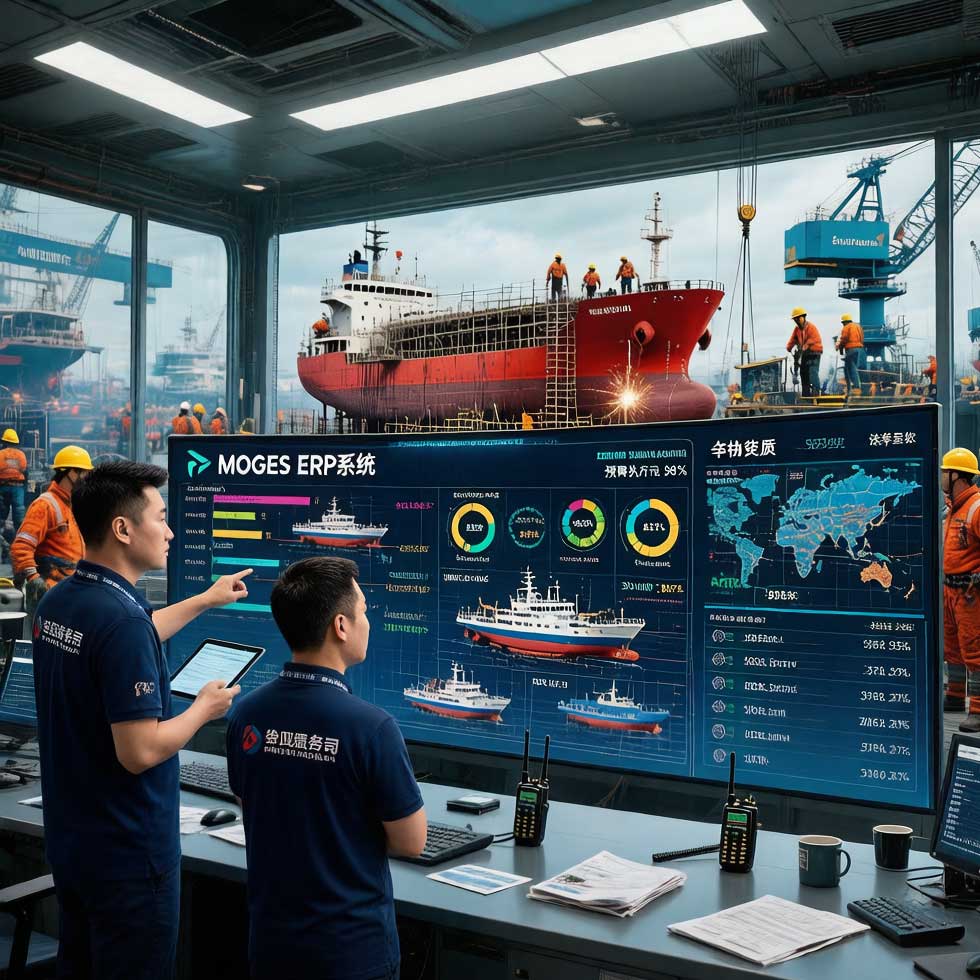
Moges doesn't just provide us with software; it helps us establish a modern ship management system. Now, instead of having papers covering my office walls, I have a large screen that clearly displays the status of all our ships.- Mr. Chen, Production Director, Nantong Yanyang Shipyard Co., Ltd.
Conclusion: Digitalizing the shipbuilding industry requires partners who "understand the industry."
The case of Nantong Yanyang demonstrates that the digital transformation of the shipbuilding repair industry must be rooted in its unique "project-based, multi-vendor, and highly compliant" business nature. Kunshan Moges, with its deep understanding of discrete manufacturing and project management, is providing increasingly more companies like Nantong Yanyang with truly practical, effective, and fast-results digital solutions.
Is your ship repair yard also facing the challenges of "unseen, uncontrollable, and unquantifiable" issues? Moges offers free business diagnostics to help you usher in a new era of transparent and intelligent ship repair.