Deep Integration of SAP and the Moges Production Management System: Flexible Adaptation to Enterprise Control Needs and a Complete Closed Loop for Mold and Sheet-Metal Manufacturing Execution
2026-04-02 09:03:48
Introduction: Trust Comes from Capability, Not Labels
In the software sales process aimed at medium and large manufacturing enterprises, customers often raise a key question: "Have you served any listed companies? Can you provide specific cases?" Behind this lies not only a demand for trust in the supplier's technical capability, but also a prudent consideration of the safety of the enterprise's own digitalization investment and the maturity of the system.
However, it must be clarified that the value of the Moges system does not depend on whether the customer is a listed company; it lies in its highly configurable architecture, which can flexibly adapt to the different management intensity needs of everything from growing manufacturing enterprises to large groups. Listed companies choose us not because the system is "designed specifically for listed enterprises", but because their internal processes are more standardized and their data consistency requirements are higher—and Moges happens to provide sufficiently fine-grained and adjustable business control capabilities, able to "tighten" process policies to meet high-standard collaborative and transparent management.
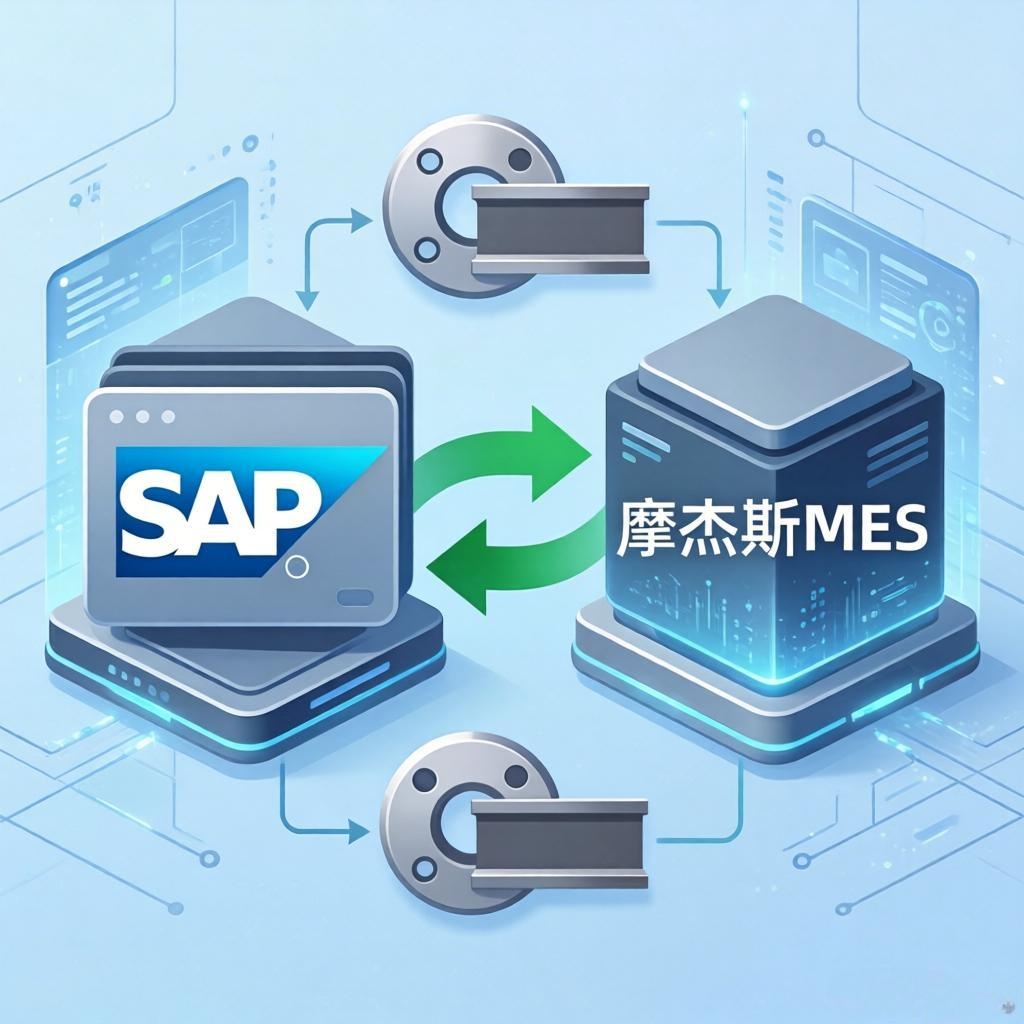
The following uses a real (anonymized) case of a listed manufacturing enterprise to explain how Moges, through deep integration with SAP, solved the core pain points of its mold department and, two years later, won a second purchase from the sheet-metal department.
1. Project Background: An Independent Mold Department Urgently Needs Transparent Collaboration
The listed company is headquartered in the Yangtze River Delta, with a main business covering high-end equipment and precision parts manufacturing, and annual revenue exceeding RMB 20 billion. The company has an independent mold design and manufacturing department; although it is a cost center, its delivery efficiency directly affects the launch pace of the main products.
Because the group fully rolled out SAP as the unified business platform, the mold department was also brought into the overall management system. However, SAP has inherent shortcomings in workshop-level execution, process tracking, and real-time job reporting, resulting in:
Information black box: requesting departments (such as product development and project management) have long been "unable to see and unable to ask about" mold progress, and can only repeatedly press for answers by phone or WeChat;
Delayed communication: the workshop is busy with production and has no time to report frequently, so information lags severely;
Inefficient decision-making: senior meetings often argue endlessly over "which process the mold is stuck at", affecting decision efficiency.
To bridge the break between planning and execution, the company decided to introduce the Moges Production Management System (MOGES-PMS) as an extended execution layer of SAP in the mold workshop, and to achieve two-way deep integration.
It is worth mentioning that such systems are procured under the leadership of the mold manufacturing and production departments. Initially they evaluated the option of developing everything within SAP, but because of the long development cycle and costs exceeding the department's control, they ultimately adopted the plan of using the Moges Production Management System as the MES. Because this system is entirely used to improve internal operational efficiency and does not directly participate in external financial accounting or form independent asset accounts, it is often not shown separately in the expenditure items of a listed company's public financial reports. But this in no way diminishes its key role in actual production management.
In addition, out of strict requirements for data sovereignty and cybersecurity, the customer's entire Moges system (including application servers and databases) is deployed behind the enterprise's intranet firewall, completely isolated from the Internet. Even so, the system still runs stably and maintains efficient, secure data exchange with SAP, fully demonstrating Moges's compliance and deployment flexibility in architecture design—it supports cloud deployment and is also fully suited to localized private deployment scenarios with high security levels. Throughout the deployment and operation process, the system was not blocked by the customer's firewall, nor identified by security detection tools as having any abnormality or risk, further verifying the security of its code and the standardization of its network behavior.
2. System Integration Architecture: Two-Way Data Flow Covers All In-House and Outsourced Scenarios
The integration between Moges and SAP builds a highly reliable, low-latency data channel around the business closed loop. The main integration contents are as follows:
SAP → Moges (downstream data)
Mold BOM: synchronizes the multi-level material structure to ensure material requisition and assembly according to the latest design version;
Material list: includes details such as main materials, auxiliary materials, and standard parts, supporting completeness checks;
Dedicated warehouse list: limits the operable inventory scope to avoid misoperations across warehouses;
Master data synchronization: employee and work center master data, ensuring consistency of personnel and equipment information.
Moges → SAP (upstream data)
Full work order lifecycle: returns statuses such as created, released, started, paused, and completed in real time;
Accurate material consumption: material requisition records are accurate to work order, process, and operator, automatically deducting SAP inventory;
Exception handling closed loop: scrap and rework data are synchronized to SAP for subsequent analysis;
Quality inspection result synchronization: after passing inspection, automatically posted to the designated SAP warehouse;
Fine-grained cost collection: process costs calculated based on actual working hours, equipment usage, and labor rates;
Performance data support: employee machining records, supporting piece-rate accounting and performance analysis.
Special Note: The Outsourcing Process Seamlessly Connects with the SAP Purchasing Module
Outsourcing requests initiated in Moges automatically generate purchase requisitions (PR) in SAP;
After the outsourcing vendor finishes processing, return inspection is completed in Moges;
When qualified products are put into stock, SAP goods receipt (GR) is triggered synchronously, providing the basis for subsequent processes;
The entire outsourcing cycle (dispatch → processing → return → quality inspection → stocking) is fully traceable, and costs are automatically collected to the corresponding mold work order.
This integration ensures that even when materials are not processed in-house, their status, cost, and delivery time are still brought into a unified control system, truly achieving integrated internal and external collaboration.
3. Flexible Configuration: Can Be Loose or Tight, Meeting High-Standard Collaboration Requirements
The Moges system has a rich set of built-in business rule configuration items, for example:
Whether a work order requires supervisor confirmation before release
Whether material requisition must strictly follow BOM completeness
Whether scrap requires review by process or quality personnel
Whether key operations record the operator and time
For enterprises with relatively loose management requirements, these configurations can be appropriately simplified to improve efficiency; for this listed company, the IT and production management departments set all relevant policies to strict mode, ensuring standardized processes, accurate data, and clear responsibilities. After the system went live, requesting departments could finally self-serve and query the real-time progress of any mold through the internal system, cross-department communication efficiency improved markedly, and management could make rapid decisions based on real data.
4. Results and Repeat Purchase: From Mold to Sheet Metal, Trust Continues to Deepen
Two years after the system ran stably, the company newly established a sheet-metal processing department. Given that the sheet-metal process is highly similar to the mold manufacturing process in planning, execution, job reporting, and quality inspection, the department proactively proposed adopting the same Moges system and again completed full integration with SAP. This is not only recognition of technical capability, but also affirmation of the core value that "the system can dynamically adjust with business complexity and management requirements".
5. Conclusion: Focus on the Problem, Not the Label
Although we cannot disclose the name of this listed company due to confidentiality agreements, this case fully proves that the Moges system is fully capable of serving large manufacturing enterprises with high standardization requirements.
We understand customers' need for "success endorsement" and always honor our confidentiality commitment to existing customers. For those of you evaluating a system, we suggest: rather than focusing on "who have you served", focus on "can you solve my problem". Moges is willing to explore the most suitable digitalization path with you through anonymized case demonstrations, POC validation, and technical white papers.
SAP® is a registered trademark of SAP SE or its affiliates. Moges is not affiliated with, sponsored by, or in partnership with SAP SE.