Why does using two different molds on the same batch of steel result in one set working properly and the other failing? How does this impact traceability and quality control? | Moges Quality Management Practical Experience
2026-04-23 12:19:07
Introduction: Why do different molds produce different results for the same batch of steel?
In 2025, an owner of a mold factory in Zhangjiagang Jinfeng Town, Mr. Zhang, who was the quality control supervisor, encountered a puzzling situation.
For the same batch of steel, from the same supplier, and from the same batch, two nearly identical washing machine outer shell molds were produced. The first mold (A) produced samples with excellent surface quality and precise dimensions, and the customer passed the initial inspection. The second mold (B) produced samples that were identical, but the products immediately cracked, with clean, knife-like breaks.
What's going on? Are there material issues? That's impossible; the same batch of steel has the same inspection reports. Are there machining issues? The same programming, the same machine operator, the same machine, and the machining parameters are exactly the same. Are there heat treatment issues? The same heat treatment plant was used, and the process parameters are also the same.
After three days and three nights of investigation, the design, machining, heat treatment, and quality control departments all thoroughly checked, but were unable to find the cause. Ultimately, we had no choice but to disassemble the entire mold cavity of the B-series, purchase new materials, and re-manufacture it. This resulted in a loss of over 100,000.
Similar situations have occurred repeatedly for Mr. Zhang. The same problem arose half a year ago, and it also took him a long time to investigate, but ultimately, the issue remained unresolved. Each time a problem arises, it feels like a detective investigation, but often, the case remains unsolved.
Every time a problem occurred, we would hold meetings to analyze it and write corrective reports, but the same mistakes would happen again the next time." Old Zhang was frustrated, "When problems occurred, everyone remembered, but over time, they would forget. Experienced employees left, and new employees would continue to make the same mistakes. Last month, a retired veteran machinist retired, and this month, there have been three low-level errors, which were not mistakes he would have made before.
After 14 years of working with mold MES, I've identified that 90% of quality issues in mold factories are recurring. The same problem occurs in one project, and then again in the next, and even in subsequent years. This isn't due to a lack of desire to improve; it's a fundamental lack of record-keeping, knowledge accumulation, and traceability.
Today, I will delve into the key pain points and solutions for quality management in mold factories, teaching you how to transform quality issues from "reactive problem-solving" to "proactive prevention."
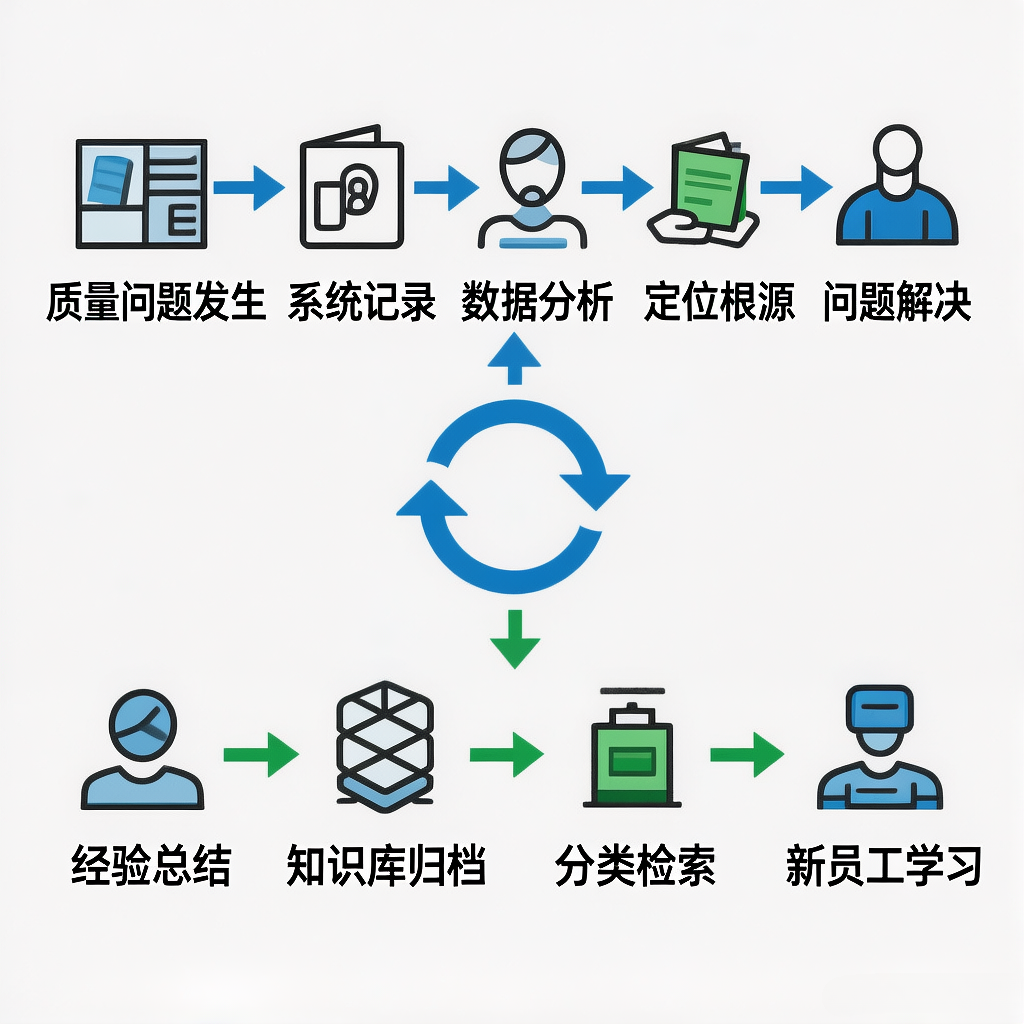
I. Three major pain points in mold factory quality management
Pain Point 1: Difficulty identifying the root cause of problems, leading to interdepartmental blame and conflict.
When quality issues arise, the most common scenario is: the design team blames the manufacturing for incorrect processing, the manufacturing team blames the programming team for programming errors, the programming team blames the material supplier for material issues, and the material supplier claims there are no problems. Departments pass the blame back and forth, ultimately resulting in no resolution, leaving everyone responsible, and achieving nothing.
Why are root causes difficult to identify?
First,No complete process records are available.. When materials were received, who performed the acceptance, and what were the results? When processing began, who performed it, what equipment was used, and what were the process parameters? When heat treatment was performed, what was the temperature curve? When assembly was completed, who performed it, and were there any issues? None of this information was recorded, making it impossible to trace back in case of problems.
Secondly,Data is incomplete and inaccurate.Even with records, they are fragmented, with some existing in Excel, others on paper, and some simply residing in employees' minds. This results in incomplete and inaccurate data, making it impossible to establish a complete chain of evidence.
Once again,Lack of data analysis capabilities"Even with data, there are no tools for analysis. When comparing several sets of molds made from the same batch of materials, it is difficult to manually determine which set is problematic, which is not, and to identify any commonalities or differences.
Ultimately, we could only rely on guesswork, and if we guessed correctly, it was considered luck. If we guessed incorrectly, we would continue to make the same mistake next time. We had a customer who encountered a problem with a mold. They guessed that it was a material issue, so they replaced the material and rebuilt the mold, but the problem persisted. They then guessed that it was a processing issue, so they replaced the processing technician, but the problem still occurred. Finally, they discovered that the problem was due to a design issue, resulting in a loss of tens of thousands of dollars.
Pain Point 2: Corrective measures fail to be implemented, and reports are completed without any follow-up.
Whenever a problem arises, a comprehensive and detailed corrective report is written, outlining numerous measures. However, once the report is completed, it is simply filed away and never followed up on or checked. This means that the same problem is likely to recur, and the same mistakes will be repeated.
Why are corrective measures failing to be implemented?
First,No tracking mechanism.The corrective measures are documented in the report, but there is no tracking of who is responsible, when the tasks are completed, or the quality of the completion. Over time, everyone forgets.
Secondly,Lack of closed-loop managementThe corrective measures were not implemented, and there is no verification of their effectiveness. The measures were implemented, but the results were unsatisfactory, and no one knows why.
Once again,No accountability is assigned.. The corrective measures were not implemented, or were implemented without effect, and no one was held accountable. Regardless, a report was written, and the task was considered complete.
We have a client who has produced hundreds of quality improvement reports, resulting in several thick volumes that accumulate dust in the archives. Despite this extensive documentation, the quality issues remain largely unresolved. The reason is that the reports are written but never reviewed or acted upon. No one knows whether the measures have been implemented effectively or if they are actually having an impact. No matter how well the reports are written, they are useless if they are not executed.
Pain Point 3: Lack of knowledge transfer and experience retention; loss of expertise when employees leave.
The quality expertise of the mold factory is entirely contained within the minds of its experienced employees. This material cannot be processed this way, this structure is prone to problems, the heat treatment from this supplier is unreliable, these process parameters need to be adjusted... The experienced employees know this, but they don't say it, or if they do, no one remembers. When the experienced employees leave, this expertise goes with them, and new employees have to start from scratch and make the same mistakes.
Why is valuable experience not being retained?
First,Lacks a built-in archiving mechanism.. Quality issues have been resolved, and experience has been summarized, but there was no place to record or archive this information. Over time, everyone forgot.
Secondly,No shared platformEven with existing records, they are fragmented and scattered, with some residing on individual computers, others in paper notebooks, and some in WeChat groups. New employees struggle to find a centralized location to learn.
Once again,No incentive mechanism. Experienced employees summarized their experiences and shared their knowledge, but there was no incentive. Ultimately, it was ineffective, and it was better not to say anything.
We have a client, a veteran machinist who had been working for the company for 20 years, who retired. The owner thought he could save a salary by doing so. However, over the next six months, the factory experienced several serious errors, all of which occurred when the veteran machinist was no longer present. The owner calculated that the losses amounted to several hundred thousand, which was more than the machinist's salary over ten years. The owner deeply regretted his decision.
II. The core of quality traceability: Full-process tracking, closed-loop management
Many factories implement quality management by holding meetings, writing reports, and imposing fines. These are merely superficial measures. True, effective quality management focuses on two key elements: leaving a trace.
Who performed the action, when it was performed, what tools were used, what were the results, how were problems addressed, who made the changes, and what were the results. All of this information must be recorded to enable traceability and improvement.
Moges helps customers with quality management, focusing on three key areas:
First, the entire manufacturing process is tracked and documented, with data providing clear evidence.
For every operation, the responsible party, the start and end times, the equipment used, the materials used, the detection results, whether there was rework, the reason for rework, and all system records. When a problem occurs, you can immediately identify which step caused the issue and who is responsible.
How do I actually perform these operations?
Material Traceability:For each batch of materials entering the factory, the system records the batch number, supplier, material report, and test results. The system automatically associates the appropriate mold. If there is a material issue, you can immediately identify which batch of materials is problematic, and determine which molds were used with that batch, allowing for a complete recall.
Processing Traceability:Before each operation, the operator scans a code to record the work order, and the system records the operator, equipment, and start time. After completing the operation, the operator scans again to record the end time and the results of the inspection. If there is a problem with the processing, you can immediately find out who did it, when it was done, and what equipment was used.
Heat Treatment Traceability:Before heat treatment begins, scan and record the heat treatment plant, process parameters, and start time. After heat treatment is complete, scan and record the end time and test results. If there is a problem with heat treatment, you can immediately identify which heat treatment process is problematic, and determine which mold was used for that specific heat treatment.
Assembly Traceability:Before assembly begins, scan and record the assembler and the start time. After assembly is complete, scan and record the end time and the inspection results. If there are assembly issues, you can immediately identify who assembled it and when.
We will no longer experience situations where departments pass the buck. The data is there for everyone to see, so no one can avoid responsibility. We have a customer who experienced a problem with a mold. After checking the system, they discovered that the heat treatment temperature curve was incorrect, and they directly contacted the heat treatment plant to demand compensation, thereby avoiding a loss of tens of thousands of dollars.
Second, the mold testing report structure is standardized, creating a closed-loop process.
Many factory trial run reports consist of just a few photos and a few lines of text, with incomplete information. Two months later, when the report is reviewed again, it is often impossible to understand the original problem.
We require all prototype reports to be structured and filled out within the system:
Problem Categories:Design issues/Manufacturing issues/Material issues/Assembly issues/Other issues. The system automatically tracks and calculates the quantity and proportion of various types of issues, identifying the main issue types.
Problem Description:Provide a detailed description of the problem, including the location of the problem, the size of the problem, and the severity of the problem.
Upload Photos:Upload photos of the problem, from multiple angles and with detailed views, for easier subsequent analysis.
Reasons Analysis:Analyze the root causes of the problem, including both direct and underlying causes. The system provides a list of common causes for easy selection.
Corrective Measures:Develop corrective measures, including short-term and long-term measures. Short-term measures address current issues, while long-term measures prevent recurrence.
Responsible Person:Designate a specific responsible person, and the system will automatically notify that person.
Completion Time:Set the completion deadline for the correction, and the system will automatically count down.
Verification Results:After the correction is completed, verify the correction effect and upload verification photos and data. The system automatically determines whether the process is closed.
The deadline for completion has passed, and the system automatically reminds the responsible person. For those that have not completed the necessary corrections, a red warning is displayed, and there is no way to avoid it. This ensures that every issue is fully resolved and not ignored.
We have a customer who previously experienced approximately 15 quality issues per month. After implementing our system, they now experience only 4-5 issues per month. This is because the system provides comprehensive tracking and closure for each issue, preventing the recurrence of similar problems.
Third, experience is accumulated and stored in a knowledge base, reducing the risk of new employees making mistakes.
All quality issues and solutions are automatically stored in the knowledge base. They are categorized and archived by part type, issue type, and material type, making them easily searchable.
How do I actually perform these operations?
Automatic archiving:After each quality issue is resolved, the system automatically archives it in the knowledge base, including the problem description, root cause analysis, solution, and preventative measures.
Category Management:Organize and manage parts by type (molds, cores, sliders, tapered tops, etc.), problem type (cracks, deformation, out-of-tolerance dimensions, surface defects, etc.), and material type (P20, 718, S136, etc.), for easy searching.
Keywords:Supports keyword search, allowing users to input problem-related keywords, and the system automatically matches similar problems and solutions.
Permissions Management:Configure knowledge base access permissions: Regular employees can view, while technical experts can edit, ensuring the quality and accuracy of the knowledge base.
When encountering similar problems, a quick search reveals how they were previously resolved, eliminating the need to start from scratch. New employees can quickly familiarize themselves with the knowledge base, avoiding the repetition of mistakes made by previous employees.
We have a customer who implemented our system. New employees are required to review the quality knowledge base during their first week, covering common quality issues and their solutions. After the first week, they begin their work, and are instructed to first consult the knowledge base for any issues. If the information is not found, they can then ask their supervisor for assistance. After three months, the new employees are able to independently handle the majority of quality issues, resulting in a two-fold increase in their onboarding speed compared to the previous method.
Three, A real-life case study from one of our clients
In Ningbo, we have a client who manufactures automotive seat molds. Previously, they experienced significant quality issues, and the problems repeatedly occurred. Even after the departure of experienced employees, new employees continued to make the same mistakes. They experienced approximately 10-15 quality issues per month, with a 30% rework rate, an average of 5 prototype iterations, and constant customer complaints.
After implementing the Moges system, they strictly followed our three key recommendations: process traceability, problem closure, and knowledge capture. After one year, the results were very clear:
Effect 1: Reduction in rework rate by 40%
The same issues, the probability of recurrence is significantly reduced. Previously, there were approximately 10-15 quality issues per month, but now there are only 4-5. This is because each issue is documented, analyzed, and has a solution, so the same issues will not recur.
For example, a recurring issue was the cracking of molds, which required rework and resulted in losses of several tens of thousands of yuan each time. After implementing the system, it was found that the cracking issues were primarily concentrated in specific batches of materials and specific heat treatment plants. The system automatically alerted, preventing subsequent cracking issues. Over the course of a year, the savings alone from avoiding rework amounted to over 500,000 yuan.
Effect 2: The number of prototypes reduced by 25%.
Previously, an average of 5 prototype tests were conducted per mold. Now, an average of 3.7 tests are conducted per mold. Each prototype test costs several thousand dollars, resulting in savings of tens of thousands of dollars per year in prototype costs alone.
Why has the number of prototype trials decreased? Because the entire manufacturing process leaves a traceable record, allowing for quick identification and resolution of issues. The prototype report structure enables more accurate problem analysis and more effective corrective measures. Experience is captured in a knowledge base, allowing for quick resolution of similar issues without the need for repeated trial and error.
The client stated: "Previously, prototyping was like gambling; we didn't know if we would succeed or fail. Now, prototyping is like an exam, with a clear standard answer, so we can pass the first time."
Benefit 3: New employees can get up to speed twice as fast.
When new employees join, they should first consult the quality knowledge base. This will help them understand the types of issues that have occurred in the past and how they were resolved. This will allow them to quickly get up to speed without needing to rely on experienced personnel for step-by-step guidance.
Previously, new employees required six months to independently perform their duties. Now, they can independently handle most quality issues within three months. Experienced technicians no longer need to provide one-on-one training; they can focus on technical problem-solving and quality improvement.
The client stated: "Previously, I thought quality management was just a formality, but now I understand that by managing quality effectively, we can save real money and resources."
4. Three practical suggestions for mold factories
Suggestion 1: Do not rely on people's self-discipline; rely on the system and processes.
Everyone has their moments of laziness, and memories are unreliable. Don't expect employees to proactively record and summarize; instead, rely on the system to force them to do so.
How do I implement it?
Mandatory Process:If a record is not filled out for each operation, it is not possible to proceed to the next operation. If the reason for a problem and the corrective measures are not documented, the process cannot be closed.
System notification:The deadline for completion has passed, and the system automatically reminds the responsible person. For those that have not completed the necessary corrections, a red warning is displayed, and there is no way to avoid it.
Access Control:Critical process records must be completed by designated personnel only; others are not permitted to modify them. This ensures the accuracy and completeness of the data.
Focusing on processes rather than people is more effective. We have a customer who initially experienced resistance from employees who found it cumbersome to fill out records. However, the management team insisted on implementing the system, and after three months, the employees adapted and found that not filling out the records actually made them feel less secure.
Suggestion 2: Prioritize solving the 80% of common issues first, rather than striving for perfection.
Mold quality issues: 80% are common, recurring problems. Addressing these issues can reduce quality losses by 80%. Don't start by aiming for Six Sigma or zero defects, as that's unrealistic.
How do I implement it?
Problem Categories:Categorize quality issues by type to identify the most common types of problems.
Prioritize:Prioritize addressing the most common problem types, and develop targeted solutions.
Step-by-step optimization:Solves one type of problem, then moves on to the next, taking a step-by-step approach.
We have a customer who initially faced issues with cracking. After resolving the cracking problem, they then addressed issues with deformation. Finally, they resolved the problem of significantly inaccurate dimensions. As a result, the customer experienced an 80% reduction in quality issues, which is a very significant improvement.
Suggestion 3: Quality is not the responsibility of a single quality control department.
Don't just leave quality issues for the quality control department to handle. Design, manufacturing, assembly, and procurement – each stage has an impact on quality. Every department must have a quality mindset, and each stage must be responsible for its own output.
How do I implement it?
Responsible party:Each stage has a designated quality manager who is responsible for the quality of their output.
Performance Linkage:Link quality data with performance evaluation, rewarding good quality and penalizing poor quality.
The CEO takes the lead:The boss needs to lead by example and prioritize quality, regularly reviewing quality data, participating in quality issue analysis, and driving quality improvement initiatives.
We have a client who holds weekly quality review meetings, where each department reports on quality issues and improvement measures. The owner personally oversees quality, which naturally leads to increased attention from the rest of the team.
V. Key Implementation Points for the Quality Traceability System
Key Point 1: Start with critical processes and gradually expand.
Don't start by requiring the recording of all processes at once, as this would create an overwhelming workload for employees. Begin with key processes and gradually expand.
Key processes include:
Material acceptance: Material quality directly affects mold quality, and must be recorded.
Rough Processing: The quality of rough processing directly impacts subsequent finishing, and must be recorded.
Heat Treatment: The quality of heat treatment directly affects mold lifespan, and it must be recorded.
Refinement: The quality of refinement directly affects mold accuracy, and must be recorded.
Prototype: The prototype is a crucial stage for verifying mold quality and must be documented.
Once key processes are properly recorded, we can gradually expand this to include other processes. We have a customer who initially recorded only key processes, and then expanded to all processes three months later. The employees adapted well and there was no resistance.
Key Point 2: Simplify operations and reduce data entry burden.
The system should be easy to operate and use, with convenient and quick data entry, and should not place an excessive burden on employees.
How do I implement it?
Scan to enter:Replace manual data entry with barcode scanning to improve data entry efficiency.
Option Selection:Replace manual data entry with selectable options to minimize errors.
Template filling:Use templates instead of free-form input to improve data quality.
Mobile Support:Supports data entry from mobile devices such as smartphones and tablets, facilitating on-site operations.
We have a customer who initially found the data entry process cumbersome. However, after we optimized the system, allowing for scanning and easy input, employees found it very convenient and are now actively using it.
Point 3: Data Visualization: Make quality immediately apparent.
Quality data needs to be visualized, allowing managers, supervisors, and employees to easily see the quality status.
How do I implement it?
Quality Dashboard:Set up quality dashboards in the workshop to display real-time quality issues, improvement progress, and quality indicators.
Report Analysis:Generate quality reports on a regular basis, analyzing quality issue trends, main causes, and improvement effects.
Warning:Issues such as exceeding quality standards and delayed corrective actions are automatically flagged and alerted.
We have a customer who has installed large-screen quality dashboards in their workshops. Employees can immediately see the quality status upon entering the workshop. High-performing teams receive rewards, while teams with poor quality performance face pressure, leading to a greater emphasis on quality across the board.
Conclusion: Quality is the best advertisement.
The mold industry is a close-knit community where reputation is paramount. Word-of-mouth spreads quickly, and everyone knows which manufacturers have a good reputation and which have a history of problems.
A reputable factory with increasing customer demand can also increase prices. A complete solution from Moges is quoted at 300,000, but you quote 350,000, and customers are still willing to choose you because your quality, delivery, and after-sales service are guaranteed.
For manufacturers with poor quality, the only option is to offer low prices and compete for orders, resulting in increasingly thin profit margins and a vicious cycle. A complete solution from Moges costs 300,000, but if you offer it for 250,000, the customer still won't choose you because they don't trust your quality, delivery, or after-sales service.
Maintaining quality is the best marketing strategy. A factory with good quality doesn't need to search for customers; customers actively seek them out. A factory with poor quality has to search for customers, and even then, customers are hesitant to come.
Remember, quality management is not a cost, but an investment. By implementing effective quality management, you will save significant amounts of money and build a strong, lasting reputation.