Left side for mold making, right side for machining – can one system manage both modes simultaneously? | Moges' Dual-Mode Architecture in Practice
2026-04-23 12:19:13
Introduction: Two Worlds, One Factory
In 2023, at a precision machining factory located in the Wuxi Hui Shan Economic Development Zone, the production manager, Mr. Zhou, was facing a challenge that kept him up at night. The factory had a unique layout: on the left was the mold manufacturing area, with a neatly arranged area for mold making, including a workbench, a prototype machine, and a spark generator; on the right was the machining area, with a row of CNC machining centers and CNC lathes operating continuously.
On the surface, this is a typical mold+machining hybrid manufacturing facility, but in reality, Old Zhou is constantly switching between two completely different management worlds every day, which is exhausting.
On the mold side, we use a typical project-based management approach.Each mold project is a standalone undertaking, encompassing everything from customer needs analysis, 3D design, 2D drawings, programming, machining, assembly, and prototyping to final delivery. The entire process typically takes 1-3 months. Design changes are common; customers may request modifications to dimensions or materials on a daily basis, requiring constant adjustments to the manufacturing process. A key focus of management is tracking project progress to ensure that each milestone is completed on time, ultimately ensuring timely mold delivery.
Regarding machining, the standard production model is batch production.For the next customer order, this could involve 500, 1000, or even tens of thousands of parts. The manufacturing process is fixed and repetitive. The key focus of management is on maximizing production capacity and ensuring continuous operation of equipment through optimal scheduling. This also includes on-time delivery management to guarantee timely fulfillment of orders, cost control to calculate the processing cost for each part, and quality control to ensure that the yield meets customer requirements.
Two distinct business models, two completely different management logics, and two entirely different evaluation systems. Logically, they should operate independently, with no interference. However, the issue arises with the information systems.
Initially, the company implemented a general ERP system to save costs, aiming to manage both the mold and machining departments with a single system. However, the results were as expected: the mold department complained that the system was too rigid, requiring three days of approval for even minor changes, making it impossible to keep up with project timelines. Workers also found the system too cumbersome and preferred to revert to paper-based processes. The machining department could use the system, but the data was incomplete, and the resulting reports were unusable.
Unfortunately, the company invested heavily in a dedicated mold MES system. As a result, we now have two systems running in parallel, and the problems have not only persisted but have also doubled.
When a mold design is completed and the parts drawings are transferred to machining production, it is necessary to rebuild materials, create a BOM, and define the production process within the ERP system. This involves repeatedly entering data, which is not only time-consuming but also prone to errors. For example, the same worker might produce mold parts one day and machining components the next, requiring separate work orders in two different systems. These systems have different operating logics, interfaces, and processes, leading to frequent errors and miscommunication. Furthermore, when the finance department needs to calculate the costs at the end of the month, they must manually export data from both systems and combine them for calculation. This process can take several days and often results in inaccurate results. When the boss asks about the financial performance, the finance department is also unable to provide a clear answer.
Old Zhou sighed: 'Other companies can't even manage their existing systems, let alone two. Our two systems have actually doubled the problems. Every day, half of my time is spent dealing with system issues, which means I have less time to actually manage production.'
These challenges are not isolated to a single factory like Mr. Zhou's. According to industry statistics, over 60% of precision machining factories in the Yangtze River Delta operate a mixed mold+machining model. Among the over 200 Moges customers, more than 60% face the same difficulties. Today, we will delve into: What are the specific management challenges for factories operating a mixed mold+machining model? Can a single system truly manage both completely different production modes?
I. The Three Core Pain Points of Mixed-Mode Factories
Pain Point 1: Two separate systems, leading to data silos and significant duplication of effort.
This is the most common and frustrating problem for mixed-mode factories. For example, like the factory owned by Mr. Zhou, they use one MES for molding and a separate ERP system for machining. These two systems are completely independent, and data cannot be shared between them.
Specific examples include:
Data Duplication:When parts designed for molds are transitioned to machining production, it's necessary to re-establish material records, BOM lists, and process routes within the ERP system. This requires duplicating the same data, which is not only a waste of manpower but also increases the risk of errors.
Information transmission delay:After the mold is changed, manual notification to the machining department is required, followed by modification of related data in the ERP system. This process is slow and prone to errors.
Data inconsistency:Data from the two systems may be inconsistent, for example, inventory quantities and standard working hours, leading to management confusion.
Low collaboration efficiency:The mold and machining departments require frequent communication and coordination, but lack a unified information platform, resulting in high communication costs.
Pain Point 2: Complex employee operations, high learning costs, and frequent errors.
The same worker may perform mold part production today and mass production of machined parts tomorrow, requiring operation in two completely different systems.
Problems Arising:
Different operational logic:The mold system operates based on a project workflow, while the machine processing system operates based on a work order workflow. The logic for both systems is completely different.
Significant interface differences:The user interfaces, menu structures, and functional layouts of the two systems are completely different, requiring employees to learn and remember two different operating methods.
Different methods for submitting invoices:When creating mold orders, it may be necessary to fill in information such as project progress and reasons for changes. For machine processing orders, only scanning the work order QR code is required, which can easily lead to confusion.
High error rate:Employees frequently mix up which system to use, and errors such as incorrect work orders and data entry are common. The monthly error rate is as high as 15-20%.
This not only increases the learning burden on employees and reduces their work efficiency, but also leads to frequent errors, causing employees to develop a negative attitude towards the system, further impacting the effectiveness of the system.
Pain Point 3: Difficulty in cost accounting, lack of clear profit margins, and decisions based on insufficient data.
This is the issue that the CEO cares about most and finds most challenging. How to calculate mold costs? How to calculate machining costs? Each system calculates these costs separately, and how to ultimately integrate them?
Specific Challenges:
Difficulty in cost allocation:Developing a mold involves significant research and development costs and subsequent production costs. What is the appropriate method for amortizing the mold cost, considering the three years of production parts provided to the customer?
Profit calculation is unclear:Is the mold business profitable or a loss? Is the machining business profitable or a loss? Is the overall business profitable or a loss? The owner cannot determine this.
Unclear Return on Investment:A mold was invested in for 500,000, and after three years of mass production, 1,000,000 was earned. What is the return on investment? It is impossible to calculate accurately.
Lack of decision-making basis:Unable to determine which business areas are profitable and which are losing money, making it impossible to make informed business adjustments.
According to industry surveys, over 70% of mixed-mode factories are unable to accurately calculate the profits of each business segment, leading to inefficient resource allocation and hindering the long-term development of the enterprise.
Two. Moges Dual-Mode Architecture: A single system, two modes, seamless switching.
It was through a deep understanding of the pain points associated with mixed-mode factories that the Moges team dedicated three years and significant R&D resources to ultimately launch the industry's first dual-mode architecture solution. What is the dual-mode architecture? Simply put, it integrates both mold project management and batch production modes within a single system. The two modes are fully interoperable, allowing for seamless switching and completely eliminating the need to maintain two separate systems in parallel.
Core Feature 1: Seamlessly switch between two management modes for a single part.
The most core innovation of the dual-mode architecture lies in the ability to freely choose a management mode for the same part, depending on the specific needs.
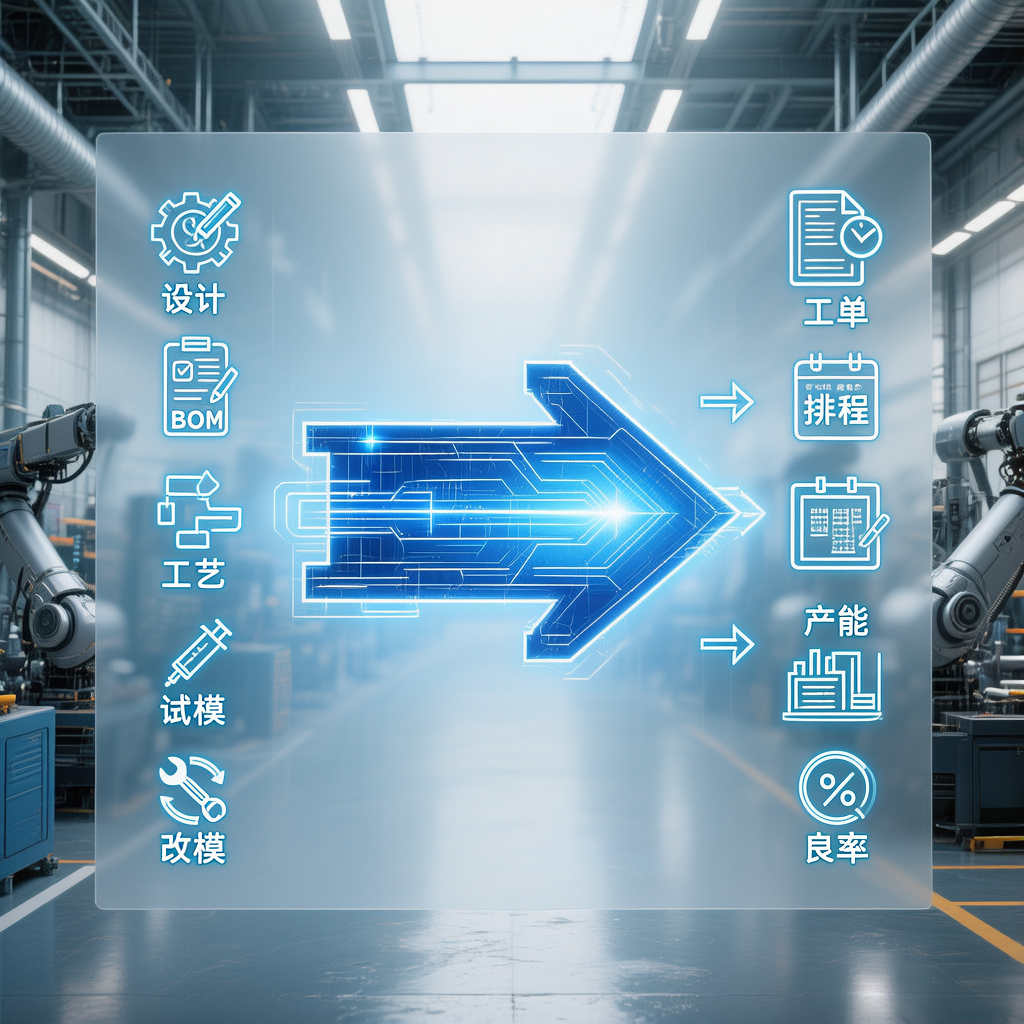
Mold Mode:When parts are used for mold manufacturing, the system automatically switches to project-based management mode. Covering the entire process from design, BOM, processes, programming, machining, assembly, mold testing, and delivery, it supports flexible and variable management. The process route can be adjusted at any time, fully meeting the management characteristics of mold projects.
Machining Mode:When parts enter batch production, the system automatically switches to batch production mode. It automatically generates work orders, performs capacity scheduling, tracks production progress, and calculates yield and costs, fully meeting the requirements for managing batch production.
Seamless Switching:Once the mold is complete, when transitioning to mass production, simply click the "Transition to Mass Production" button, and the system will automatically convert the mold data into machine processing data. Materials, BOM, and process routes will be automatically transferred, eliminating the need for manual re-entry. When making changes, the system automatically synchronizes and updates the data on both sides, ensuring data consistency.
This design completely solves the problems of data duplication and information silos, reducing data entry workload by more than 80%.
Core Two: Unified Work Order Entry, Simple and Consistent Operation
The second core innovation of the dual-mode architecture is the unified design of the work order system.
Single Entry Point:Whether it's for mold parts or machining parts, workers use the same entry point and the same operation interface. Workers simply scan the QR code on the part, and the system automatically identifies whether it's a mold project or a machining work order, and automatically assigns it to the corresponding project or work order.
Consistent Operation:The work order process is completely consistent, involving scanning a code, selecting the operation, entering the quantity, and submitting. This eliminates the need for workers to learn two different operating logics, significantly reducing training costs.
Intelligent Recognition:The system automatically determines which project or work order to assign parts to based on the management mode, automatically calculates data such as working hours and costs, and requires no manual intervention.
This design has reduced the error rate in work order processing from the original 20% to below 1%, resulting in a significant increase in employee satisfaction.
Core Feature 3: Unified Reporting, Automatic Cost Allocation, and Clear Profit Visibility
The third core innovation of the dual-mode architecture is the unified design of the financial accounting system.
Data originates from a single source:All data originates from a single system, ensuring data consistency and accuracy, and completely resolves the issue of data discrepancies between two systems.
Automatic data collection:The system automatically allocates mold costs and machining costs separately. It also supports the amortization calculation of mold costs for parts produced, accurately calculating the profit for each business segment.
Unified Reporting:The owner wants to see overall data. The system automatically generates unified reports, showing the output, cost, and profit for each mold, as well as the output, cost, and profit for machine processing. Detailed data can also be viewed by drilling down into the details of each project and each work order.
Return on Investment Analysis:The system can automatically calculate the return on investment (ROI) for each mold, including mold development costs, production revenue, and investment return cycle, providing scientific basis for the boss's decision-making.
This design improves cost accounting accuracy from less than 50% to over 95%, allowing the owner to finally understand where profits are being made and where losses are occurring.
Three, Customer Case: Real changes after the dual-mode architecture has been live for six months.
Suzhou Precision Manufacturing Co. Ltd. is a typical customer of Moges' dual-architecture solution. This factory, with over 60 employees, operates in two areas: mold making and machining. Previously, they were running two separate systems, which resulted in numerous problems.
In the first half of 2024, they decisively decided to replace their two outdated systems and fully implement the Moges dual-mode architecture. Six months later, the results are impressive:
Change 1: Significantly improved data management efficiency
Previously, after completing a mold, the data needed to be re-entered in the ERP system, requiring participation from the design, engineering, and finance departments. This process typically took 2-3 days. Now, with a single click, the data is automatically transferred, and the entire process takes only a few minutes. The workload for data entry has been reduced by 80%, allowing design engineers to dedicate more time to design innovation instead of repetitive data entry.
Change Two: Significant improvement in the accuracy of production reporting.
Previously, two separate systems were used for reporting, which often led to errors and confusion. This resulted in significant time spent by the finance department on data verification and correction each month. Now, with a unified platform and standardized operations, errors are almost eliminated. The error rate in reporting has decreased from 20% to below 1%, and the time required for reconciliation has been reduced from 3 days to 1 hour, significantly improving work efficiency.
Change Three: Clear Cost Accounting, Decisions Based on Data
Previously, the two systems operated independently, and the combined figures were always inaccurate. When the owner inquired, the finance department was also unable to provide a clear explanation. Now, with a single system, data is sourced from a single source, and costs are automatically allocated. This allows for a clear understanding of which business areas are profitable and which are not. The owner can finally understand the true source of the company's profits and make more informed business adjustment decisions. The accuracy of cost accounting has increased from less than 50% to over 95%.
Change Four: Improved Employee Satisfaction
Previously, employees had to learn two different systems, leading to many complaints. Now, they only need to learn one system, which is simpler and more consistent, resulting in a reduction of over 50% in learning costs. Employee resistance to the system has been significantly reduced, and their active use has increased significantly.
The client expressed his feelings: "If I had known about this system earlier, I wouldn't have wasted money buying two separate systems. One system solves two problems, saving both money and time. Now I can clearly see the profit margins for each business, which gives me more confidence in making decisions."
IV. Suitable Scenarios and Factory Types for Dual-Mode Architecture
While a dual-mode architecture is powerful, it is not suitable for all factories. According to Moges' years of implementation experience, a dual-mode architecture is primarily suitable for the following three types of factories:
Type 1: A factory with integrated mold and injection molding.
The key characteristics of these factories are: first, create the mold; then, use their own injection molding machines to produce injection molding in large quantities based on the completed mold. This approach utilizes a typical project-based management system for mold creation and standard batch production management for injection molding. The dual-mode architecture perfectly fits this business model. Once the mold is completed, it can be seamlessly transitioned to injection molding, with data automatically transferred, and costs are automatically amortized, providing clear return on investment.
Suitable for factories with 30-200 employees and an annual turnover of 10 million - 100 million.
Type 2: Precision Manufacturing Facilities
These types of factories have the following characteristics: they handle both the machining of mold parts (project-based) and the machining of parts for mass production (batch production). These two types of work are interleaved; the same workshop, the same equipment, and the same workers are used to produce mold parts one day and mass production parts the next. The unified work order entry and intelligent recognition features of the dual-mode architecture are particularly well-suited for this business model, significantly reducing operational complexity.
Suitable for factories with 20-150 employees and an annual turnover of 5 million - 80 million.
Type Three: Mold factories with in-house developed products.
The characteristics of these factories are: after several years of working as mold manufacturers, they began to develop their own products, transitioning from pure manufacturing to independent brands. The product development phase uses project management, while the product mass production phase uses batch production management. The dual-mode architecture supports a smooth transition from project management to batch production, making it particularly suitable for this transition process.
Suitable for factories with 50-300 employees and an annual turnover of 20 million - 200 million.
If your factory falls into any of the three categories above, and you are struggling with issues related to two separate systems or a single, cumbersome system, we strongly recommend trying Moges' dual-mode architecture. It could open new doors for you and significantly improve your management efficiency.
V. Technical Advantages and Implementation Guarantees of the Dual-Mode Architecture
Technical Advantage 1: 14 years of industry experience and expertise.
More than half of the Moges team members have experience in the mold industry, and possess a deep understanding of the operations of mold factories and machining shops. The dual-mode architecture is not a product developed in isolation, but rather the result of 14 years of continuous iteration and optimization based on the real needs of over 200 customers.
Technical Advantage 2: Flexible and Configurable
The dual-mode architecture supports highly flexible configuration, allowing users to adjust management modes, process nodes, and report formats according to the specific needs of each factory, ensuring that the system perfectly fits the unique business model of each factory.
Technical Advantage 3: Mobile Support
The system supports mobile devices such as smartphones and tablets, allowing workers to submit work orders on-site in the workshop at any time. Management personnel can also view production progress at any time and from any location, significantly improving the convenience and real-time nature of management.
Implementation Guarantee 1: Professional Implementation Team
Moges boasts a professional implementation team with an average of over 8 years of industry experience, enabling them to quickly understand customer needs and develop appropriate implementation plans, ensuring smooth project launches.
Implementation Assurance 2: Standardized Implementation Process
Moges employs standardized implementation processes, including needs assessment, solution design, system configuration, data import, training and go-live, and continuous optimization, to ensure that each project is delivered with high quality.
Implementation Guarantee 3: Continuous Technical Support
After system deployment, Moges provides ongoing technical support services, including system maintenance, troubleshooting, and feature optimization, to ensure the system's long-term stable operation.
Conclusion: Understanding the industry is essential for creating truly effective products that solve real-world problems.
In the software industry, technical expertise is undoubtedly important, but a deeper understanding of the industry is even more crucial. Many software companies possess strong technical capabilities and advanced architectures, but their products are often unusable. This is because they lack a fundamental understanding of the industry.
They don't know how mold factories operate, they don't know the pain points of mixed-mode factories, and they don't know how frontline workers actually work. Building a product in isolation without understanding the industry's realities makes it impossible to create a truly useful product.
Moges has 14 years of experience in providing IT solutions for the mold industry. More than half of our team has a background in the mold industry, and we understand the specific needs and challenges of this industry. Our dual-mode architecture is not a product of our office; it originated from customer feedback and was developed through direct interaction with customers on-site. It is the result of the accumulated needs of hundreds of customers.
We understand that a good system not only needs to be technologically advanced, but also needs to be tailored to the specific needs of our customers and truly solve their pain points. The dual-mode architecture is precisely such a product. It not only solves the management challenges of mixed-mode factories, but also enhances the overall level of digitalization in the industry.
Remember, when choosing an information system, it's not just about selecting a technically advanced solution; it's also crucial to choose a system that understands the industry. Only a system that understands the industry can create truly effective products that solve real-world problems.