Mold Shops Keep Growing While Profits Shrink? For Small and Mid-Sized Mold Manufacturers, the Way Out Is Not Scale—It's Specialization | Moges Industry Insights
2026-04-23 12:19:14
Introduction: Mr. Wu's Dilemma in Huangyan, Taizhou
Huangyan in Taizhou, Zhejiang, is known as the mold-making capital of China—plastics mold shops are everywhere. Mr. Wu runs one of them, and he has been at it for nearly 20 years.
Back in 2015, his shop had only 5 people, generating annual output value of RMB 3,000,000 with a net profit of RMB 600,000—a 20% profit margin. It was small, but life was comfortable. The owner didn't have to watch over everything every day; customers came through personal referrals, orders were never a worry, profits were solid, and cash flow was healthy.
By 2023, the shop had grown to 50 people, with output value reaching RMB 15,000,000—a 5-fold increase. But when the year-end numbers came in, net profit was only RMB 900,000, a 6% margin. Headcount grew 10 times, output value grew 5 times, yet profit rose only 50%, and the margin dropped from 20% to 6%.
Mr. Wu was puzzled: "The shop keeps getting bigger and I keep getting busier—so why am I making less and less money? What on earth is going on?"
Mr. Wu is not alone in this confusion—thousands of small and mid-sized mold shop owners share it. It seems that in the mold business, once you reach a certain size you hit a ceiling: grow beyond it, and profits fall instead of rising.
Today, let's talk about exactly this: where is the way out for small and mid-sized mold manufacturers?
1. Why Bigger Often Means Less Profitable: Three Fatal Reasons
Many owners know this story well: when the shop was small, profits were decent; after scaling up, it became less and less profitable. Why?
Reason 1: Management Costs Rise Exponentially
In a 5-person shop, management costs are nearly zero.
The owner is the manager—keeping an eye on things is enough. Everyone is a multi-skilled generalist; whoever is free pitches in, and efficiency is high. A shout solves a problem: no meetings, no procedures, no finger-pointing. Communication costs are low, coordination costs are low, and internal friction is low.
In a 50-person factory, management costs rise exponentially.
You need supervisors, QC staff, designers, programmers, buyers, accountants, admin staff. Managers and support roles alone take up a dozen or more people—none of them generate output value directly, yet their wages must be paid and their social insurance covered, so management costs jump overnight.
More importantly, as headcount grows, the invisible costs—communication, coordination, and internal friction—rise exponentially.
In concrete terms:
Communication costs: With 5 people, a shout solves the problem; with 50, you need meetings, procedures, and back-and-forth, and a single issue can take half a day to sort out.
Coordination costs: With 5 people, whoever is free helps; with 50, you need division of labor, collaboration, and coordination—and if one link gets stuck, the whole process stalls.
Internal friction: With 5 people, everyone pulls together; with 50, silos go up, people pass the buck and squabble, and internal friction becomes severe.
Supervision costs: With 5 people, the owner's watchful eye is enough; with 50, you need oversight mechanisms, performance reviews, rewards and penalties—management costs keep climbing.
As management costs rise exponentially, profits naturally shrink. The bigger the scale, the harder the management, the thinner the margins.
Reason 2: Price Wars—Scale Goes Up, Prices Go Down
When the shop is small, order sources are relatively simple and prices are relatively fair.
Orders come through referrals; customers trust you, prices are fair, and margins are healthy. No need to compete on price or sacrifice profit for volume.
Once you scale up, order sources diversify and prices get squeezed hard.
Capacity grows, orders fall short, so you go after big customers. But big customers' money is hard to earn: they buy in volume, bargain hard, push prices down, and impose harsh payment terms—90-day or even 180-day monthly settlement is the norm. If you won't take it, plenty of others will.
In concrete terms:
Falling unit prices: To win big customers' orders, prices get pushed down hard—gross margins fall from 30% to 20%, even 15%.
Longer payment cycles: Big customers impose harsh payment terms—90-day or 180-day monthly settlement is the norm—and cash flow pressure builds.
Higher risk: If a big customer runs into trouble—bankruptcy, overdue payments—the factory faces enormous risk.
Thinner profits: Output value looks higher, but unit prices, gross margins, and payment cycles all move the wrong way, and actual profit declines instead.
The net result: output value looks up, but unit prices and gross margins are down, payment cycles are longer, cash flow pressure is greater, and risk is higher. It looks busy and lively, but what you're really earning is hard-earned scrapings—and done badly, you can even lose money.
Reason 3: Spreading Too Thin—Taking Every Order and Doing Nothing Well
When the shop is small, it knows its own limits and only takes orders it is good at.
Quality is assured, delivery is assured, and customers are satisfied. It doesn't take on work outside its strengths, doesn't take low-margin jobs, doesn't take high-risk jobs. Fewer orders, perhaps, but every order makes money and every customer is happy.
Once you scale up, to keep machines running and workers busy, you take every order that comes.
Auto molds, appliance molds, consumer-goods molds—you promise everything at order intake, then discover mid-production that you can't handle much of it. Quality suffers, deliveries slip, you keep going even at a loss, and in the end your reputation takes the hit.
In concrete terms:
Inconsistent quality: Making every kind of mold with no focus area means unstable quality and high defect rates.
Missed deadlines: Molds outside your expertise take longer to build, deadlines slip repeatedly, and customers grow dissatisfied.
Hard cost control: Making everything means a huge variety of materials, high procurement costs, and serious inventory build-up.
Damaged reputation: Unstable quality and late deliveries leave customers unhappy, and your reputation keeps eroding.
Try to do everything, and in the end you do nothing with excellence and nothing well. More orders mean more problems and lower profits.
2. The Way Out for Small and Mid-Sized Mold Shops: Not Scale, but Specialization
Many owners labor under a misconception: the bigger the factory, the stronger it is; the more employees, the more successful. In reality, for small and mid-sized mold shops, blind expansion is often a dead end.
The nature of the mold industry dictates that this is not a business won by scale. Molds are custom products, not standardized ones, and economies of scale rarely cut costs here. On the contrary: the bigger the operation, the harder the management, the higher the risk, and the thinner the margins.
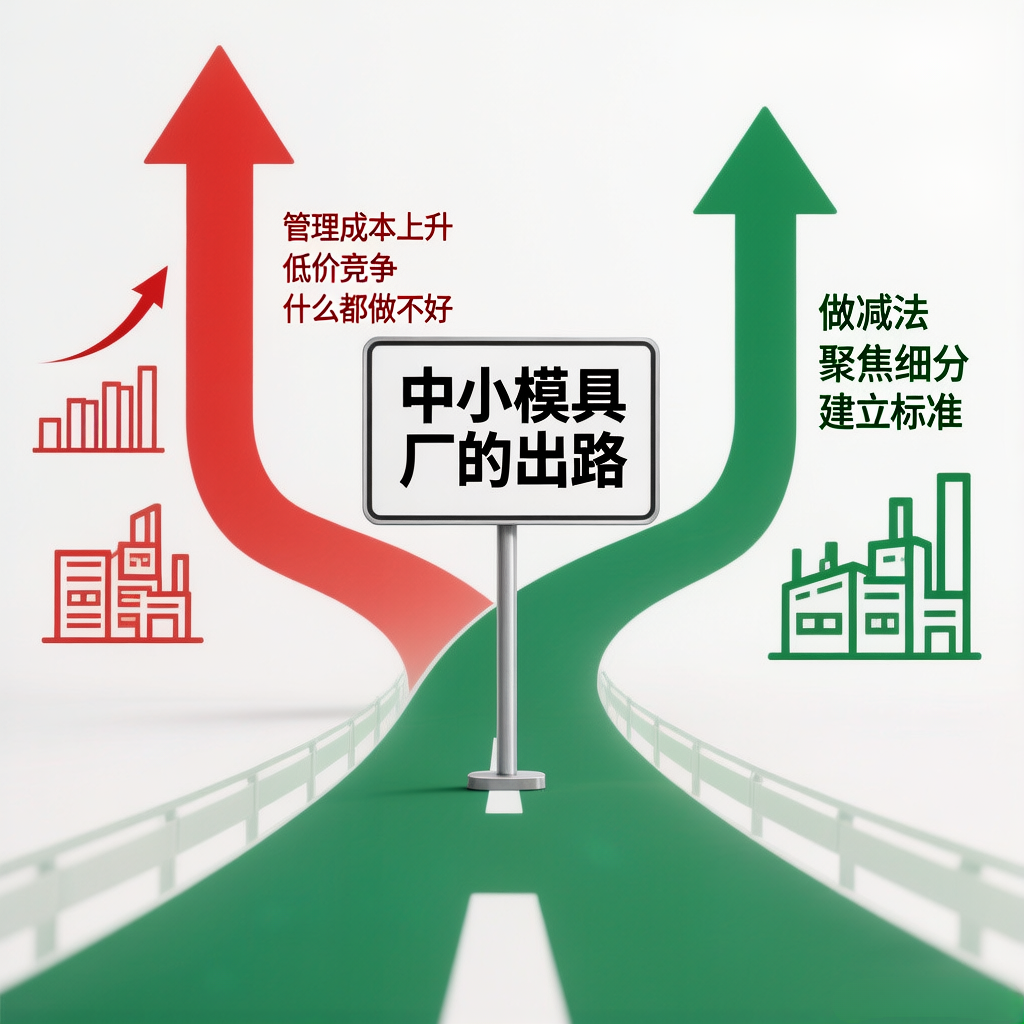
For small and mid-sized mold shops, the way out is not to get bigger—it is to get specialized.
What Does Specialization Mean?
Specialization means making only one category of mold and doing it to perfection—becoming one of the top two or three in the industry for that category. Whenever anyone mentions that type of mold, you are the first name that comes to mind.
One of our customers in Ningbo runs a 30-person shop that makes nothing but plastic molds for medical devices. Nothing else—just this one category.
Because they specialize, they hold three major advantages:
Technical advantage: They understand the requirements, standards, and processes of medical-device molds thoroughly, execute exceptionally well, and deliver highly stable quality with defect rates far below their peers'.
Efficiency advantage: A mold that takes competitors 45 days, they deliver in 30—a 33% efficiency gain—and they can still charge 10% more than their peers.
Reputation advantage: Customers rate them so highly that they come knocking on their own—no sales staff hunting for business, no price wars.
They generate annual output value of RMB 12,000,000 with net profit of over RMB 3,000,000—a margin above 25%—out-earning many factories with hundreds of employees, while the owner enjoys an easier life.
That is the power of specialization.
3. Three Benefits of Specializing
Benefit 1: Build a Technical Moat and Escape the Price War
Which molds are hardest to make? Not the most complex ones—the ones you have built a hundred times. Make something once and make it a hundred times, and your depth of understanding is completely different, and so is the quality you deliver.
Focus on one category of mold for three to five years and a few hundred sets, and your understanding of it is something catch-all factories simply cannot match. You know exactly where problems tend to arise, what can be optimized, and where costs can be cut.
In concrete terms:
Technical depth: A deeper grasp of the category lets you solve problems others cannot.
Quality advantage: More stable quality and lower defect rates mean happier customers.
Efficiency advantage: Higher efficiency, shorter lead times, lower costs.
Pricing advantage: You can charge more, and customers are still willing to give you the work.
That is the technical moat. On the same order, you deliver better quality in less time and still charge more, and customers still choose you. Competitors can't steal your orders, and you never have to fight a price war.
Benefit 2: Raise Efficiency and Cut Costs
Build the same molds often enough, and much of the work can be standardized: standard libraries for design, templates for programming, standards for processes, fixed suppliers for procurement—even mold trials follow a standard workflow.
In concrete terms:
Standardized design: Designing a mold used to take 7 days; now it's done in 3—a 57% efficiency gain.
Standardized programming: Programming used to take 5 days; now it's done in 2—a 60% efficiency gain.
Standardized machining: Machining used to take 15 days; now it's finished in 10—a 33% efficiency gain.
Consolidated purchasing: The same steel costs one price at 100 tons a year and another at 10 tons. Stronger bargaining power with suppliers cuts procurement costs by 10%-20%.
Standardization drives efficiency. As efficiency climbs, costs naturally fall, and the margin widens.
Benefit 3: Reputation Brings Customers—Sales Costs Near Zero
Excel in a niche and word spreads fast. The mold industry is a small world: word of mouth about who does what well travels quickly, and soon the whole industry knows.
Customers come to you on their own—no daily sales chasing, no trailing after clients begging for orders, no wining and dining. Sales costs are nearly zero, and the owner's life is easier.
Our medical-device mold customer hasn't hired a single salesperson in three years; every new customer comes from an existing one. Orders are booked six months out, and they can afford to be selective—turning away orders with poor margins.
That is the benefit of specialization.
4. How to Specialize: A Practical Three-Step Guide
Everyone knows the theory—but how do you actually do it? Here is a simple, practical three-step method.
Step 1: Subtract—Cut the Business You're Not Good At
Many owners can't bear to let go—every order looks like money, and cutting any feels wasteful. But nothing ventured, nothing gained: unless you cut the unprofitable, off-strength, attention-draining business, you'll never have the bandwidth to perfect what you're actually good at.
How to do it:
Audit your orders: Take a hard look at the orders from the past two years and rank them by customer, mold type, and profit margin.
Spot the problems: Identify the orders with the lowest margins, the most headaches, and the least fit with your strengths.
Phase them out: Wind these orders down gradually rather than all at once, giving customers a transition period.
What if orders shrink? No matter—do fewer orders, do them well and do them precisely, and profits actually rise. Less is more.
Step 2: Focus—Go Deep in One Niche
Once you've cut what you're not good at, pour all your energy and resources into the niche where you are strongest and most profitable.
How to do it:
Pick your niche: Based on the audit in Step 1, decide the niche you will focus on.
Commit resources: Put all your energy and resources into that niche.
Go deep: Master this mold category completely—perfect the processes, maximize quality, minimize lead times, and deliver the best service.
Don't fear a small market. China is vast and the mold market is huge; in even the smallest niche, ranking among the top few brings more orders than you can handle—plenty to keep you well fed.
Step 3: Accumulate—Build Your Own Standards System
Specializing in one mold category means gradually building your own standards system: design standards, programming standards, process standards, inspection standards, mold-trial standards, mold-modification standards—your own standards in every aspect.
How to do it:
Design standards: Build a design standards library, including standard component, standard structure, and standard process libraries.
Programming standards: Build programming templates, including tool libraries, machining parameter libraries, and process route libraries.
Process standards: Establish process standards covering machining, assembly, and mold trials.
Inspection standards: Establish inspection standards covering incoming materials, in-process checks, and finished products.
Mold-trial standards: Establish mold-trial standards covering trial workflows, trial parameters, and trial reports.
Once standards are in place, dependence on individuals shrinks. New hires following the standards rarely make serious mistakes. Quality stabilizes, efficiency rises, and costs fall.
Standards are a factory's core competitive advantage—the one thing competitors cannot copy.
5. Specializing Doesn't Mean Staying Small—It Means High-Quality Growth
Many owners will ask: if I only do this little bit of business, how does the factory grow? The truth is that specialization doesn't mean staying small or refusing to grow—it means growing with quality.
What Is High-Quality Growth?
Specialize in one mold category and perfect it, and customers and orders will naturally multiply and scale will follow. But this is quality growth, profitable growth, healthy growth—not the hollow prosperity bought through price wars and sacrificed margins.
Why Does High-Quality Growth Matter More?
First, stronger resilience.
With a moat in your niche, competition struggles to touch you; you live comfortably and weather storms well. In good times you out-earn your peers; in bad times you outlast them.
Second, thicker margins.
With a technical moat and reputation advantage, you can charge more and enjoy higher margins. On the same RMB 10,000,000 of output value, a competitor at a 10% margin earns RMB 1,000,000 while you at 25% earn RMB 2,500,000—2.5 times as much.
Third, an easier life for the owner.
Orders arrive on their own—no daily sales hunting. Management is simpler—no constant watching. Cash flow is healthy—no daily worry about money. The owner's life is easier and its quality higher.
Success Story: A Cap Mold Specialist
One of our customers has specialized in cap molds for over a decade and ranks among China's top three. Today they generate annual output value of over RMB 200,000,000 with profits running into the hundreds of millions of yuan—living far better than many big mold shops that make everything.
It's not that they stayed small—they specialized first and grew later, building the moat before expanding. Only growth built that way is solid and sustainable.
6. Moges' Take: Small and Excellent Beats Big but Weak
After 14 years of mold MES and more than 200 customers served, we have seen plenty of factories rise and fall.
The Factories That Last and Thrive Are Rarely the Biggest—They're the Most Specialized
Cultivating their own small patch of land with care, doing it better than anyone, they live more comfortably than anyone. They chase neither scale nor output value—only profit, only quality, only reputation.
It's the blindly expanding, do-everything factories that look huge and bustling—yet the moment the industry wobbles or risk appears, they are the first to fall.
The Current Environment Is No Time to Expand
The economy is slowing, competition is fierce, costs are rising, demand is weak. In today's environment, expansion is a bad bet. Steady, slow, and focused: thicken your margins, manage your cash flow, build your core competitiveness—nothing matters more.
Small and Excellent Beats Big but Weak
A small-but-excellent factory—margins above 20%, healthy cash flow, a relaxed owner, stable staff, satisfied customers—lives better and longer than a big-but-weak one.
Don't envy how big others are or how high their output value. Tend your own patch well, hone your craft, run your management well, lift your profits, and hold cash in hand—nothing beats that.
7. Five Recommendations for Mold Shop Owners
Recommendation 1: Re-examine Your Business Mix
Audit your orders from the past two years, rank them by profit margin, identify the unprofitable and most troublesome ones, and consider phasing them out. Concentrate your energy on the most profitable business you're best at.
Recommendation 2: Pick One Niche and Go Deep
Don't do everything. Choose the niche where you are strongest and most advantaged, pour all your energy and resources into it, and pursue it to perfection—until you rank among the top two or three in the industry.
Recommendation 3: Build Your Own Standards System
Specializing in one mold category means gradually accumulating your own standards system: design, programming, process, inspection—your own standards in every aspect. Standards are your core competitiveness.
Recommendation 4: Prioritize Cash Flow; Don't Expand Blindly
In today's environment, cash flow matters more than profit. Don't expand for expansion's sake or chase scale for its own sake. Steady and slow, with cash flow well managed—nothing matters more.
Recommendation 5: Go Digital to Lift Efficiency
Specializing in a niche calls for digital tools to raise efficiency. Moges has spent 14 years building mold MES specifically to help small and mid-sized mold shops raise efficiency and cut costs. Managing with a system versus managing with people are two entirely different propositions—the efficiency gap can exceed tenfold.
Closing Thoughts: Slow and Steady Goes Farther
The mold industry is not the internet industry—you can't burn your way to the future with cash and scale. It is a trade that demands depth, accumulation, and patient craftsmanship.
Don't envy how big others are or how high their output value. Tend your own patch well, hone your craft, run your management well, lift your profits, and hold cash in hand—nothing beats that.
Be the best in the field you know best—take it to the extreme—and you have succeeded.
Moges has spent 14 years on mold MES, and we don't build sprawling all-in-one products either. We focus on the mold industry, build only the features small and mid-sized mold shops need, and make them the best they can be—until customers are satisfied.
We would gladly walk the road of specialization alongside our fellow mold makers—slowly, steadily—and work together to make China's mold industry better.
If you share the belief in specialization, or you're thinking about where your factory should go next, come talk to us. Over a cup of tea, as friends, trading experience—there's always something to gain.