Don't be misled by overly broad and comprehensive solutions. What should a mold factory actually manage with precision component management software?
2026-05-17 08:04:20
Don't be misled by overly broad and comprehensive solutions. What should a mold factory actually manage with precision component management software?
Last week, I met with the owner of a mold factory with an annual turnover of over 3 million, who immediately vented his frustrations. They had received an order for a batch of precision components, including a critical insert, which was sent out for vacuum heat treatment. However, the external processing factory delivered late, by three days. Due to the tight production schedule, this delay directly resulted in the entire mold production being delayed. The most critical issue was that the owner only realized the external factory had not delivered the components on time when the customer called to inquire. He opened the Excel progress table in the workshop, which still showed "Heat Treatment in Progress." He had no way of knowing when the components were actually sent out, when they were expected to return, or if there were any issues. He relied on asking the order clerk to go to the workshop and call to inquire.
This owner is determined to implement a precision component management software solution. However, he previously experienced a negative situation: he purchased a general-purpose ERP system, which appeared to have a wide range of features, but ultimately failed to be implemented in the workshop. As a result, it became a standalone accounting system used only by the finance department. In reality, this type of situation is very common in the mold and precision manufacturing industries. Many factories are misled by the "all-in-one" approach of general software, but they fail to recognize the unique characteristics of the mold industry, including its non-standard, variable, and mixed production processes. If a system fails to address the core pain points, the purchased system will be useless.
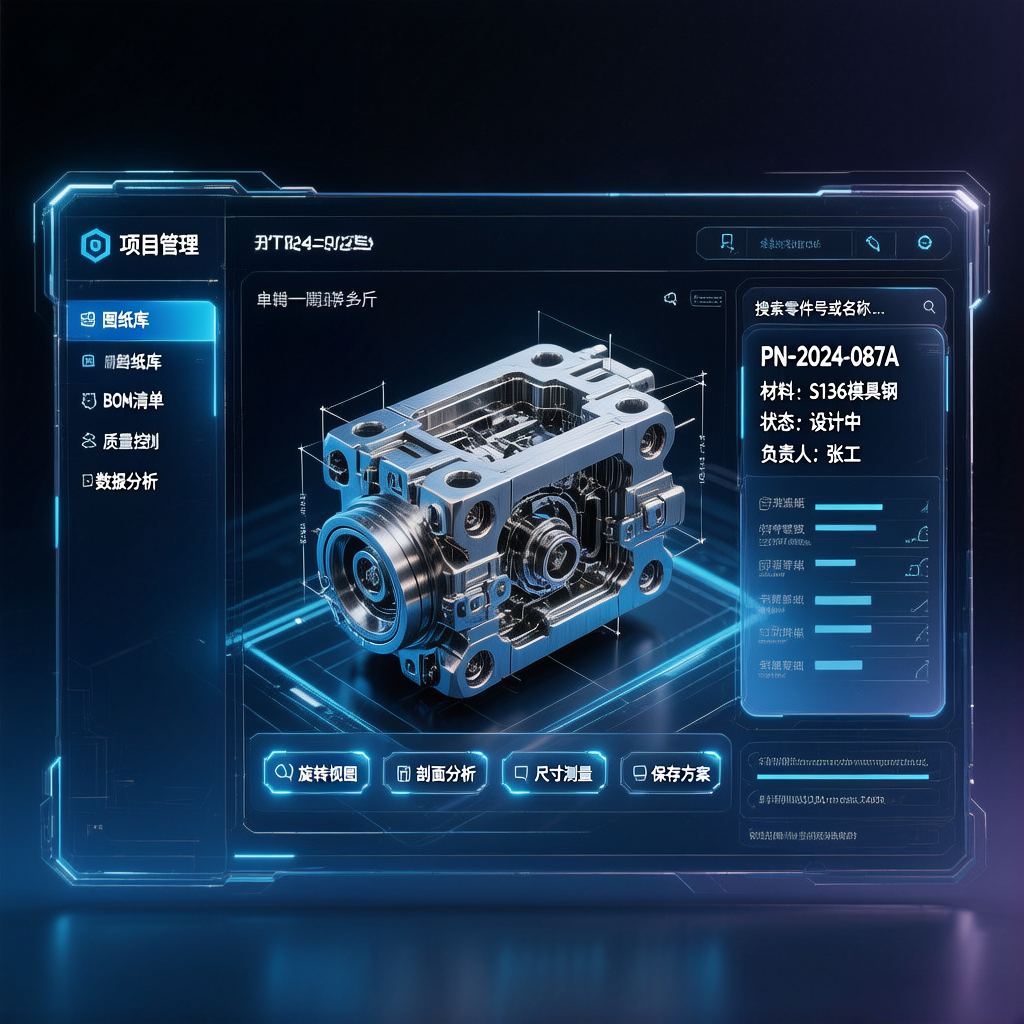
Why do general-purpose systems often struggle in mold workshops?
In essence, the production logic for molds and precision parts is fundamentally different from that of standard parts. Standard parts have a fixed Bill of Materials (BOM) and are produced in large quantities. Molds, on the other hand, are typically project-based, with more design variations and a constantly changing BOM. The machining of precision components like electrodes and inserts is particularly complex, as it requires a holistic approach. Many software companies use logic designed for standard parts to create mold systems, which is clearly not effective.
Furthermore, many factories currently operate in a mold + machining hybrid mode. A mold is typically produced on a project basis, with a focus on milestone control, while the machined parts are produced in batches, with an emphasis on delivery dates and capacity utilization. Managing these two systems separately leads to data silos, making reconciliation and capacity planning extremely challenging and frustrating. Therefore, the system must possess the following capabilities:Dual-mode architectureThis system supports both mold project manufacturing and batch production using CNC machines, and data can be seamlessly shared between the two modes. This underlying logic, which many pure IT companies cannot conceive of or implement, requires deep industry expertise.
Don't aim for everything and the kitchen sink; 80% of the value lies in these 20% of features.
When choosing precision component management software, don't get lost in a long list of features. The value of Moges MES comes from its 20% of core features, which solve the most critical issues. These include:
Full-process production progress tracking:For each mold and each precision component, the status must be immediately clear. It is no longer necessary to rely on staff to go to the workshop and ask. The mature solution is to use work order scanning, which is easy for frontline employees to use. Scanning a code takes a few seconds, and the progress is updated immediately. The boss can also see the progress in real-time on his mobile device, without having to listen to the workshop supervisor's report, such as "almost finished."
Complete external process management:The mold factory's outsourcing is too frequent. Processes like heat treatment, electrical discharge machining, and wire cutting require sending out and receiving parts, which is a major concern. The system must manage the entire process, including tracking the quantity sent, the return date, the number of parts scrapped, and whether rework is being performed, and provide a clear and accurate reconciliation. It should not be a vague or unclear accounting.
Precise Cost Accounting:This is likely the biggest pain point for mold factory owners. After producing a set of molds, how much profit is actually made? How much profit is realized? If the system cannot automatically capture and process data for accurate cost accounting, including material costs, outsourcing fees, design costs, and workshop labor, the owner will find that a year of hard work has ultimately benefited only the suppliers and employees.
Don't be fooled by fancy reports and peripheral features that you'll never actually use. Focus on the core modules and avoid trying to do too much at once. Solving 80% of your problems with 20% of the features is the right approach.
Software is 30%, implementation is 70%. Expertise is more important than code.
Many factories buy software solely based on the attractive demo interface, only to find themselves in a difficult situation during implementation. While the software itself is good, the implementation team lacks understanding of molds, and even basic concepts like "flying knife" and "chamfering" are unknown. How can they then effectively map out the production process? Ultimately, they are forced to manually input the data themselves, making it impossible for the system to go live.
I started my own business, Moges, in 2012 after leaving Foxconn. I did this because I was frustrated with pure IT companies that lacked industry knowledge and tried to dictate solutions without understanding the specific needs. Having spent over ten years working with molds in large factories, I have a deep understanding of the industry. Our approach is not just about selling software; it requires on-site implementation consultants with expertise to ensure successful deployment. We advocate a five-step implementation process, from foundational data setup to full deployment, which can be used within 3 months. The core principle is to first pilot the system and then roll it out, minimizing implementation risks. By first establishing a working line and allowing workers to experience the benefits of scanning and reporting, we can then implement it across the entire operation, resulting in minimal resistance.
Furthermore, the stability of the underlying architecture directly determines whether the system can function effectively in the workshop environment. The workshop environment is complex, and if the system crashes or becomes infected with viruses frequently, workers will quickly abandon it. We adhere to a native Linux architecture, which is stable, secure, has fewer viruses, and offers high performance. This is a significant advantage in real-world workshop environments.
AI is not a panacea, but not using AI is absolutely out of the question.
Currently, the concept of AI is very popular, but don't believe those who claim that AI can directly replace production planners. AI is not a panacea, and choosing the right entry point is crucial in mold and precision machining.
For example, in workshop scheduling, the insertion of mold components is a common practice. Manual production often only focuses on the immediate task, and even a slight change in the insertion of a component can disrupt subsequent processes. At this point,AI-powered SchedulingOne key application is to quickly determine the optimal production schedule based on equipment capacity and process constraints, minimizing order conflicts. For example,Quality WarningWhen the system detects an abnormal increase in the scrap rate of a specific precision component in a particular process, AI can provide an early warning, preventing the entire batch from being defective, even before final inspection. These proactive technologies are now mature and readily available, and are truly effective tools for reducing costs and improving efficiency in workshops.
The system is designed for the "Boss Project," and should not be relied upon for spontaneous initiative from lower-level personnel.
Finally, let me say something straight from the heart: when implementing precision component management software, 9 out of 10 implementations fail. The reason? It's because the owner doesn't lead by example. Relying on the workshop director or clerks to promote transparency? They won't do it. They want to maintain control, and if everything is transparent, they can't hide their shortcomings. Therefore, this must be a project driven by the owner.
What does the boss want? He wants quality traceability, the ability to pinpoint responsibility for issues, and the ability to leverage accumulated experience. He also wants to be able to see the real-time operation of the workshop simply by opening his phone while traveling. As long as the boss consistently makes decisions based on data within the system and uses system cost data for accounting, the rest of the team will naturally follow. We have served over 200 mold and precision machining factories in Kunshan over the past ten years, with a success rate of over 95% and a renewal rate exceeding 90%. This is not just due to the product's functionality, but also because we ensure that the boss is actively involved in implementing the core processes.
When selecting, don't just focus on the price of the software. First, ask yourself: which specific problem in your workshop do you want to solve? Once you have a clear understanding of this, then evaluate whether the software's core functions can meet your needs. This is more important than anything else.