Automated Project Management Software Selection: Avoiding Common Pitfalls – Why 80% of Companies End Up Losing Out?
2026-05-18 08:17:15
Why did a system costing hundreds of thousands of dollars end up being just a simple attendance tracking tool?
Yesterday, I had tea with an old friend who specializes in customized automation. He complained that he spent tens of thousands of dollars last year on a system, but now only the front desk is used for clocking in, and the workshops are still operating in the same way. I calculated the cost for him:
Visible Costs:The cost of the software purchase, plus server costs and implementation fees, represents a direct expenditure of tens of thousands of dollars.
Hidden Costs:Resistance from frontline employees leads to inaccurate data entry and a system that is essentially useless.
Opportunity cost:Initially, we expected the system to streamline production and track progress, but the project delivery still relied on chasing and asking, resulting in a complete inability to calculate the lost profits.
Many business owners are choosingAutomated Project Management SoftwareAt that time, we only focused on the quoted price in the contract, while ignoring the potential for complete failure upon system implementation. In simpler terms,Buying a system is not about buying code; it's about acquiring the ability to solve problems., I don't understand the accounting, and this problem will definitely not be avoided.
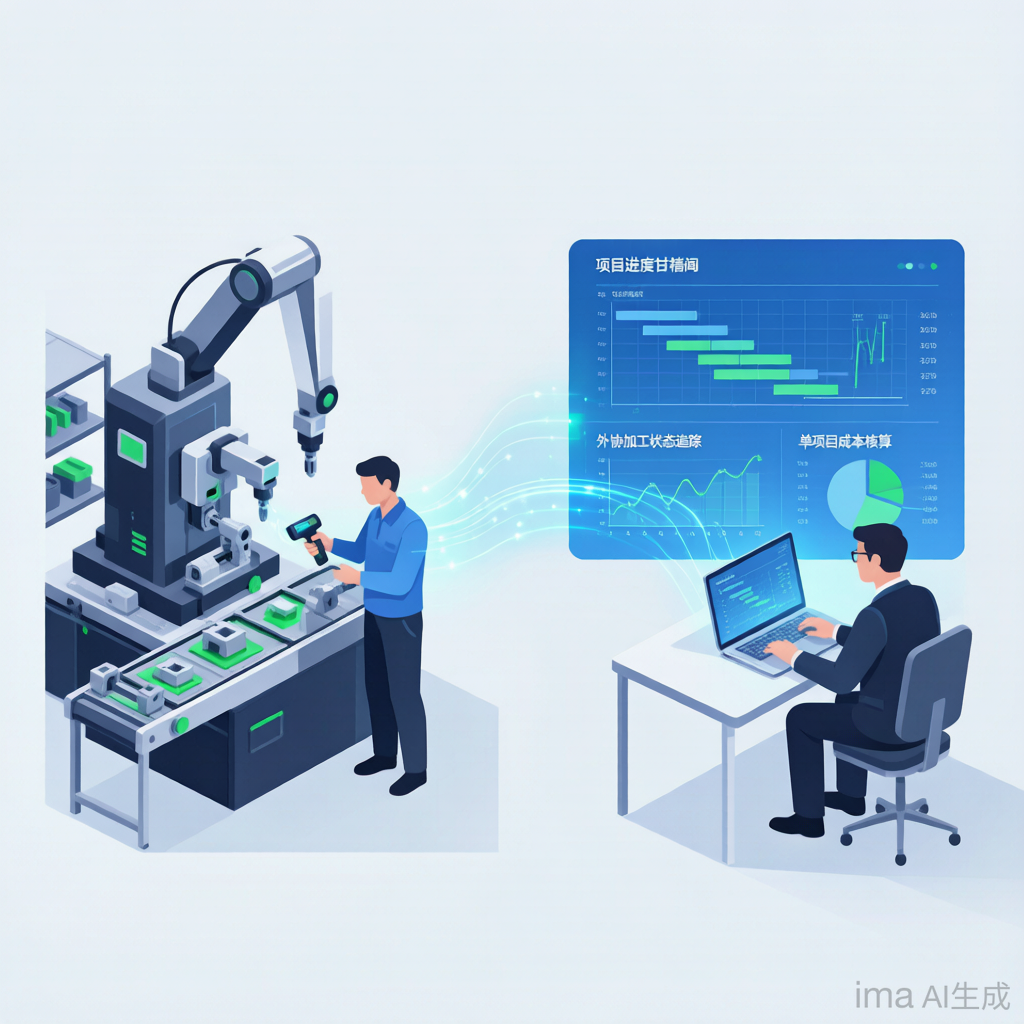
1. The "Big and Comprehensive" Trap: 80% of the budget is wasted on unnecessary features.
A common misconception in the industry is that more system features are better. Many software vendors, during demonstrations, present elaborate PPTs, including features for finance, HR, and OA. However, when you actually implement the system in the factory, you'll find that these elaborate features are often unusable.
For non-standard automation companies with annual sales ranging from 10 million to 50 million, your specific pain points are:Project progress is out of control, external vendors are not properly accounted for, and costs are a complete mystery.. 80% of the value of non-standard automation projects comes from the 20% of core functions.
Don't be fooled – focusing on a comprehensive, large-scale solution is not always the best approach. Solving 80% of problems with 20% of the functionality is the right way to go.Having complete control over core functions like progress tracking, cost accounting, and sub-contractor management is far superior to trying to solve everything with a single system. If a system attempts to address all issues, the result will inevitably be that some issues remain unresolved.
Three Core Features
| Key Elements | Specific requirements | Why is it important? |
|---|---|---|
| Work order submission must be as simple as possible. | Scanning for work order completion is a fundamental requirement, and frontline operators can learn it in just 5 minutes. | If this cannot be achieved, the data source will inevitably become unusable. |
| Progress tracked down to individual work steps | Every stage of the equipment manufacturing process is clearly visible. | Not just seeing a general "In Process" |
| Eliminate redundant approval workflows | Don't simply move offline, cumbersome signatures online. | The system is designed to make things easier, not more complicated. |
II. Progress and External Vendor Costs: Hidden Costs That Significantly Impact Profitability
What is the biggest fear when implementing non-standard automation? Losing control of the schedule. A project involving hundreds or even thousands of parts, with outsourced processes interspersed, such as heat treatment, surface treatment, and electrical discharge machining, can be easily sent out, but difficult to retrieve. Every day, the workshop manager spends all their energy calling external vendors, which is a significant hidden cost in itself.
Many factory systems only manage internal operations, neglecting external factors. This is like building a highway halfway and then stopping abruptly, resulting in a significant disruption.A comprehensive and effective automation project management software solution must manage the entire outsourcing process, from start to finish.
Four core aspects of external management
External Material Issuance Management:How much material has been shipped out? Scan to register, eliminating over-shipping and under-shipping.
External Project Tracking:Gain real-time visibility into the progress of your external manufacturing partners, without the need for daily calls.
External Procurement Reconciliation:How many items were recovered, how many were scrapped, and how many times were they reworked? A clear and detailed inventory will be provided.
External Cost Allocation:External expenses are directly allocated to the project cost pool, resulting in more accurate cost accounting.
Stop wasting time and resources arguing with suppliers over a few hundred dollars in external services, and avoid delays in the entire assembly line due to external service bottlenecks.Streamline external vendor progress and accounting, saving not only money, but also the confidence to deliver projects on time.
3. Calculate Actual Profit: How much profit does each project actually generate?
At the end of the year, when the accounts are tallied, it seems like not much work was done, but where did the money go? This is a common situation for many small and medium-sized business owners. This is because your cost accounting is too basic. When quoting, you rely on experience and guesswork, and when executing, you only focus on purchasing materials and sending orders out. Finally, you can only calculate a total, without knowing which projects are profitable and which are losing money, or where the losses are occurring.
Accurate cost accounting is one of the most core values that the system can bring to businesses..For each non-standard automation project, the revenue generated must be clearly defined. This requires the system to have strong data capture and collection capabilities:
Material Costs:Directly linked to materials and projects, eliminating ambiguity and misrepresentation.
Labor and Manufacturing Costs:By accurately allocating labor costs to specific projects through precise work order processing.
External costs:Real-time recording of external processing costs in the project cost pool.
Only by carefully analyzing these three aspects can you identify where your profit leakage is occurring. Quality traceability also requires this level of detail: being able to trace issues back to specific processes, operators, and equipment allows for the accumulation of experience, rather than repeatedly falling into the same traps.
4. Choosing the system is also about choosing the right people: 70% of the success depends on the implementation.
There are countless software companies on the market, but truly knowledgeable ones are rare. Many pure IT companies, while writing impressive code, fail to understand even basic aspects such as BOM level details and the characteristics of non-standard equipment. As a result, their logic is completely counterintuitive.It is more important to find an implementation team with industry expertise than the software itself.
Implementation is not simply installing the software; that's the logic of selling pirated copies. True implementation involves helping companies streamline their business processes and standardize their workshop practices. We at Moges have consistently maintained an on-site implementation consultant service, not just selling the software and then abandoning the customer. This is because only by being present in the workshop, observing how workers scan and listening to the arguments about production schedules, can we truly make the system work.
Methodology for Reducing Implementation Risks
Pilot first, then widespread implementation:Don't adopt a one-size-fits-all approach; instead, select representative projects for initial trial use.
Only include the core modules:Focusing on three core areas: progress, cost, and outsourcing, get ready to use it in 3 months.
On-site Implementation:Implementation consultants conduct thorough on-site assessments to ensure the system aligns with actual business operations.
Achieves a success rate of over 95% and a renewal rate exceeding 90%, not through sales pitches, but through solid on-site implementation and practical application.
5. The foundation: Don't let viruses and lag drain your resources.
When choosing a system, many people overlook the underlying architecture, which can be a hidden cost. Many older systems are based on the Windows architecture, and are prone to ransomware and require frequent patching and restarts. If the system crashes for two hours during a critical production period, who is responsible for the resulting losses?
Modern, more forward-looking systems are now built on native Linux architectures.. Stability, security, low virus rate, and high performance – this is the foundation that a production system should have.
Furthermore, for factories employing a mold+machine processing hybrid model, a single system must support both mold project-based and machine processing batch production modes. That is,Dual-mode architectureYou can't possibly be suggesting that a factory needs two separate systems, can you? And how would the data be integrated between them?
Regarding AI, don't think of it as a toy for large corporations. AI is not a panacea, but it is essential. Choosing the right entry point is crucial. For example,AI-powered intelligent scheduling and quality alertsThis is no longer just a concept; it's a mature and readily available feature. Shop scheduling is no longer reliant on the intuition of experienced schedulers, and the quality anomaly system can provide early warnings. This is the real benefit that technology brings to productivity. Support for mobile devices is also available, allowing managers to monitor production status while traveling, eliminating the need to call shop floor supervisors at 10 PM to inquire about progress.
6. The system is designed for the "Boss Project," so do not expect the lower-level staff to implement it.
Finally, let me be frank:The project, led by the boss, was unsuccessful. The boss did not take the lead, and out of 10 projects, 9 failed.. If you simply purchase a system and hand it over to your employees without reviewing the data or asking about progress, then your employees will inevitably find a hundred ways to make the data appear useful, even though it is not.
After carefully evaluating the costs involved in purchasing software, it should be clear that selecting the right automation project management software is only the first step. The true path to realizing a return on investment lies in fully implementing the owner's vision and eliminating hidden costs.
What hidden costs is your factory incurring every day?
VII. Lessons from Successful Case Studies
Moges has served over 200 non-standard automation companies for 14 years, and has identified several key success factors:
| Key Success Factors | Specific procedures | Effect |
|---|---|---|
| Focus on core pain points | Focusing on solving the three major problems of progress, cost, and outsourcing, rather than aiming for a comprehensive, all-encompassing solution. | Rapid deployment in just 30 days |
| Industry experts implement | Implementation consultants must have experience in the non-standard automation industry and provide on-site service. | Success rate of over 95% |
| The CEO personally championed the initiative. | The manager regularly reviews system data to make data-driven decisions. | Visible results within 3 months |
| Quick results | Implement a phased approach: start with pilot programs before widespread deployment. Avoid a one-size-fits-all approach. | Average delivery cycle reduced by 22% |
These companies have achieved an average reduction of 22% in delivery cycles, a 35% reduction in costs, and a 30% increase in customer satisfaction. The key to their success lies in avoiding the "one-size-fits-all" approach and instead choosing systems that specifically address their needs.
Conclusion: Invest in the areas that will yield the greatest returns.
In today's highly competitive market, digital transformation is no longer an option, but a necessity. However, the direction and methods of transformation determine success or failure.
Don't pay for fancy features; pay for the ability to solve problems.Choosing a management system that truly understands the non-standard automation industry, focusing on core pain points, and achieving rapid implementation and results is the wise investment.
Moges MES, focused on serving small, non-standard automation enterprises, with a rapid 30-day deployment, without the need for custom development.