Having trouble managing your mold workshop? Are you still using mass production thinking for small-batch production?
2026-05-19 14:26:02
Why do MES systems costing tens of thousands of dollars become increasingly chaotic over time?
Last week, I visited a mold factory in Kunshan Zhangpu. The owner pulled me into the workshop and immediately started complaining: "We just bought a tens of thousands of RMB MES system, and it's getting more and more chaotic the more we use it! The CNC machines and steel materials have been idle for two days. The machinists are rushing to fulfill urgent orders, and the delivery date has been delayed by 10 days. Even after reinstalling the system, we can't figure out where the problem lies."
I took a quick look at their system logic and immediately said:Using manufacturing-oriented thinking to manage a mold workshop is not effective. You won't be able to manage it effectively.
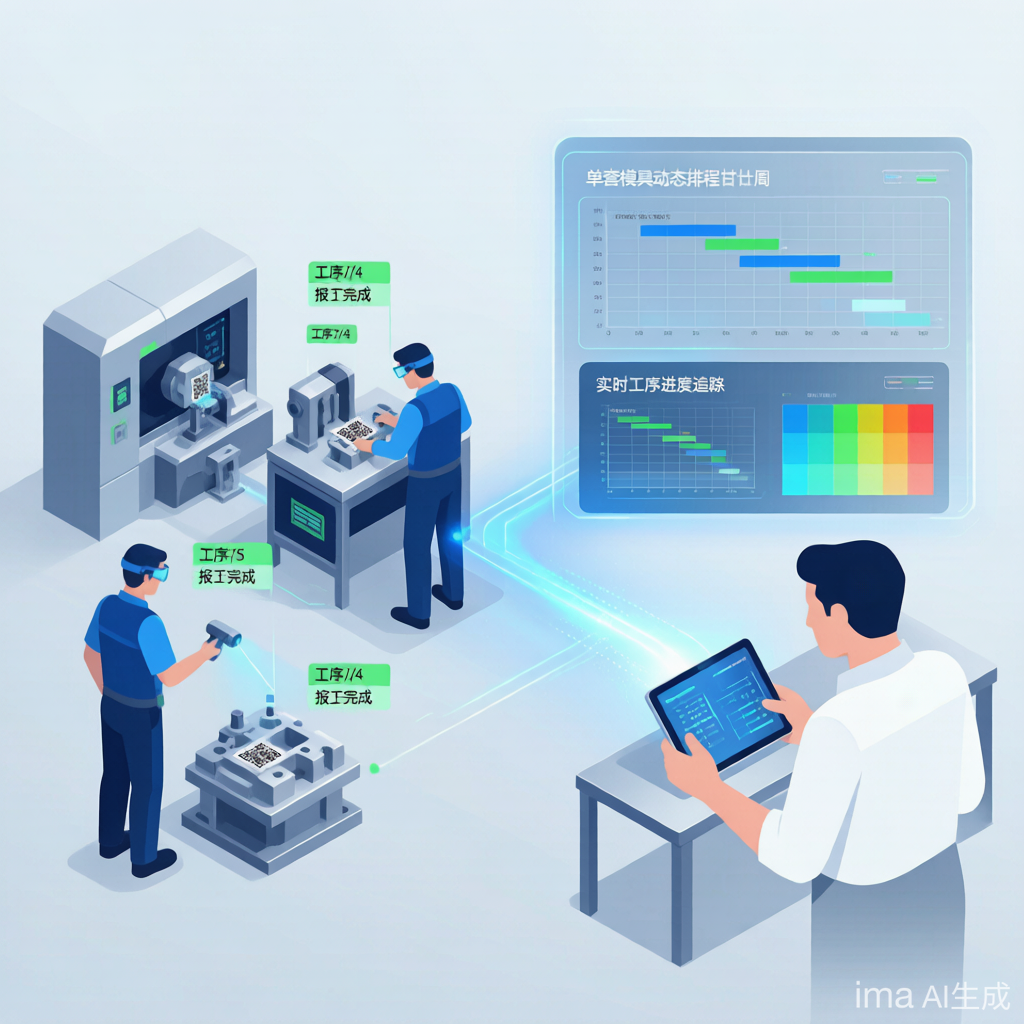
The root cause of chaos in the mold workshop: The inherent incompatibility between mass production thinking and high-end custom single-piece manufacturing.
Many people fall into the misconception that mold manufacturing is simply a smaller-scale production process, essentially involving lower volumes. They then try to apply the management practices used for high-volume machine processing directly to mold manufacturing. In reality, you are missing the fundamental nature of the mold industry:
Mold has been a part of the company since its inception.High-end, low-volume, custom manufacturing--It's impossible to have two completely identical molds. Even a minor change in a customer's product specifications, such as a slight adjustment to a tolerance or a change in the number of cavities, will completely alter the design, manufacturing, and assembly process for the entire mold.
| Comparison Dimensions | Production Logic | Mold single-piece customization logic |
|---|---|---|
| Production Essence | Doing the same thing over and over again | Each is brand new. |
| Process Characteristics | Fixed processes, fixed working hours, and fixed standards. | Today: Changes to design. Tomorrow: Shortage of raw materials. The day after tomorrow: Urgent order insertion. |
| Scheduling methods | Ensure stable operation for one week after initial setup. | All are dynamic and adjustable at any time. |
| Core Value | Profit through volume-based processing fees. | Create customized solutions that others cannot, with high added value. |
Don't confuse highly complex, one-off custom projects with low-value, small-batch manufacturing. The core value of mold lies in creating custom solutions that others cannot, not in simply increasing profits through high-volume production. This is not a mass production model; attempting to adapt it is simply not feasible.
Three specific manifestations of general MES incompatibility with water and soil:
I have seen at least dozens of mold factories that spent a significant amount of money on a generic MES system, only to find that it was completely unsuitable for their needs. The core issue is that generic MES systems are inherently designed for mass production, and the three key aspects are not compatible with the mold manufacturing process:
1. Scheduling: Fixed logic cannot handle dynamic changes.
The general MES scheduling has fixed working hours by default, with very few ad-hoc jobs. When applied to a mold workshop, the working hour flexibility can result in a 30% difference. Daily ad-hoc job changes lead to daily rescheduling, and the machine load becomes chaotic after each change. This results in either excessive idle time or excessive workload, making it impossible to meet deadlines.
2. Billing: Batch statistics cannot provide precise traceability.
Production reporting is done by shift and batch, so simply count the number of units completed each shift and batch. The molds must be accurate down to the individual unit and process – you must know whether the mold cavity has been milled or heat-treated, and any deviation will prevent shipment. General MES batch reporting only indicates that 5 units were completed today, without specifying which units were completed and which processes were performed, making progress tracking entirely dependent on dispatchers going to the site to ask, resulting in information delays of two to three days, which is perfectly normal.
3. Quality Inspection: The sampling logic does not meet the requirements for full process control.
Mass production relies on bulk inspection; achieving a satisfactory pass rate is the key. Every critical process in the mold manufacturing must be fully inspected, and even a single dimensional error can render thousands of pieces of steel unusable. Furthermore, any issues must be traceable back to a specific unit: which technician performed the task, which machine was used, and which batch of materials were utilized. The general MES system, with its batch-based data recording, makes it impossible to trace specific individual processes. When problems arise, it takes days to conduct a full review of the entire production line, making it impossible to pinpoint the root cause.
Simply put, the problem isn't your workshop's execution; it's that the management system you're using is fundamentally flawed. It's not designed for mold production, which involves small batches.
A 80 million scale mold factory's real transformation from chaos to order.
Last year, we had contact with a mold manufacturing company in Suzhou, with an annual turnover of over 80 million, which had transitioned from machining to mold making. They continued to use their original production management logic, implemented a general MES system, but still had a timely delivery rate of less than 55%. They couldn't determine whether each mold set was profitable until the end of the year, when accounts were settled. The outsourced mold frames were delayed for a week, and the procurement team didn't follow up, leading to daily customer visits and complaints.
Their core adjustment is straightforward:Abandon traditional mass production thinking and completely adapt to the characteristics of mold single-piece, small-batch production to rebuild management..After implementing a dedicated management system specifically designed for molds, we completely revamped the following three stages:
Scheduling:Dynamic mold scheduling per order, with AI automatically adjusting machine load at any time, reducing the original scheduling time of 4 hours to just 20 minutes.
Invoice Submission:Scan the Moges QR code, and work processes will be updated in real-time. The boss can check the status of each mold set, from start to finish, on their phone while traveling, without the need for daily on-site visits.
Cost:Directly calculate profit per unit, with clear and transparent costs for steel materials, labor hours, and external services. You can estimate the profit directly when placing an order, without waiting until the end of the year to discover losses.
Over the past three months, on-time delivery rate has increased to 89%, unnecessary waste has been reduced by nearly 20%, and the boss now no longer needs to spend time monitoring progress in the workshop, freeing up time to discuss two new clients.
Don't mistake high-end, single-piece, low-volume molds for low-end capacity.
Currently, there's a trend in the industry where focusing on small-batch, single-piece production is perceived negatively as being small-scale and low-end. Wake up! The pinnacle of the mold industry is not about mass production; the ability to handle high-precision, high-complexity custom orders is what truly represents high value. Selling a single automotive component mold for tens of thousands of dollars is far more profitable than producing dozens of low-value, small-batch sub-contracting jobs.High-end, low-volume, single-piece production, is the core competitiveness of the mold factory, not low-end capacity.
Many owners are misled into adopting generic systems and mass production management, only to find that they cannot succeed and then blame their own factories for being inadequate. In reality, they are choosing the wrong path. Digitalization is not inherently bad; it simply means you cannot use mass production methods with a system designed for small-batch production.The system shouldn't be the most expensive; understanding molds and adapting to single-batch, small-volume production is the key.
Conclusion: First, take a look at what your dashboard displays.
Now, please go to the signboard at the entrance of the workshop and check the current total production or the progress of each mold at each specific process. If you cannot even track the progress of a single mold, don't blame the team's poor execution. First, consider whether the management logic you are using from the beginning is correct.