How businesses can reduce costs and improve efficiency using AI: Stop treating AI intelligent systems as just chatbots.
2026-06-06 07:31:35
Introduction: AI intelligent agents are not advanced chatbots.
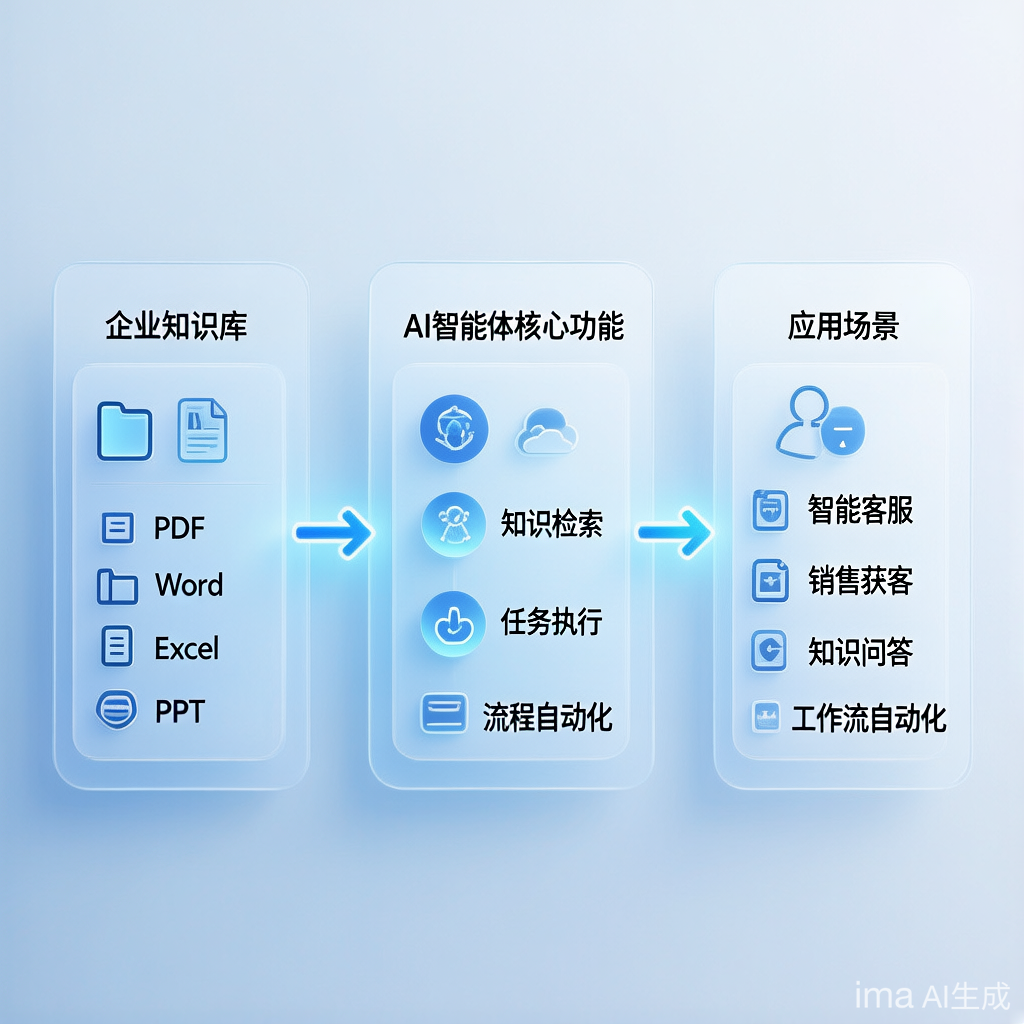
Many companies, when they hear about AI, immediately think, "Should we get a large model and have it answer questions?" This understanding is only half right. The real AI intelligent agents that can reduce costs and increase efficiency are not simple question-answering interfaces, but rather...Once integrated with the company's knowledge base, business processes, and existing systems, AI employees can continuously handle specific tasks.
The biggest weakness of ordinary chat tools is "not understanding you." They lack knowledge of internal company policies, customer issues, and service guidelines, and cannot reliably access business data. Asking the same question multiple times may yield different answers. The value of AI agents lies in importing company-specific documents such as PDFs, Word documents, Excel spreadsheets, PowerPoint presentations, web pages, and Feishu documents into a knowledge base, and using RAG (Retrieval-Augmented Generation) to enhance responses, ensuring that answers are sourced and have clear boundaries, thereby minimizing speculation.
Cost reduction is not achieved through layoffs; instead, prioritize delegating repetitive tasks to AI.
The most easily implementable scenarios for businesses are often not the grand "comprehensive intelligent" solutions, but rather the daily, repetitive tasks that consume human resources. For example, customer service representatives repeatedly answer questions about pricing, procedures, after-sales service, and information requests; sales teams need to assess lead value and follow up with customers; and internal employees repeatedly search for procedures, consult documents, and ask about workflows. These tasks are not complex, but they consume a significant amount of time.
For example, a customer service intelligent agent can automatically respond 24 hours a day, 7 days a week, understand the company's knowledge base, and support multi-turn conversations.Replace more than 60% of manual customer service workload in suitable scenarios..Sales lead generation automation can automatically identify potential customers, score leads, and perform intelligent follow-up. Data from the knowledge base can improve performance.30%+ conversion rateWorkflow automation agents can also connect to CRM, OA, Enterprise WeChat, Feishu, and other systems, automatically performing repetitive tasks, thereby improving efficiency.5-10 times.
Work Analysis Table for Repetitive Tasks:
| Job Type | Repetition frequency | AI Replacement Potential | Expected Benefits |
|---|---|---|---|
| Customer Support Q&A | Multiple times per day | More than 60% | Reduce labor costs and improve response speed. |
| Lead Qualification | Tens of lines per day | More than 40% | Improve conversion rates and shorten sales cycles. |
| Internal Knowledge Search | Multiple times per day | More than 80% | Improve employee efficiency and reduce training costs. |
| Data consolidation and summarization | Several times per week | More than 70% | Reduce manual errors and improve data quality. |
How businesses can reduce costs and improve efficiency using AI: The key lies in these three things.
Many companies want to use AI, but don't know where to start. The key is actually to focus on three things:
Can it integrate with enterprise knowledge?It is not sufficient to provide generic answers. It is essential to understand the specific information, rules, and service guidelines of each company. This includes understanding and answering questions accurately regarding product parameters, service processes, pricing policies, and frequently asked questions.
Can the following actions be performed:A true AI intelligent system not only answers questions, but also can query, organize, remind, triage, and follow up. For example, after a customer inquiry, it can automatically categorize, record the requirements, and forward them to sales, and also generate follow-up scripts.
Can we quickly deploy and validate?AI project delays by three months; many small and medium-sized enterprises cannot afford this. The high trial-and-error costs are also a major concern. It is advisable to choose solutions that can be delivered and validated quickly, thereby reducing risk.
This is also a common reason why many companies make mistakes. Large AI services typically start at $200,000, with a cycle of 3 months or more, making them suitable for large projects with ample budgets. Individual developers may offer lower prices, but their quality and maintenance are often unstable. Overseas SaaS tools have limited support for Chinese business scenarios, and data security is also difficult to control. Low-code AI platforms are easy to use, but they have limited capabilities for deep customization and system integration.
Why isn't an AI agent simply a ChatGPT wrapper?
A readily available enterprise AI engine typically requires a multi-model routing layer, a vector database, a RAG (Retrieval-Augmented Generation) engine, a workflow engine, and access control. For example, different questions can be routed to models such as OpenAI, Claude, Tongyi Qianwen, ZhiPu GLM, and DeepSeek; knowledge retrieval can be based on Qdrant or Milvus to enable large-scale vector retrieval; after document import, the documents are automatically segmented and vectorized, and the retrieval results are then used to generate answers.
AI Intelligent Core Architecture:
Multi-model routing:Based on the type and complexity of the problem, intelligently select the most suitable AI model.
Vector Database:Vector representation of enterprise knowledge for storage, enabling fast and accurate retrieval.
RAG Engine:Retrieval-Augmented Generation, ensuring answers are based on actual company data.
Workflow Engine:Define and execute business processes, enabling automated task management.
Access Control:Ensure data security, with different roles viewing different content.
More importantly, the deployment method. For companies that handle internal data, customer information, and service records,Private deployment is an option.Not an enhancement, but a fundamental security requirement. Through one-click deployment using Docker, data remains within the company's internal network. Furthermore, by combining data encryption, access control, and audit logs, we prevent sensitive information from being exposed in uncontrolled environments.
Even with a limited budget, it's possible to start by implementing a solution for a single scenario.
Moges adopts a practical approach: instead of recommending a large, comprehensive system from the outset, it suggests starting with a high-frequency, clearly defined, and impactful scenario. This involves deploying individual intelligent solutions.Starting from 2999 yuanDelivered within 1-3 days; Intelligent customer service solutions starting at 3999 yuan, knowledge base question answering solutions starting at 4999 yuan, and sales lead generation solutions starting at 7999 yuan. More complex workflow automation solutions cost between 10000-30000 yuan and are delivered within 5-10 days.
Pricing and cycle times for intelligent agents in different scenarios:
| Smart body type | Price Range | Lead Time | Suitable Applications |
|---|---|---|---|
| Single-scenario intelligent agent | Starting from 2999 yuan | 1-3 days | Simple Q&A, document lookup |
| Intelligent Customer Service Agent | Starting from 3999 yuan | 3-5 days | 24/7 automated customer service |
| Knowledge Base Question Answering Agent | Starting from 4999 yuan | 3-7 days | Internal knowledge search, employee training |
| Sales Lead Generation Engine | Starting from 7999 yuan | 5-7 days | Lead qualification and customer follow-up |
| Workflow Automation Intelligent Agents | 10,000-30,000 yuan | 5-10 days | Multi-system integration, process automation |
If internal data is scattered, you can build an internal knowledge base, which typically takes 1-2 weeks. If you want to integrate intelligent summarization, automatic generation, and data analysis capabilities into your existing office system, you can also integrate an AI-assisted office system. Kunshan Moges Information Technology Co., Ltd. has been engaged in technical development since 2012.14 years of technical experienceWe have delivered hundreds of real-world projects, not a team that simply presents concepts in PowerPoint presentations.
True risk control starts with promising results.
Companies are most concerned about two things when adopting AI services: slow deployment and ineffective results. Moges Technology offers a solution to minimize the risk of trial and error.3-day deliveryAvailable AI-powered solutions, with 7 days of free optimization after deployment. If the AI solution does not meet expectations after deployment,Full refund if not satisfied.Monthly maintenance services range from 500 to 3000 yuan/month/intelligent body, including model invocation fees, knowledge base updates, and performance optimization.
Triple Risk Control Assurance:
Fast Delivery:Available version delivered within 3 days, enabling quick validation of results.
Free Optimization:Free optimization for 7 days after launch, ensuring expected results are achieved.
If you are not satisfied, we offer a full refund.If the results are not as expected, full refund, risk-free trial.
Five-Step Implementation Path for Businesses to Reduce Costs and Increase Efficiency Using AI
You don't necessarily need to start with a complex system. A more reliable approach is to implement the following five steps:
Step 1: Scenario Selection (1 day)
Choose a scenario with high repetition, clear rules, and complete data, such as customer service FAQs, sales lead filtering, and internal knowledge base queries.Step 2: Prepare the necessary documents (1-2 days)
Organize relevant materials, including product manuals, service processes, frequently asked questions, and pricing policies, and import them into the knowledge base.Step 3: Intelligent Agent Setup (1-3 days)
Build intelligent entities based on business processes, define workflows, configure permissions, and test the results.Step 4: Go-Live Validation (1-7 days)
Officially launched, collecting user feedback, and continuously optimizing performance.Step 5: Expand Applications (Ongoing)
After the initial scenario was successfully validated, the system was gradually expanded to include customer service, sales, knowledge management, and office automation.
AI intelligent systems in various industry application cases
AI-powered solutions have achieved significant cost reduction and efficiency gains across multiple industries.
Manufacturing Applications:
Non-standard automation equipment manufacturers use AI-powered systems to automatically answer customer inquiries regarding technical questions, quote requests, and after-sales service, reducing the repetitive workload for sales and technical support staff by 50%.
Service Industry Applications:
Consulting firms are using AI-powered agents to automatically organize client data, generate initial proposals, and schedule meetings, resulting in a 30% increase in advisor productivity.
Retail Applications:
E-commerce businesses can use AI agents to automatically handle customer inquiries, order queries, and return/exchange requests, reducing customer service costs by 60%.
Educational Industry Applications:
Training institutions use AI-powered entities to automatically answer course inquiries, schedule trial sessions, and follow up with students, resulting in a 25% increase in enrollment conversion rates.
Conclusion: AI agents are tools, not replacements.
How can businesses use AI to reduce costs and improve efficiency? You don't necessarily need to start with complex systems. A more reliable approach is to first identify a scenario with high repetition, clear rules, and complete data. This allows you to integrate an AI agent with real-world knowledge and processes, generating measurable results. Once the first scenario is validated, you can then expand to areas such as customer service, sales, knowledge management, and office automation, which will be less risky.
Remember these three key points:
First sentence: Start with a single scenario.Don't start with a large, comprehensive system right away. Instead, choose a high-frequency scenario to validate the effectiveness first.
Second sentence: Emphasize the construction of a knowledge base.The value of AI agents lies in their ability to understand a company's own data and information. The quality of the knowledge base determines the effectiveness of the AI agent.
Third sentence: Focus on actual benefits.Don't focus on simply having the most advanced technology; instead, prioritize whether it can truly reduce costs and improve efficiency, and whether it can deliver measurable value.
If you are considering using AI to reduce costs and improve efficiency, you might want to start by addressing these three questions: What problem do we most want to solve? Which scenario is the most repetitive? Are all the relevant materials complete? Moges offers single-scenario AI solutions starting at 2999 yuan, with a 3-day delivery timeframe, and a full refund if you are not satisfied. Please contact us to learn more.