How to Solve Loose-Part Inventory Chaos? Seven Practical Steps to Control Finding, Missing, and Mixing Up Parts
2026-06-06 08:31:25
How to Solve Loose-Part Inventory Chaos? First Get "Finding, Missing, and Mixing Up Parts" Under Control
Many bosses searching "how to solve loose-part inventory chaos" don't want concepts — their factories are already being dragged down by loose parts daily: an order is ready for assembly, but the key part can't be found; the system says it exists, yet half a day of searching on-site finds nothing; the warehouse says it never received it, while the shop says it was machined long ago. Loose parts aren't like standard items — one batch, one drawing number, one process, one status. Relying on human memory, paper slips, and veteran experience, chaos is only a matter of time.
I've seen many machining factories where the boss walks into the shop each morning asking three questions: "Where is this batch of parts?" "Why hasn't it been booked into inventory?" "Where did those rework parts go last time?" By the end, warehouse, planning, shop, QC, and outsourcing each tell their own story — nobody is deliberately stalling, but information breaks in the middle, and inventory becomes "looks like it exists, unavailable when truly needed".
Why Does Loose-Part Inventory Get Messier the More You Manage It? The Problem Usually Isn't Just the Warehouse
Many factories initially blame inattentive warehouse keepers — swap the person, change the ledger, run one more count; it improves briefly, then gets messy again. The trouble with loose-part inventory is that it isn't simply "how much came in, how much went out" — it is bound together with production progress, process flow, quality status, and outsourcing shipments and receipts.
Common scenarios include:
Machined parts not booked into inventory promptly: The shop finishes and leaves parts beside machines, in inspection areas, or on semi-finished racks; the warehouse ledger doesn't have them yet, and planning assumes they're incomplete.
Rework parts mixed with qualified parts: Same drawing number, same batch, status unclear — discovered only at assembly when the wrong part is grabbed.
Outsourced parts going off-radar after dispatch: How many went out, how many came back, how many are missing — reconciled via WeChat groups and Excel; month-end reconciliation is painful.
Distorted inventory status after rush-order insertion: Parts originally allocated to order A are temporarily moved to order B; nobody records it promptly, and later order A is missing parts.
Inconsistent drawing numbers, names, and versions: The same part is called differently by engineering, procurement, and the warehouse — auditing feels like solving riddles.
So, to get loose-part inventory under control, you can't just stare at warehouse shelves — you must connect the line of "where loose parts come from, where they are now, whether they're usable, and where they go next".
Step One: Classify Loose-Part Status First — Don't Lump Everything as "Inventory"
Much inventory chaos comes from calling everything "inventory". In reality, loose parts need at least several statuses: awaiting machining, in machining, awaiting inspection, qualified and booked in, under rework, scrapped, at outsourcing, awaiting assembly. If status is unclear, no ledger detail helps.
Factories should first make a simple status table — it doesn't need to be complex; the most important thing is that the shop floor understands it. For example:
Awaiting machining: Material or blank has arrived; machining hasn't started.
In machining: Has entered a certain process; cannot yet count as available inventory.
Awaiting inspection: Machining complete but quality unconfirmed; cannot go directly to assembly.
Qualified: Can be issued, assembled, or shipped.
Under rework: Must be stored separately; never mixed with qualified parts.
At outsourcing: Not physically in the factory, but must remain within management scope.
This step looks simple, yet it's the foundation many factories lack. Previously, asking "is there inventory?" got the answer "a few pieces", but nobody knew whether those pieces were usable. Once status is classified, planning, assembly material issuing, and the boss's progress checks are never delayed by an "it should be there".
Step Two: Give Every Loose Part a Fixed Identity — Stop Identifying Parts by Human Recognition
What the loose-part business fears most is "they all look alike". Two parts with close dimensions and similar processes, one misplaced during a busy moment, leads to rework, material replenishment, and delays downstream.
A practical approach is fixing each loose part's identity, which must include at least: order number, drawing number, name, quantity, process, status, and batch or project affiliation. On-site, labels, barcodes, and turnover-box cards can carry this information.
The key here is not how pretty the labels are, but achieving when the person leaves, the part's information remains. When the veteran takes leave, a new employee takes over, or the night shift hands over, anyone can understand whose part this is, what step it has reached, and whether it can be touched.
If the factory is already using a system, keep frontline reporting as simple as possible. For example, scan-code work reporting: an employee scans once after completing a process, and the loose part's status advances automatically. The process scan-code reporting Moges built for mold and machining scenarios exists precisely to solve this: not making frontline workers fill piles of forms, but leaving a timely record that "it's done".
Step Three: Manage Storage Locations — Don't Let the Warehouse Become "Guided by Acquaintances"
In some warehouses, only the veteran keeper knows where things are; others entering feel like entering a maze. Ask the boss's question about a part, and the keeper walks along saying "I remember it's in that corner". This management style shows no problems in normal times, but the moment deadlines tighten, personnel change, or volume grows, big trouble follows.
Loose-part location management doesn't need to be complicated from day one, but it needs basic rules:
Zone by project or order: Loose parts of the same mold set or the same order batch should be grouped together to reduce search time.
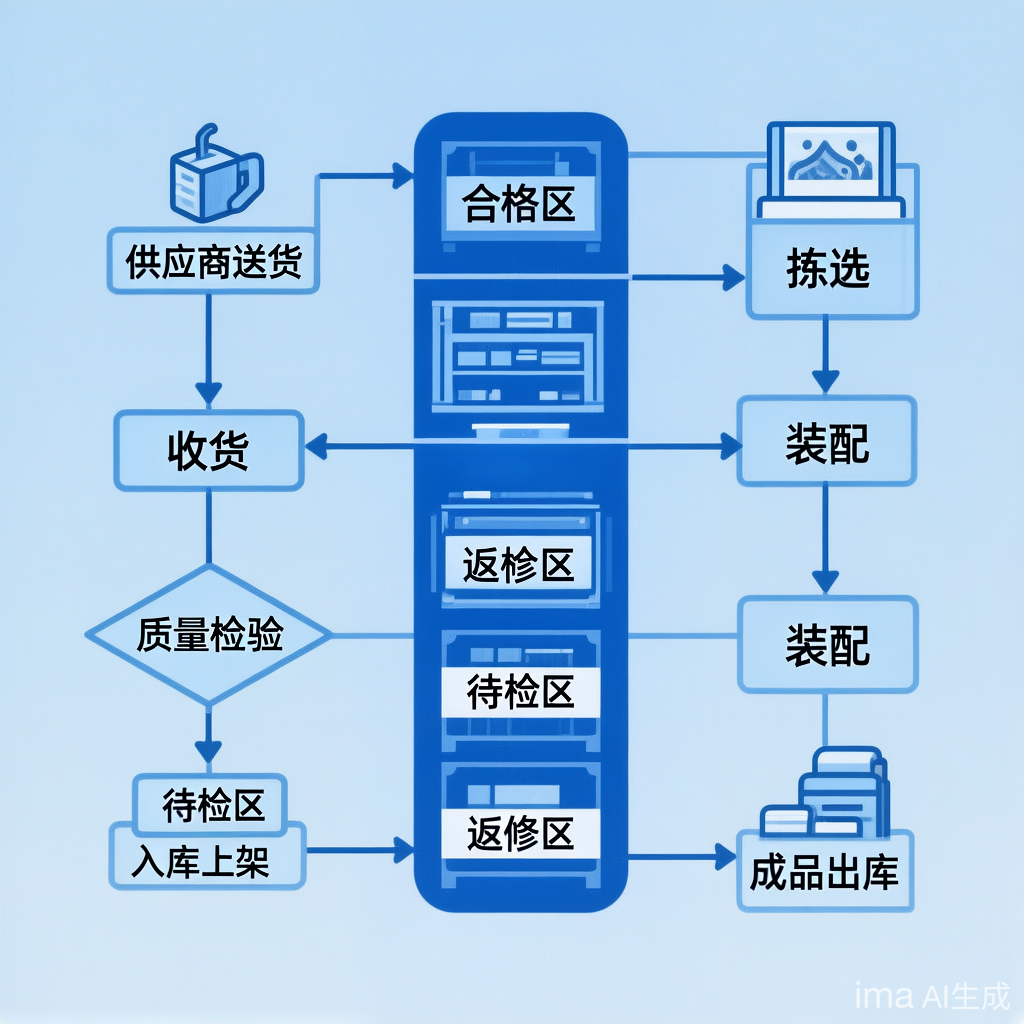
Zone by status: Keep qualified, awaiting-inspection, rework, and outsourcing-to-ship areas separate to avoid grabbing the wrong part.
No mixed storage in turnover boxes: One box should hold only one type, one status of parts.
Record location changes: Moving from rack A to rack B must leave a trace — otherwise the ledger matches but the goods can't be found.
I'd rather recommend small and medium factories first manage the "loose parts that cause problems most frequently" — parts always needed before assembly, outsourced parts returning to the factory, rework parts. Don't deploy factory-wide at once; the motion is too big and the shop floor easily resists.
Step Four: Outsourced Parts Must Be Managed Separately — Not Just via WeChat Groups
When machining factories' loose-part inventory gets chaotic, outsourcing is often the disaster zone. One slip goes out; several batches come back — some qualified, some for rework; month-end reconciliation again means digging through chat records, delivery notes, and inspection records.
To manage outsourced parts clearly, watch at least four points:
How many went out: Drawing number, quantity, process, and supplier must be explicit.
When they should come back: Don't discover missing outsourced parts only when assembly lacks them.
How many came back and how many are qualified: Receiving and inspection results must correspond.
How discrepancies are handled: Missing parts, rework, and scrap all need records for later reconciliation.
The value of full-process outsourcing management is not making supplier management complicated, but letting the factory know: the goods may not be on-site, but they remain under control. This matters especially for loose-part inventory, because much "missing inventory" is actually outsourcing flow information failing to keep up.
Step Five: View Production Progress and Inventory Together — Never as Two Separate Worlds
Many factories have a habit: production manages production, the warehouse manages inventory. The result: production says it's done, but the warehouse hasn't booked it in; the warehouse says no stock, while production says it was handed to inspection; inspection says there's a problem and it's under rework, while planning still schedules assembly with qualified parts.
For loose-part inventory to stay orderly, production progress must be trackable end to end. Where each loose part has reached, which process it's stuck at, whether it's awaiting inspection, whether it's at outsourcing — all must be queryable. That way the boss and production supervisor don't need daily meetings and interrogation to know where the sticking point is.
For mold factories and precision machining factories that mix project-based and volume production, the difficulty is more obvious: one side advances by mold set, the other machines parts in batches. Managing the two logics separately easily leads to duplicate entry on-site. Moges' dual-mode architecture — one system supporting both mold project-based and machining volume production — suits such hybrid-mode factories well.
Step Six: Inventory Counts Should Cover "Ledger, Goods, and Status", Not Just Quantity
Traditional counting only tallies quantity: ledger says 10 pieces, floor has 10 pieces, and it's considered a match. But for loose-part inventory, that's not enough. What truly needs counting is three things: is the ledger right, are the goods present, is the status accurate?
For example, the ledger says 10 pieces and the floor has 10 pieces, but 2 are awaiting rework and 1 awaits inspection — that cannot count as available inventory. If planning schedules assembly with 10 qualified pieces, shortages will still follow.
Recommended counting criteria:
Quantity: Do ledger and floor quantities match?
Location: Does the system or ledger's recorded position match the floor?
Status: Are qualified, awaiting-inspection, rework, and at-outsourcing clearly marked?
Responsibility: Which link did the discrepancy occur in? Don't let the warehouse take all the blame.
Counting frequency needn't be the same for all loose parts. High-value, deadline-critical, error-prone parts can be counted frequently; ordinary parts on a cycle. This captures the priorities without exhausting the floor.
Step Seven: Don't Chase the Big and All-Inclusive at the Start — Get the Shop Floor Truly Using It First
Many bosses hesitate about deploying systems, fearing cost, complexity, and worker non-adoption. That worry is realistic. If loose-part inventory management deploys all modules and all processes at once, the shop floor easily finds it troublesome and retreats to Excel and WeChat groups.
The steadier way is to pilot first. Pick one typical product line, one order with heavy outsourcing, or one area where parts are often lost, starting from the core actions: basic data, scan-code reporting, locations, and outsourcing shipments and receipts. Solve the 80% of high-frequency problems first, then expand gradually.
On implementation, the industry says it well: three parts software, seven parts implementation. The software's features are sitting there, but how the floor's processes are sorted out, how employees are trained, how exceptions are handled — these decide whether it gets adopted. For small and medium machining factories, no need to chase big-factory-scale solutions from the start; what fits your own pace lands more easily.
Once Loose-Part Inventory Is Orderly, the Changes the Boss Feels First
Once loose-part inventory shifts from "finding by people" to "querying by status, taking by location, tracking by progress", the boss's daily life lightens considerably. Time once spent daily asking where parts are can now go to delivery dates, capacity, and customer communication; the production supervisor no longer chases everywhere — knowing which process is stuck means handling that process; the warehouse no longer passively takes the blame daily, because every flow leaves a record.
More importantly, once inventory is clear, many hidden costs surface: duplicate machining, duplicate purchasing, outsourcing discrepancies, rework mixed storage, assembly waiting. These losses used to scatter in every corner, unaccountable by anyone; now the process of every mold set and every batch is more transparent, and cost accounting has better grounding.
Loose-part inventory chaos wasn't formed in a day, and no single inventory count can thoroughly solve it. Start from the most painful point: is it unclear outsourcing receipts, mixed rework parts, or always missing parts before assembly? Get that point running smoothly, then expand to other links. In managing loose parts, the greatest fear is thinking too big and landing nowhere; the most effective approach is often giving every part an identity, a location, and a status first.