Kunshan Non-Standard Automation Company Selection Guide: Synergistic Strategies for Equipment Automation and Production Management Systems
2026-06-07 08:01:36
The core of non-standard automation transformation: the synergy between equipment and management systems.
For many mold factories and precision machining factory owners, a typical day often starts with several phone calls: customers requesting mold progress updates, production supervisors reporting that a specific part is still outsourced, machinists requesting electrodes, and procurement departments confirming that materials have arrived but no one is confirming. While these may seem like minor issues, when they accumulate daily, owners realize a significant problem: despite having many employees and equipment, information flow is often disrupted.
Therefore, many companies are starting to consider finding "Kunshan Non-Standard Automation Company"The goal is to improve on-site efficiency through automation, specialized equipment, tooling, and material handling modifications. This is a valid approach, but there's a practical issue that's often overlooked:If production tasks, work order statuses, external vendor information, quality issues, and cost data are inherently inconsistent, then implementing a single automated device will only address isolated actions and will not resolve the overall lack of coordination within the entire plant.
In essence, non-standard automation is not just about purchasing a few pieces of equipment. For mold and precision machining companies, automated equipment is like hands and feet, while a production management system is more like the nervous system. The hands and feet are quick, but the brain doesn't know who to tell to do what, or how to trace problems when they occur. The situation on the shop floor remains chaotic.
Common pitfalls to avoid in non-standard automation: Focusing solely on equipment cycle times, while neglecting system coordination.
Many business owners, when evaluating automation solutions, immediately ask about cycle times: how many seconds per action? How many pieces can be produced per day? And how many people can be saved? These are certainly important considerations, but in the mold industry, focusing solely on cycle times can lead to inaccurate assessments.
Moges mold factories are not standard assembly lines; orders are often project-based. A single mold involves design, programming, CNC machining, EDM, laser cutting, grinding, machining, prototype making, and modifications. The process also includes outsourcing and rework. Precision machining may involve both batch production and single-piece production, requiring management of cycle times, batches, invoicing, and quality records. Many companies are essentially "Mold project and CNC machining batch production are mixed together.This type of situation cannot be effectively managed with a simple Excel schedule.
If the front-end planning is inaccurate, the back-end automated equipment may encounter several awkward situations:
Idle equipment and materials:The equipment is very advanced, but there are frequent delays waiting for materials, drawings, and programs. This significantly reduces the actual operating rate, resulting in a poor return on investment.
Bottleneck Transfer:While the efficiency of one process has improved, the bottleneck has shifted to external vendors, inspection, or manual assembly, resulting in a lack of overall efficiency gains.
Difficulty in tracing quality:Information was disseminated through WeChat groups and verbal communication, making it difficult to trace quality issues back to specific processes and responsible individuals.
Cost accounting is unclear:The owner only sees an increase in production, but cannot see the true cost and profit of mold sets, making it impossible to determine whether the automation upgrade actually brings benefits.
Therefore, before evaluating the Kunshan Non-Standard Automation Company's solution, the boss should first ask himself:Can my on-site data support automated operation?If not, it is best to consider equipment modification and management systems in conjunction, and at a minimum, there should be clear procedures for work instructions, progress tracking, cost management, quality control, and external vendor management.
For mold and precision machining companies, the five core data points that are most critical to manage:
For small and medium-sized factories, the biggest concern is implementing a system that is too complex from the start. Many projects fail not because the software is bad, but because the features are too extensive, leading to resistance from on-site employees and making it difficult for supervisors to manage. In the mold industry, the key is to focus on a few core functionalities that can generate value early on.
First: Full-process production progress tracking
The most important information for the boss to know is the current status of each mold, whether it is being processed on CNC machines, EDM machines, or outsourced, along with inspection and assembly. Relying on supervisors to provide daily verbal updates is not a reliable or timely way to obtain this information. Real-time progress dashboards allow the boss to stay informed about production status at any time and make quick decisions.
Second: Simple and efficient work order submission.
Frontline employees shouldn't be burdened by complex forms. Methods like scanning codes for reporting work are better suited for the shop floor, as they are simple to use, allowing data to be captured, and then analyzed for things like working hours, bottlenecks, and anomalies. The simpler the reporting process, the more accurate the data.
Third: Closed-loop management for external vendors.
It is common for mold factories to outsource processes such as heat treatment, surface treatment, wire cutting, and EDM. Knowing what is being sent out, when it will be returned, whether the quantity is correct, and how the costs are calculated is crucial. Without a system to record this information, reconciling at the end of the month can be very difficult. Establishing a closed-loop system for managing outsourcing is key to ensuring timely delivery.
Fourth: Quality Traceability System
Quality issues are not a problem; the real problem is having to start from scratch every time. When an issue occurs, it's difficult to determine which process, who was responsible, which batch of materials, and whether the materials were reworked. Without proper records, it's impossible to find the root cause. A quality traceability system helps companies accumulate experience and continuously improve.
Fifth: Precise Cost Accounting
Many business owners are constantly struggling with cash flow, without understanding which types of molds are profitable or which customer segments are consuming the most resources. Without accurate cost accounting, it's easy to make decisions based on intuition, leading to inaccurate pricing and order acceptance. Precise cost accounting can help businesses optimize their product structure and improve profitability.
Why "Understanding Molds" is More Important Than "Software Functionality"
Some software demonstrations showcase extensive features and a beautiful interface, but perform poorly in real-mold manufacturing environments. The reason is simple: mold manufacturing is not a standard assembly process. Plans frequently change, rework and ad-hoc orders are common, and factors such as different versions of drawings, production routes, external manufacturing nodes, and prototype feedback all impact delivery.
This is also why many bosses eventually come to agree with the same statement:Software accounts for 30%, while implementation accounts for 70%.Whether a system can be effectively used depends not only on its features, but also on whether the implementation team understands the terminology and language used in the field. For example, if a supervisor says, "This mold is for electrode cutting," or "This component requires outsourcing and then additional processing," it is difficult for implementation personnel to design the process correctly if they do not understand these terms.
Kunshan itself has a solid manufacturing foundation, with a dense cluster of mold, machining, and electronics support companies nearby. Choosing a local service team offers an advantage: low communication costs and the ability to directly address on-site issues. Kunshan Moges Information Technology Co., Ltd. has been developing mold-related management systems since 2012. The founding team has experience working with large companies like Foxconn, and this experience is valuable because it allows them to identify the most vulnerable points in the production process.
Implementation Strategy: Focus on the 20% of key features that solve 80% of the problems.
Many companies fail to implement systems because their goals are too ambitious, rather than too small. Owners often aim to solve all problems related to quoting, planning, procurement, warehousing, production, quality, finance, equipment, and performance in a single system. However, this approach often leads to chaos because the underlying data is not properly organized, and resistance from employees begins before the system is even fully implemented.
A more practical approach is to implement it in phases:
| Stage | Time | Core Objectives | Avoid common pitfalls |
|---|---|---|---|
| Stage 1: Basic Data Organization | 1-2 weeks | Organize basic information such as orders, processes, equipment, and personnel, and establish a unified standard. | Inconsistent data leads to difficulties in running the system later on. |
| Stage 2: Core Function Configuration | 2-3 weeks | Implement core modules for configuration progress tracking, barcode-based work order entry, and external vendor management. | Too many features, resulting in high employee learning costs. |
| Stage 3: Pilot Implementation | 3-4 weeks | Implement a pilot program with a representative order, then roll it out after successful testing. | Full-scale, simultaneous push, resulting in high resistance. |
| Stage 4: Full-scale Promotion | 1 month | Leveraging successful experiences to gradually expand the scope. | Rushing to achieve results, neglecting detailed optimization. |
| Stage 5: Continuous Optimization | Long-term | Continuously optimize processes based on actual usage. | The system will not be further optimized after go-live. |
Moges utilizes a five-step implementation methodology, with the core idea of starting with fundamental data and gradually progressing to full deployment. The goal is to achieve true operational use within 3 months, rather than implementing a system that remains a theoretical solution. Moges has over 200 customers, with a success rate exceeding 95% and a renewal rate exceeding 90%. These figures demonstrate that small and medium-sized factories do not need to be burdened by complex concepts; the key is whether the system can run effectively on-site.
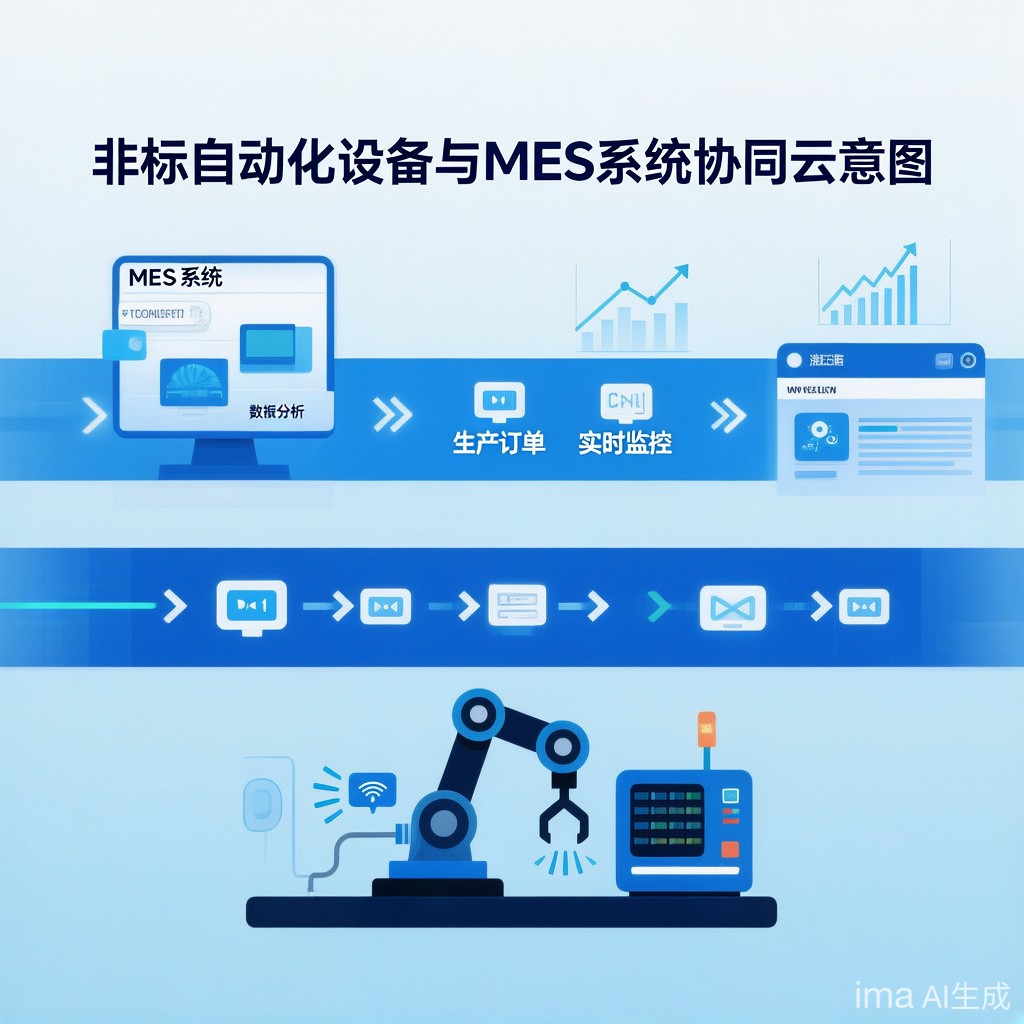
Coordinated operation between automated equipment and MES systems.
When looking for a non-standard automation company in Kunshan, the owner can break down the problem into two layers to consider:Device-level solutions address operational efficiency, while system-level solutions ensure process transparency.
Equipment Layer (Automated Equipment):Robotic material handling, automatic inspection, and dedicated machine processing solve the issue of human-machine efficiency at a specific workstation. After equipment deployment, it can significantly improve the capacity and quality stability of local processes.
System Level (MES System):This solution addresses the challenges of planning production schedules after orders are received, determining the correct sequence of operations, reporting exceptions, tracking quality, and calculating costs. Once implemented, the system makes the entire production process transparent and controllable.
If they are disconnected, common results are:
Equipment data resides within the equipment, production data resides in Excel, and external vendor data resides in WeChat.
The boss still relies on meetings to gather information, and is unable to keep real-time track of production status.
The benefits of automated equipment are difficult to quantify, and the return on investment is unclear.
Truly valuable on-site management requires achieving at least the following key actions:
Real-time order progress monitoring:No need to constantly ask supervisors for updates; the boss can see the progress of each mold at any time.
Timely reporting of work order completion:Scan to record work, reducing post-recording corrections, resulting in more accurate data.
Full-cycle external vendor tracking:Records are maintained for outgoing shipments, returns to the factory, and reconciliation, preventing information gaps.
Traceable quality issues:Trackable to specific work processes and responsible parties, enabling the accumulation of improvement experience.
Mobile access:Even when the boss is away, production status can be viewed via the mobile app.
Currently, AI-powered scheduling and quality alerts are starting to be implemented in practice, but don't let the concept mislead you. AI is not a panacea; it requires accurate underlying data. If process details, work times, equipment loads, and anomaly records are missing for an extended period, AI can only make judgments based on incomplete information. For small and medium-sized factories, it is more important to first collect and standardize data than to chase new concepts.
The management must actively drive the implementation, otherwise it is likely to result in a "two-layer" situation.
Whether it's equipment setup or MES implementation, fundamentally, it will change the existing on-site practices. Previously, operations relied on supervisors, technicians, and WeChat group notifications. Now, it requires scanning codes according to work procedures and tracking the flow according to the process, as well as recording any exceptions. If the management doesn't take the lead and only allows the IT department or production supervisors to implement this, there will be significant resistance.
The boss doesn't necessarily need to understand every technical detail, but they should clearly understand these three things:
Which data must be accurate:Core data such as progress, invoicing, external vendors, and quality must be accurately recorded; it is not acceptable to rely on backfilling.
Which processes cannot be bypassed:Critical processes must be executed according to system requirements; shortcuts are not permitted.
Which positions must be coordinated:Clearly define roles and responsibilities to ensure smooth system operation.
Otherwise, after the system goes live, the on-site operations will continue using the old methods, which will eventually lead to a situation where there are two separate systems: one in the system and one on-site. In this situation, neither the automated equipment nor the management system can function effectively.
Six key questions before selecting
If you are evaluating Kunshan Non-Standard Automation Company, we recommend that you first identify the three most pressing issues you are currently facing, such as: inability to control delivery times, confusion with external vendors, or difficulty in tracing quality. Once you have clearly defined these problems, you can then decide whether to prioritize upgrading equipment, implementing a system, or doing a pilot project together.
When selecting, it is recommended to first ask yourself the following questions:
Can real-time field data currently support automated operation?If the data is disorganized, it is recommended to first implement a management system and then consider equipment upgrades.
What are the goals of automation?Is the goal to improve efficiency, reduce costs, or enhance quality? With a clear objective, the solution can be precisely tailored.
Do the implementation team members understand the mold shop environment?Implementing the system on-site can be challenging if you lack practical experience. The implementation team should have experience in mold factories.
Can equipment and systems work together?Can device data be integrated into the system? Can the system guide device operation?
Will the owner be willing to actively drive the implementation?Without leadership, the system and equipment are likely to change.
Do you offer on-site implementation services?On-site implementation reduces the risk of failure, ensuring that the system is actually used.
Improvements in the mold and precision machining industries often require a gradual, step-by-step approach, focusing on optimizing key processes such as progress tracking, reporting, outsourcing, quality control, and cost management. Automation equipment can improve local efficiency, while management systems provide visibility into the entire process. Ultimately, business owners need to determine the optimal sequence of actions and prioritize tasks, avoiding unnecessary spending on solutions that appear promising but are not actually utilized.
Summary: Collaborative transformation, implemented in phases.
For mold factories and precision machining factories in Kunshan and surrounding areas, non-standard automation upgrades do not necessarily need to be implemented all at once. More importantly, it is crucial to identify the most suitable upgrade path, ensuring that equipment and systems work together effectively to truly improve production efficiency and management levels.
The key to successful transformation lies in three points:
Data must be accurate:Collect real-time data from the production floor to provide a foundation for automation and intelligence.
The process should be closed-loop:From order to production to cost accounting, creating a complete closed-loop system.
The management team is committed to:The CEO personally champions the implementation, ensuring that the system and equipment are fully adopted.
When you can clearly answer questions like "What is the equipment availability rate, what is the cost per mold, and where are the quality issues occurring" after automation, your factory has achieved the core capabilities of intelligent transformation. Non-standard automation is not the end, but rather a new starting point for continuous improvement in your factory.