Analysis of Price Differences for AI-Powered Agent Development: Three Barriers to Adoption by Enterprises and Their Solutions
2026-06-08 07:30:48
Introduction: The Real Challenges of Using AI in Businesses
Many companies, when discussing AI, initially react with "We want to try this too," but often get stuck when it comes to implementation. They struggle to decide whether to focus on customer service, knowledge base question answering, or business process automation. They also worry about high costs and the risk of investing in a tool that simply creates a chatbot without delivering tangible results.
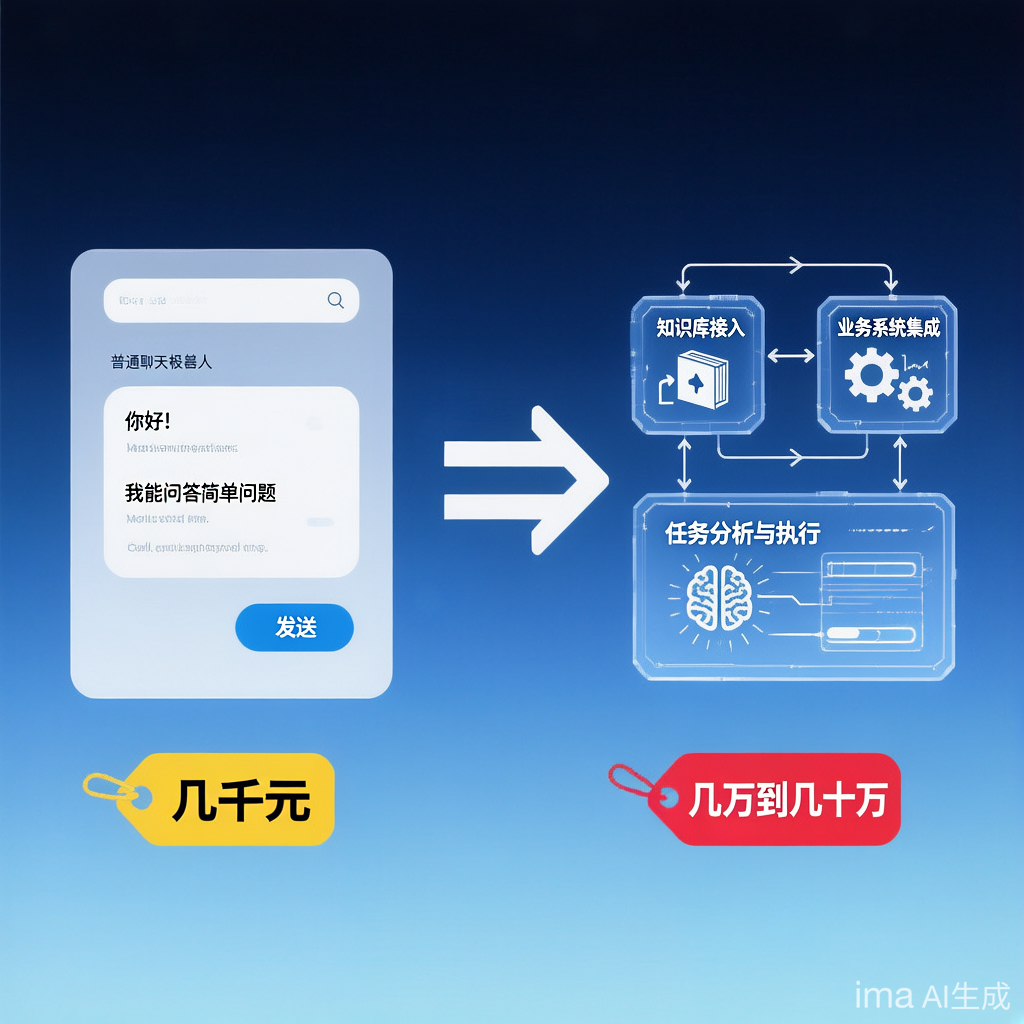
Underlying this situation,Smart Body Development PricingThe difference lies in the capabilities. While all may be referred to as "AI intelligent agents," some simply provide a chat interface, while others can integrate with enterprise knowledge bases, access business systems, and execute tasks based on rules, delivering results that are entirely different. Businesses need solutions that are tailored to their specific needs, not the cheapest option.
It's not that companies don't want to use AI; it's that they don't know where to start.
The demand for AI from businesses is real. Whether it's to improve customer service efficiency, optimize sales conversion, simplify internal inquiries, or automate repetitive tasks, AI has enormous potential applications. But why are many businesses still hesitant to fully implement AI?
The main reasons are:
Obstacle 1: Lack of clearly defined, practical use cases.
Many companies recognize the value of AI, but are unsure which specific business area to apply it to. Should it be used for customer service question answering, knowledge base management, or sales follow-up? The lack of clear use case definitions makes it difficult to launch projects.
Obstacle 2: Lack of understanding of the quotation system
The cost of developing intelligent agents ranges from several thousand to hundreds of thousands of dollars, making it difficult for companies to determine which price corresponds to which delivery content. Concerns include spending a large amount of money only to receive a simple chat interface, or worrying that a low-cost solution will not meet actual needs.
Obstacle 3: Concerns about implementation risks
AI projects have long cycles and high costs. If the results are not as expected, companies will incur significant trial-and-error costs. This concern has deterred many companies from pursuing AI projects.
Unlike ordinary chatbots and AI agents, the fundamental difference lies in their ability to "actually perform tasks."
To understand the differences in pricing for developing intelligent agents, it is first necessary to distinguish the fundamental differences between ordinary chatbots and AI intelligent agents.
Limitations of General Chatbots
Typical chatbots primarily handle a "question-and-answer" format. They can generate text and summarize content, but their understanding of a company's actual business operations is limited because they lack knowledge of your documents, policies, customer interactions, and internal processes. These tools are more like a "general assistant" rather than a "business expert."
Core capabilities of AI agents
The core of AI agents is not just chatting, but ratherIntegrate with enterprise knowledge base and business systems. It possesses the following core capabilities:
Knowledge Base Integration:Import PDF, Word, Excel, PPT, web pages, and Feishu documents, as well as other corporate data.
Business Understanding:Understanding the specific business processes, rules, and terminology of each enterprise.
Task Execution:Automatically handle tasks according to defined workflows, such as customer inquiries, lead follow-up, and document organization.
System Integration:Connect CRM, ERP, OA, and other business systems to enable data flow.
Typical Application Scenario Comparison
| Application Scenarios | Basic Chatbot | AI-powered intelligent body |
|---|---|---|
| Customer Support Q&A | Answer general questions, relying on the quality of user inquiries. | Read company FAQs and service policies, support multi-turn follow-up questions, and automatically handle common inquiries. |
| Knowledge Base Q&A | Simple information retrieval, with unclear knowledge boundaries. | Import enterprise documents, automatically vectorize and segment, and generate precise answers through RAG retrieval. |
| Sales Lead Generation | Provide general sales advice | Identify potential leads, set follow-up reminders, and score leads to increase conversion rates by 30%+ |
Smart body development pricing primarily depends on the complexity of the scenario.
The differences in pricing for intelligent body development primarily stem from variations in complexity and the scope of deliverables. From the perspective of Moges' delivery model, the pricing structure is clear and transparent:
Single-scenario intelligent body (2999-8000 yuan)
Suitable for simple question-and-answer and information retrieval scenarios, typically delivering a usable version in 1-3 days.
Customer Service Agent:Starting from 3999 yuan, 7×24-hour automatic response, replacing more than 60% of repetitive customer service tasks.
Knowledge Base Q&A Agent:Starting from 4999 yuan, transform scattered documents into a searchable AI knowledge system.
Sales Lead Generation Engine:Starting from 7999 yuan, identify potential leads, perform intelligent follow-up, and score leads to increase conversion rates by 30%+
Automated Workflow Intelligent Agents (10,000 - 30,000 yuan)
Suitable for handling repetitive business processes with a delivery cycle of 5-10 days.
Automatically process form approvals
Intelligent report document generation
Automated data collection and analysis
Multi-agent collaboration system (20,000-50,000 yuan)
Suitable for multiple intelligent agents to collaborate and complete complex tasks, with a delivery cycle of 10-20 days.
Multi-department collaborative workflows
Cross-system data integration
Automate complex business processes
Post-implementation support services
Pricing can be calculated from 500 to 3000 RMB per month per intelligent entity, including model invocation, knowledge base updates, and performance optimization.
A low price does not necessarily mean low quality; the key factor is the delivery method.
AI projects are often expensive, not necessarily due to the technology itself, but rather due to long initial communication cycles, complex solution packaging, and complicated delivery chains.
Limitations of large-scale solutions
Common pricing for large-scale solutions starts at 200,000, with implementation cycles lasting 3 months or more. This makes it too expensive for small and medium-sized enterprises, as the trial and error costs are high. Although these solutions offer comprehensive functionality, their long implementation cycles and slow time to value make them unsuitable for quickly validating scenarios.
Risks associated with individual developers
While individual developers may offer lower prices, common issues include inconsistent quality, inadequate after-sales support, and a limited technology stack. The lack of enterprise-level project management and quality assurance systems results in higher risks.
The boundaries of low-code platforms
Low-code AI platforms offer quick setup, but their functionality has clear limitations, and deep customization and system integration can be challenging. They are suitable for simple scenarios, but often struggle to meet complex business requirements.
Advantages of Engineering-Driven Delivery
Moges' approach is more focused on engineering delivery: leveraging a mature architecture to reuse common capabilities, and then customizing for the company's knowledge base, terminology, processes, and permissions. This allows for the implementation of...Smart Body, starting from 2999 yuan, with delivery as fast as 3 days.The key here is not to make AI overly "flashy," but rather to first get a specific scenario running so that the results can be quickly verified.
What businesses should focus on, besides price.
When evaluating quotes for intelligent body development, it is recommended to focus on answering these four key questions:
Question 1: Can I import real company data?
It only connects to large models; it is not an enterprise-level intelligent system. A true AI intelligent system must be able to access and utilize the company's own knowledge base, including documents, policies, processes, and customer data.
Question 2: Can the system be continuously optimized?
7-day free optimization after launch is more important than one-time delivery. The AI engine needs continuous optimization based on actual usage, including updating the knowledge base, fine-tuning the model, and improving processes.
Question 3: How is the data handled?
Supports private deployment, allowing data to remain within the company's internal network, along with encryption, access control, and audit logs. Data security is the fundamental requirement for enterprise-level AI applications.
Question 4: What should I do if the results are not as expected?
If dissatisfied, full refund guaranteed. This provides greater assurance than verbal promises, allowing businesses to take risks and try new things with confidence.
Kunshan Moges Information Technology Co., Ltd. has been engaged in technical development since 2012, accumulating 14 years of technical experience and delivering hundreds of actual projects. The value of this background lies in the fact that the company's AI solutions are not just demo pages, but rather, they incorporate knowledge bases, permissions, interfaces, exception handling, and ongoing maintenance, ensuring system stability and reliability.
First, avoid a "big and comprehensive" approach; start with a high-frequency scenario.
If a company hasn't yet adopted AI, it's often not a lack of ideas, but rather a lack of a cost-effective, short-cycle, and low-risk starting point.
Choose the right pilot scenario
Scenarios such as customer service, knowledge base Q&A, and sales follow-up are best suited as the initial step because:
Clear Requirements:Clearly defined business objectives, making it easy to define success criteria.
Easy to verify results:The return on investment (ROI) is easily calculated, and the results are immediately visible.
Manageable Risk:Even if there is a failure, the impact is limited.
Complete information:Typically includes readily available documentation, processes, and data.
Implementing a "Small Steps, Fast Progress" Strategy
A practical suggestion is: First, choose a scenario that occurs daily, involves significant manual effort, and has relatively complete data. Implement a working intelligent agent in this scenario. You can see real results within 3 days, which is more valuable than spending several months discussing a large-scale solution.
Key elements for success
Clearly defined business objectives:AI is not about showing off, but about solving real business problems.
High-quality knowledge base:The quality of the knowledge base directly determines the performance of the intelligent agent.
A reasonable implementation pace:First, start with a small scenario to verify the effectiveness, and then gradually expand.
Continuous Optimization and Iteration:AI applications are not a one-time solution and require continuous optimization.
Management Support:AI applications will change existing workflows, and require support and promotion from management.
Conclusion: Choosing the right path for developing your own intelligent system.
The differences in pricing for intelligent body development highlight the distinctions between various delivery methods and service content. Businesses need solutions that are not necessarily the cheapest or the most expensive, but rather the ones that are best suited to their specific needs.
The key question to consider is: which repetitive task within your business is most suitable for AI to handle first? Is it customer service inquiries, internal queries, sales follow-ups, or another business scenario? Identify this initial point of entry and validate the effectiveness with a starting price of 2999 yuan and a 3-day delivery, with a full refund guarantee if you are not satisfied.
AI is not the future, it is the present. Choose the right delivery method to enable your business to truly utilize AI, improve efficiency, reduce costs, and create value. Developing AI solutions does not necessarily need to cover all business areas at once. It is more practical to first solve a specific problem effectively, and then expand later.