Enterprise AI Implementation: The Fundamental Differences Between AI Agents and Chatbots
2026-06-09 07:30:51
Introduction: A New AI Paradigm Beyond "Question-and-Answer Windows"
Many companies are exploringEnterprise AI ImplementationAt that time, the first thought often is to "add a question-and-answer window to the existing system." This approach actually underestimates the enormous potential of AI intelligent agents. Ordinary chatbots can only respond to pre-defined questions, and they are easily prone to providing incorrect or irrelevant answers when dealing with complex business contexts, document details, or continuous follow-up questions. Traditional software, on the other hand, is like a fixed assembly line, where users must precisely click through each step, and it is passively executed.
The key difference between AI agents and traditional robots lies in their ability to deeply integrate with a company's knowledge base and business systems. AI agents can understand the ultimate goal of a task and autonomously call upon relevant capabilities to complete a series of actions. For example, when a customer asks, "Is this service suitable for our company?", a traditional robot might simply send a generic introduction. However, a true AI-powered customer service agent can combine detailed company information, historical service cases, and internal rules to confirm customer needs through multiple interactions, ultimately providing highly accurate and business-specific answers.
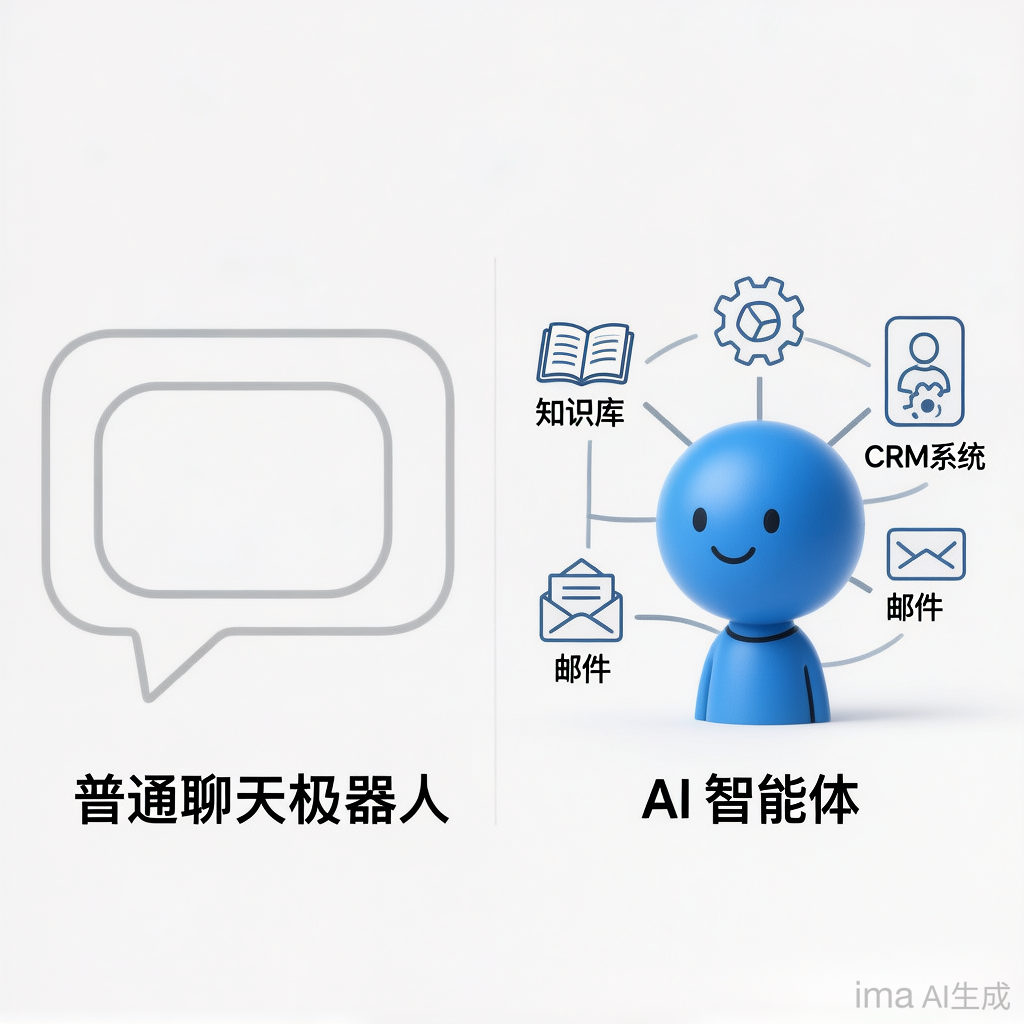
Common pitfalls in implementing AI for businesses: Lack of a closed business loop.
Currently, the market offers a range of AI tools with impressive demonstration capabilities. However, in practical applications, they often encounter bottlenecks in three key areas: ineffective integration with internal enterprise data, difficulty in aligning with existing business processes, and a lack of ongoing optimization after deployment. Ultimately, employees find that using AI actually increases the number of steps required, leading them back to the old methods of copying and pasting. As a result, AI becomes an expensive "advanced search box."
A truly usable and value-creating AI intelligent system must meet at least the following three core conditions:
Gain a deep understanding of your company's data:Capable of seamlessly importing content in various formats, including PDF, Word, Excel, PPT, web pages, and Feishu documents, and building a structured and highly searchable knowledge base.
Supports continuous contextual conversations:Overcoming the limitations of simple question-and-answer, it can understand the context and nuances of conversations, enabling proactive follow-up questions, information supplementation, and logical reasoning.
Possesses the ability to execute business actions:By utilizing API interfaces, the AI can seamlessly integrate with existing business systems such as CRM and ERP, transforming it from a passive "information provider" into an active "task executor," functioning as a digital employee.
These three points represent the fundamental difference between AI intelligent agents and ordinary chatbots. The former are specifically designed "AI employees" for particular business scenarios, while the latter are primarily general-purpose dialogue interfaces.
Unveiling the "3-Day Delivery" Secret: Engineering is the Core Driver
Many companies mistakenly believe that AI projects inherently require several months, due to a perception of past capital-intensive project models. Solutions from large AI service providers typically start at $200,000 and have a cycle length of 3 months or more, with long communication chains, making them suitable for large projects with ample budgets. However, for most small and medium-sized enterprises, the most pressing need is not a grand blueprint, but to quickly validate the feasibility of a high-frequency business scenario.
Moges Technology employs a methodology that focuses on practical engineering implementation: We break down common AI intelligent body capabilities into a series of reusable, standardized modules, including multi-model intelligent routing, RAG (Retrieval-Augmented Generation) engine, vector database, visualization workflow engine, and a fine-grained permission control system. This allows individual intelligent bodies to achieve:1-3 days of ultra-fast deliveryThis is not achieved by shortening testing times, but rather by pre-packaging and standardizing the underlying technical capabilities, allowing all efforts to be focused on defining enterprise-specific knowledge, defining business rules, and optimizing human-machine interaction details during the project implementation phase.
Prioritized Launch: Four Ideal Scenarios for AI-Powered Systems
The key to successful AI implementation for businesses lies in avoiding the initial pursuit of "big and comprehensive" solutions. A more reliable strategy is to select business scenarios with clearly defined problems, relatively concentrated data requirements, and easily quantifiable results as entry points.
Smart Customer Service Assistant:Offers 24/7 uninterrupted automated response, in-depth understanding of enterprise knowledge bases, and support for complex, multi-turn conversations, effectively replacing over 60% of manual customer service workloads. Starting price: 3999 yuan.
Knowledge Base Q&A Assistant:Integrate scattered documents, manuals, and procedures into a single, self-service knowledge hub, empowering employees and customers. Starting at $4999.
Sales Lead Acquisition Assistant:Automatically identify potential customers, execute intelligent follow-up, and perform lead quality scoring, helping to increase sales conversion rates by more than 30%. Starting price: 7999 yuan.
Workflow Automation Assistant:Seamlessly integrates with existing business systems to automatically execute various repetitive, rule-based tasks, resulting in a 5 to 10 times increase in efficiency.
If you only need to validate a single scenario, a basic intelligent agent.Starting from 2999 yuanCan be launched immediately; for more complex automation needs, the price typically ranges from 10,000 to 30,000 yuan. This transparent and lightweight pricing model is undoubtedly more appealing compared to the solutions offered by many traditional AI companies.
Data Security: Private deployment is the foundation for enterprise-level applications.
When implementing AI, businesses face the most sensitive and critical issue: data security. Customer information, internal regulations, and core business documents, once exposed to uncontrolled external environments, pose significant and potentially unquantifiable risks. Therefore, when planning the implementation of AI within a business, it is essential to proactively consider data boundaries and security architecture.
Private DeploymentThis is a critical option for ensuring data security: by deploying the entire AI system within the company's internal network servers using Docker container technology, combined with end-to-end data encryption, strict access control, and comprehensive audit logs, all core data is guaranteed to remain within the company's controlled environment from beginning to end. For scenarios with slightly lower data sensitivity, flexible options such as encryption cloud services can also be selected based on budget and security level requirements.
"Full refund if unsatisfied": Rooted in deep confidence in our delivery performance.
Since its establishment in 2012, Kunshan Moges Information Technology Co., Ltd. has accumulated14 years of experience in technology development and project deliveryWe have successfully completed hundreds of real-world projects. We understand that building an effective AI intelligent system goes far beyond simply writing a prompt or using a template. The real challenge lies in systematically organizing enterprise knowledge, precisely defining the boundaries of the AI's responses, and appropriately handling various exceptions.
Precisely because of this, our delivery guarantees are not empty promises. Each intelligent agent comes with a 7-day free optimization period after deployment. Furthermore, you can choose monthly maintenance services, which cover model invocation, knowledge base updates, and continuous performance optimization. The most core guarantee is:If the results do not meet expectations, full refunds are supported.This straightforward and powerful commitment aims to eliminate partnerships that focus solely on selling concepts without regard for the ultimate results, ensuring that every customer receives genuine and measurable value.
Conclusion: Start your AI journey with a specific problem.
Don't start implementing enterprise AI with grand strategic discussions; instead, begin with a specific business pain point. Instead of asking "Should we do AI?", ask: "Which repetitive tasks within the company consume the most manpower on a daily basis? Which critical piece of information is the most difficult to quickly find? Which business process has the most significant efficiency bottlenecks?"
If this problem can be clearly defined, the AI intelligent system has the opportunity to generate the first verifiable version in just a few days. The ultimate goal of AI technology should not be to add new burdens to businesses, but to empower employees – to allow them to spend less time reviewing complex documents, less time on repetitive communication, and less time performing mechanical tasks. The starting point for business AI success is often a small but real and urgent business scenario.