Want to Build an Independent E-commerce App? Let's Talk About the Real Pitfalls in E-commerce App Development Costs
2026-06-11 07:01:32
Introduction: The Urgent Need for Independent E-commerce Apps and the Real Dilemma
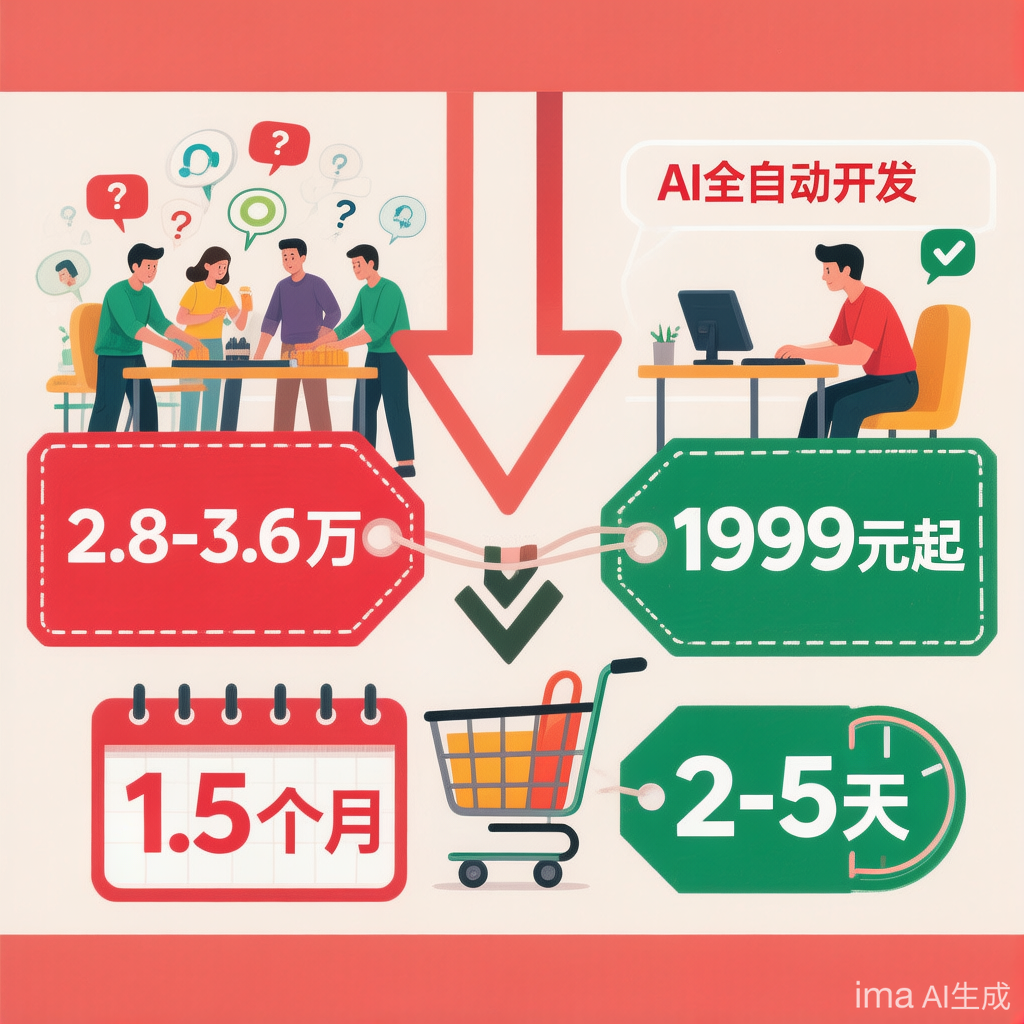
Last month I helped a friend who runs a private-domain women's clothing business ask about app development. She had been doing business on WeChat for three years and was pained by platform commissions, so she wanted to build her own independent e-commerce app and bring her old customers into it. But she approached two traditional outsourcing companies, and the first quotes were RMB 28,000 and RMB 36,000, with a cycle of a month and a half and extra charges for requirement changes. That scared her accumulated startup capital right back, and she said she might as well keep enduring the commissions.
This is not an isolated case. More and more small and medium-sized merchants are aware of the risk of platform dependence and eager to have their own independent e-commerce platform. However, high development costs and long delivery cycles have become the biggest stumbling blocks. This article will deeply analyze the cost traps of traditional e-commerce app development and reveal how AI fully automated development can achieve low-cost, high-efficiency independent e-commerce app construction.
Why the Cost of Traditional E-commerce App Development Deters the Vast Majority
In fact, it is not just this friend. I have seen too many small and medium-sized sellers who want to build independent apps get stuck at the cost step. In the traditional outsourcing model, everything from requirement communication to front-end and back-end coding relies on manual time. A project takes at least three to five people one or two months, and with labor costs sitting there, the quote naturally cannot come down.
Cost Structure Analysis of Traditional Outsourcing
For conventional e-commerce apps, traditional outsourcing quotes generally range from RMB 10,000 to 50,000. Even for only basic product display and order management functions, it starts at RMB 20,000, and later changes such as modifying a category or adding an activity entry all incur additional service fees. The specific cost composition is as follows:
Product manager: requirement analysis, prototype design, project management (20-25% of total cost)
UI/UX designer: interface design, user experience optimization (15-20% of total cost)
Front-end developer: interface implementation, interaction logic (25-30% of total cost)
Back-end developer: server-side logic, database design, payment integration (25-30% of total cost)
Test engineer: functional testing, compatibility testing, performance testing (10-15% of total cost)
Project management and communication cost: cross-department coordination, customer communication, progress tracking (10-15% of total cost)
Main Pain Points of Traditional Outsourcing
High initial investment: a starting cost of RMB 20,000-50,000 puts huge pressure on small merchants
Long delivery cycle: one to two months of waiting misses market opportunities
Hidden charging traps: requirement changes and function adjustments all require extra payment
High-risk investment: once the finished product does not meet expectations, the invested funds cannot be recovered
Subsequent maintenance costs: bug fixes and feature updates after launch all require continuous payment
Today's E-commerce App Development Costs Have Long Broken Out of the Traditional Framework
In the past two years, AI technology has landed in the development field and has brought the entire cost and cycle down. Moges Technology does AI fully automated Android app customization, replacing 90% of the manual development work and directly reducing costs to one-tenth of traditional outsourcing. Not only do basic versions start at RMB 999, but even e-commerce customization starts at only RMB 1,999, lower than the deposit of many outsourcing firms.
Technical Advantages of AI Fully Automated Development
Unlike the H5 shell of low-code platforms, it is written in real native Android code, compatible with 99% of devices running Android 8.0 and above, runs smoothly without lag, and meets app store listing requirements.
Intelligent requirement parsing: AI automatically understands e-commerce requirements and converts them into technical specifications
Automated code generation: generates high-quality native code based on standard e-commerce templates
Prebuilt e-commerce function modules: product display, shopping cart, order management, payment integration, etc.
Intelligent UI construction: automatically generates user interfaces that follow e-commerce best practices
Automated testing: built-in comprehensive test suites for e-commerce scenarios
Concrete Manifestations of the Efficiency Revolution
The whole process is AI fully automated development. From requirement input to code generation and packaging, you can get the APK the same day at the fastest; even an e-commerce app with order management and payment functions only takes 2-5 days to get the finished product.
Requirement confirmation: requirement sorting completed in 1-2 hours
Code generation: completed automatically by AI, no manual coding required
Test verification: automated testing ensures functional completeness
Packaging and delivery: one-click generation of installable APK files
Clear Pricing to Avoid Hidden Consumption Pitfalls in Development
The biggest fear in app development is low-price bait followed by layer upon layer of price increases. Many small studios make money this way: quote a few thousand at first, then add tens of thousands after completion. Now, with this AI customization model, prices are clearly marked by app type, with no hidden consumption:
Transparent Pricing System
Display apps: from RMB 999, delivered the same day at the fastest
Utility apps: from RMB 1,499, delivered in 1-3 days
E-commerce apps: from RMB 1,999, delivered in 2-5 days
Complex customization needs: quoted according to actual functions, delivered in 3-7 days
Zero-Risk Cooperation Guarantee
To ease customers' concerns, this model is now willing to make a zero-risk commitment. Moges says a full refund if you are not satisfied: if the delivered APK does not meet the requirements you raised, you get a full refund directly, with no quibbling clauses. After delivery, you can also fine-tune the content 3 times for free, and you can still reach after-sales service if there are problems later, so they will not disappear after payment.
Full refund commitment: 100% refund if the finished product does not meet requirements
Free fine-tuning service: 3 free content adjustments after delivery
Permanent after-sales support: technical support for problems during use
No hidden charges: one-time payment with no subsequent mandatory consumption
Core Functional Modules of E-commerce Apps
Basic E-commerce Functions
Product display: category management, product details, image display
Shopping cart: adding products, quantity adjustment, price calculation
Order management: order creation, status tracking, history
User account: registration and login, personal information, shipping address
Advanced E-commerce Functions
Payment integration: WeChat Pay, Alipay and other mainstream payment methods
Promotional activities: coupons, full-reduction discounts, limited-time discounts
Inventory management: real-time inventory synchronization, low-stock alerts
Data statistics: sales reports, user behavior analysis
Applicable Scenario Analysis
E-commerce Scenarios Best Suited to AI Fully Automated Development
Private-domain e-commerce: WeChat fan conversion, old customer maintenance
Vertical e-commerce: specialized malls for specific categories
Local e-commerce: regional product sales, same-city delivery
B2B e-commerce: inter-enterprise wholesale business, supply chain management
Personal brand e-commerce: designers, craftspeople, content creators
E-commerce Scenarios Not Suited to AI Fully Automated Development
Ultra-large e-commerce platforms: require handling massive concurrency and complex business logic
Highly customized needs: require deep customization of the underlying architecture and algorithms
Special industry requirements: e-commerce applications in strongly regulated industries such as finance and healthcare
Selection Advice and Implementation Strategy
Decision Framework
Assess business scale: determine whether you fall into the small and medium-sized merchant category
Clarify functional needs: list the required e-commerce function modules
Make a budget plan: set a reasonable budget based on pricing starting at RMB 1,999
Consider time requirements: whether you need a usable app within 2-5 days
Weigh risk tolerance: choose a service provider with a refund guarantee
Implementation Steps
Requirement sorting: clarify core e-commerce functions and user needs
Solution selection: choose the appropriate development approach based on requirement complexity
Rapid validation: validate the business model and user feedback through an MVP
Iterative optimization: optimize functions based on user feedback
Official launch: complete the final version and officially launch it to the market
Conclusion: Let Every Small and Medium-sized Merchant Have an Independent E-commerce Platform
Many people's understanding of app development is still stuck ten years ago, believing that you must spend a lot of money and wait several months to build one. In fact, after technological iteration, the path of low-cost trial and error is already very clear. If you just want to build a basic version first to validate demand, there is absolutely no need to invest tens of thousands at the start. Spending a little over a thousand to get a finished product and run it through the market is actually much safer than pouring in large funds and developing blindly.
Independent e-commerce apps are no longer the patent of large enterprises. AI fully automated development enables small and medium-sized merchants to have their own mobile e-commerce platforms at extremely low cost and risk. This is not only technological progress but also a business model innovation. Shaking off platform commissions and building your own private-domain traffic - now is the best time.
Remember, a successful e-commerce business does not depend on how much money is invested, but on whether it can respond quickly to market demand. Through AI fully automated development, you can gain the same competitive advantage at one-tenth of the cost and one-tenth of the time.