Which sheet metal quoting software is the most user-friendly? Don't just focus on "instant quoting," but also consider whether the quoting process can be closed.
2026-06-20 08:01:50
Introduction: Orders are coming in, but profits are disappearing?
A few days ago, I had a conversation with the owner of a company specializing in sheet metal parts, and he was very direct: "Salespeople are quoting prices faster, and customers are putting more pressure on prices. While there are many orders, when we calculate the actual profits at the end of the month, we find that some orders barely generate any profit."
What's the problem? It's not that no quotes are being generated, but rather that...Discrepancy between quoted prices and actual production costs.. When quoting, material, laser cutting, bending, welding, and painting costs were estimated based on experience. However, when production actually began, it was discovered that material utilization was not accurately estimated, the number of bending operations was higher than anticipated, painting was outsourced and required rework, and the urgent addition of a new order diluted the working hours. As a result, the finance department could only see the overall account and could not determine where each order was incurring losses.
Therefore, many bosses search forWhich sheet metal quoting software is the most user-friendly?In reality, we're not just looking for a software that can quickly calculate prices; we're trying to solve a more fundamental problem:Can the quoted price withstand production verification? Can the quoted price model be accurately validated by reversing the order after it is completed?
Cognitive correction: Sheet metal pricing is not simply a matter of calculating material costs.
The pricing variables in the sheet metal industry are numerous: material grade, plate thickness, unfolded dimensions, utilization rate, cutting length, number of holes, number of bending angles, welding length, grinding requirements, surface treatment, packaging and transportation, and outsourcing costs. Each of these factors can impact gross profit.
Some software promotes "automatic quoting based on imported drawings," which sounds convenient, but business owners should be aware that:Whether the software can recognize drawings is one thing, and whether the pricing logic aligns with your factory's actual processes is another.
For example, the same 2.0 cold plate component, some factories have high laser cutting efficiency, while others have bottlenecks in bending. Some factories frequently outsource painting and experience long lead times. If a quotation software simply applies standard unit prices, it may appear neat initially, but it can easily lead to "fast quoting but also fast losses."
Core Requirements: A useful quoting software must solve these 5 problems.
From a factory management perspective, sheet metal quoting software should not only serve sales staff, but also be understandable and usable by owners, production, and finance departments.
The quotation basis must be clear:Materials, processes, outsourcing, management expenses, and profit margins should not be combined into a single total price. This will allow for accurate analysis and identification of the specific area with the largest discrepancies during post-implementation review.
The production route must be practical and implementable:For processes such as laser cutting, bending, welding, grinding, and painting, it is essential that the information is not only included in the quotation, but also corresponds to the subsequent production execution.
The actual cost must be recoverable:Once an order is completed, actual material usage, actual labor hours, external vendor costs, and rework losses must be able to be reflected in the cost analysis. Otherwise, pricing will always rely solely on the experience of the master craftsman.
Data collection on-site should be simple:If on-the-spot reporting is complex and employees are unwilling to use it, the time data within the system will become inaccurate, and the pricing model will become increasingly skewed (recommended: use barcode reporting).
External vendors must be under control:For processes such as painting and electroplating, which are external, it is crucial to establish a closed-loop system for tracking the quantity of materials sent out, the quantity received, and reconciliation. Relying on Excel and WeChat for record-keeping will inevitably lead to discrepancies and financial losses.
Common Misconceptions:Pricing software isn't about having the most features. Small factories should instead focus on the core issues that have the biggest impact on profitability, such as managing materials, processes, outsourcing, and cost accounting.
In-depth analysis: Relying solely on quotes without considering production details makes it difficult to accurately determine the best price.
The pricing needs to be increasingly accurate, and this requires correction based on actual data. For example, when estimating the bending cost for a particular part, the initial estimate was 30 minutes, but the actual time used was 50 minutes. Was this due to complex drawings, frequent tool changes, or a lack of familiarity on the part of the operator? If the cost of outsourcing an order exceeds the initial estimate, was this due to a price increase by the supplier, or was it caused by rework?
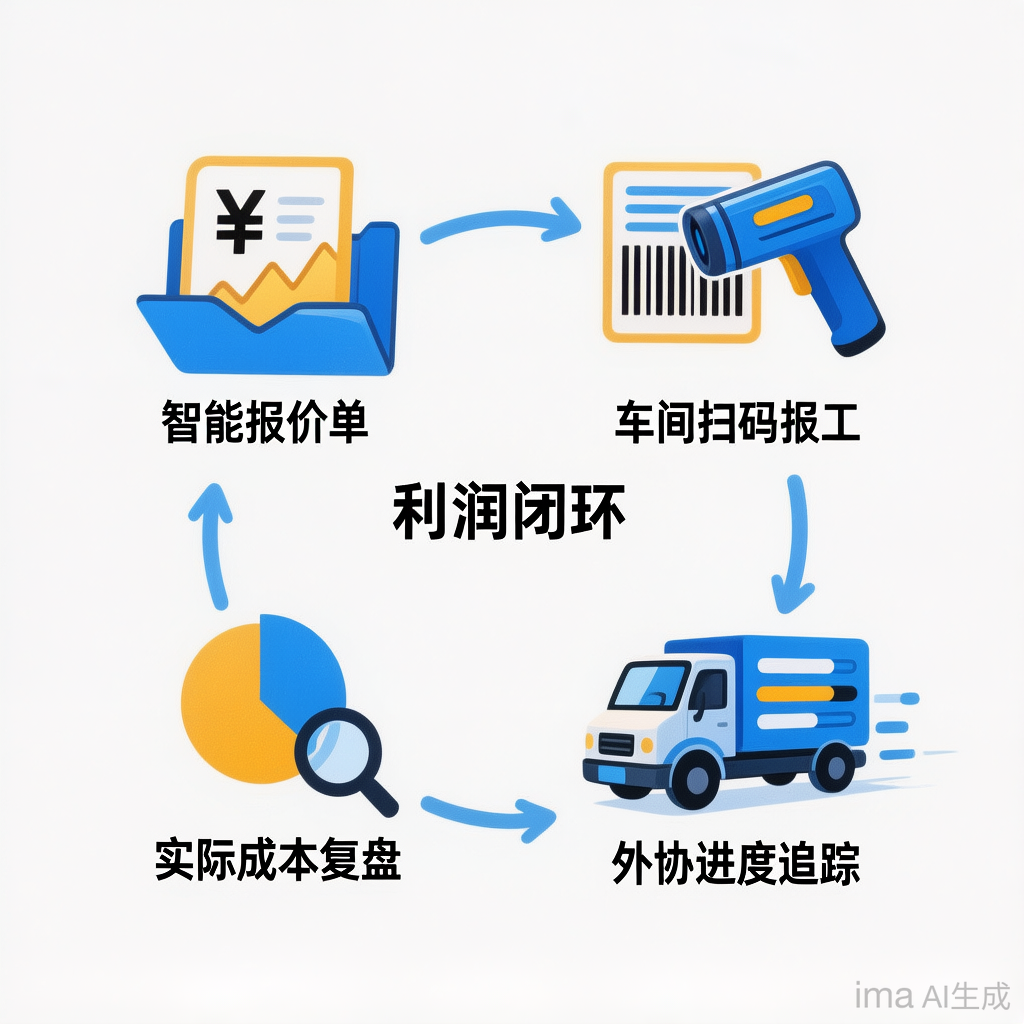
These issues make it difficult to track production progress, submit invoices, manage external vendors, and perform cost accounting.What a factory truly needs is not just a pretty quotation, but a management logic that can connect "quotation-production-cost-review."
Similarly, if employees have to fill out complex forms for each operation, the system simply cannot be implemented. The advantage of methods like scanning and reporting, which are extremely simple, is that they are easily accepted by frontline workers. Without real progress and real working hours, cost accounting is inaccurate; inaccurate cost accounting leads to inaccurate quotes based on intuition.
External Management: Even if pricing is meticulously detailed, you'll still lose money if you miss something here.
Sheet metal factories commonly have outsourcing processes (painting, electroplating, heat treatment, etc.). When quoting, outsourcing costs are often estimated based on historical prices, but during execution, issues such as unclear quantities, unclear return quantities, unclear supplier reconciliation, and unclear rework responsibility can arise.
If outsourcing processes rely solely on WeChat groups and manual reconciliation at the end of the month, the pricing data in the quotation system can only be considered static data. When selecting software, it is essential to ask:Can the entire process of sending, receiving, and reconciling external orders be closed in a loop?These features have a more significant impact on profitability than simply adding an additional quotation template to the interface.
Practical Selection: Ask your supplier these 7 questions directly.
If you are comparingWhich sheet metal quoting software is the most user-friendly?We recommend that you not only listen to the sales team's explanation of the features, but also directly ask the following questions:
Can the materials, processes, outsourcing, and profit margins in the quotation be broken down and viewed separately?
After an order is completed, can the actual cost be automatically compared to the quoted price?
How is on-site work time data collected? Are frontline employees easily able to operate it?
Are there complete records for external vendor deliveries, receipts, and reconciliation?
Can the boss view order progress and exceptions on his mobile phone?
How is the system implementation carried out? Is there a "pilot-first, then rollout" mechanism?
Does the software company understand the factory environment, or does it only configure according to standard processes?
After asking these questions, we can effectively eliminate a large number of software vendors who only focus on demonstrations and lack practical field experience.
Conclusion: Don't be misled by the phrase "automatic quoting"
Automated quoting can be valuable, but it should not be overemphasized. If a company lacks clear internal manufacturing standards, has inaccurate cost data, or has opaque external vendor costs, automation will simply amplify existing errors.
A truly useful sheet metal quoting software should enable more data-driven quoting, allow for post-order analysis, and provide management with insights into which orders are profitable and which are merely busy work.Getting a quick quote is just the first step. Accurate quotes, clear cost information, and clearly defined responsibilities are what provide long-term value.