Which external manufacturing management software is the best? Don't just look at the features; see if it can effectively manage the Bill of Materials (BOM) and order fulfillment.
2026-06-20 10:02:57
Introduction: The root cause of problems arising from outsourcing is often due to poorly executed outsourcing contracts.
Many equipment manufacturers search for "Which external manufacturing management software is best?My initial reaction was to check if the modules for managing external orders, suppliers, reconciliation, and payments were complete. This approach seems logical, but in the non-standard automation industry, the real culprit that causes chaos with external collaborations is often not the external order itself, but rather...The BOM order placement on the front-end does not have proper control..
The origin of an external order should be determined from which project, which equipment, and what is the original demand specified in the BOM. Also, it's important to determine if there's any mixing with in-house manufactured parts. Since we can't fully clarify the situation upfront, even the best external order tracking software will only provide supplementary records. Therefore, when evaluating whether a particular external order software is good, the key factors to consider are:Does it start with the project BOM and naturally integrate external processing, and can it connect acceptance, receiving, and reconciliation into a single workflow?
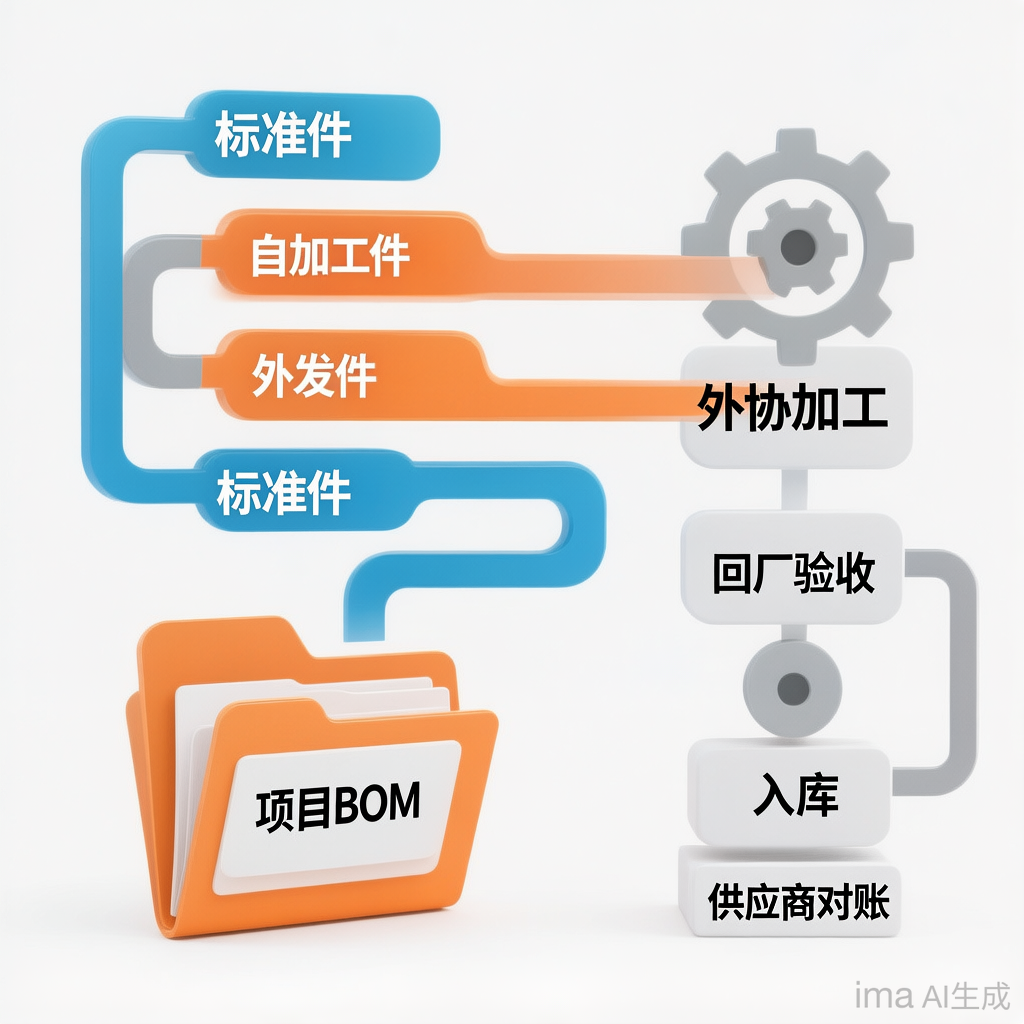
1. The issue with outsourcing to non-standard equipment manufacturers is not a simple procurement issue.
Standard parts for industry-wide procurement materials have fixed models, but for non-standard equipment, there are standard parts, outsourced parts, and parts manufactured in-house. Modifying the BOM, replenishing materials, and canceling orders are common practices. The most problematic aspect of outsourcing is:
Once the Bill of Materials (BOM) is generated, it is not clear which parts need to be externally sourced. Confirmation is obtained through verbal communication between engineering, procurement, and production departments.
Multiple external suppliers are working on the same project simultaneously, and after parts are returned, the only information available is "a batch has arrived," without knowing which specific purchase order the parts correspond to.
Upon acceptance and receiving, the physical goods are inspected, and the project manager still sees the status as "Not Completed."
During the end-of-month reconciliation, the quantities sent out, quantities received, and quantities put into inventory do not match. The only way to resolve this is to review chat logs and Excel spreadsheets.
These issues cannot be resolved simply by hiring an additional external vendor. What non-standard equipment manufacturers truly need is to integrate external processing into the main project workflow, rather than simply creating a separate external vendor record.
II. The Starting Point for Outsourcing Software: Automatic Generation of Detailed BOMs from Purchase Orders
If the software's external vendor management starts with manually adding new external orders, it only addresses "record-keeping." In non-standard projects, the source of external vendor requirements should be the BOM. Once the BOM for equipment is organized, the system can then separate different types of materials when placing orders: standard parts go through procurement, and self-made parts enter the processing task.External shipment creation of detailed external processing..
External processing details are automatically generated from the BOM order, which can at least reduce three types of issues:
Avoid missed parts:Parts that need to be sent out, as specified in the BOM, will not be missed due to manual data entry.
Minimize mixed components:Standard parts, parts manufactured in-house, and parts outsourced to external vendors all follow separate processes, making it difficult to consolidate them into a single comprehensive overview.
Excellent Traceability:Post-acceptance, receiving, and reconciliation processes can all be traced back to the project and BOM source.
Moges PMS9 operates based on this logic: using the project BOM as the core, generating detailed outsourcing processing information after an order is placed, and then entering the outsourcing order, acceptance, receiving, reconciliation, and other stages. Outsourcing is integrated throughout the entire project workflow.
III. External Acceptance and Warehouse Integration: Eliminating Information Silos
Unlike outsourcing and purchasing standard parts, parts received from external vendors directly impact the assembly rhythm. Even a slight deviation in hole placement or a shortage of one part can cause a bottleneck on the assembly line.The external acceptance process must link the "external order" and the "acceptance" records.The system should clearly indicate which parts are on which external purchase orders, whether they can be accepted and entered into inventory after acceptance.
Furthermore, after external component acceptance, the most meaningful aspect for the project is the receiving and subsequent usage. If there is no linkage between external acceptance, procurement acceptance, and receiving, the assembly team will still be unsure whether the components can be used. A good system allows external components to undergo quality inspection and receiving after returning to the factory, directly linking inventory data with project requirements.
4. Reconciliation is not a task for the end of the month; the difficulty is determined by each step taken beforehand.
The biggest fear when outsourcing reconciliation is the lack of accurate records upfront. If the data on the quantity sent, received, accepted, and put into inventory is not accurately recorded, reconciliation at the end of the month will require re-processing.
A suitable system should be able toSupplier Purchase Invoice ManagementPrioritize business outcomes. Outbound orders, acceptance, and receiving all follow established processes, providing a basis for subsequent reconciliation, confirmation, and payment planning. Finance no longer needs to search for vouchers in chat logs, and procurement no longer needs to temporarily organize tables to explain discrepancies.
V. Avoiding Pitfalls in Selection: Focus on asking detailed questions rather than watching demos.
When choosing an external processing management software, it's recommended that non-standard automation companies directly ask the following specific questions:
After placing a BOM order, can it automatically generate the details for external processing?
Can outward orders be created in bulk based on detailed information, rather than requiring manual entry for each item?
After sending goods back to the factory, is there a management process for acceptance? Can the goods be accepted and then proceed to the receiving process?
Do external parts, standard parts, and self-made parts follow different business paths, but can still be returned to the same project?
Does the system support invoice reconciliation, confirmation, and payment scheduling for suppliers?
Managing external manufacturing operations doesn't have shortcuts. Establishing clear processes for BOM sourcing, external execution, receiving, and vendor reconciliation is more practical than pursuing complex features. Software that can effectively manage this entire process is worth further evaluation.