Management Software Selection Pit-Avoidance Guide for Small and Medium Mold Factories: 4 Heartfelt Truths from a 14-Year Veteran
2026-06-29 08:03:52
Introduction: 60% of Bosses Want a System — Why Do Over Half Eventually Return to Excel?
Over the past two years I've visited dozens of small and medium mold factories with annual output of 10-500 million, finding a universal pattern: about 60% of bosses have digitalization intentions, but over half either spent hundreds of thousands on "big and all-inclusive" systems now gathering dust, or keep using Excel for progress and notebooks for outsourcing, fearing wasted money.
As a 14-year veteran of the mold industry, let me say something heartfelt: when small and medium mold factories choose software, never believe "the more features the better". Grasp the core needs precisely, and the money lands on the blade's edge.
1. The First Pit: Chasing the Big and All-Inclusive — Money Spent, Never Adopted
Many bosses think "whatever big factories use, I'll use" — buying a dozen-plus modules for hundreds of thousands, most never opened. Frontline staff find it complex and refuse to use it, eventually returning to the old ways.
In fact, small and medium factories' staffing simply cannot sustain massive systems. Industry consensus: 80% of a mold management system's value comes from 20% of its core features. Using that 20% well solves 80% of the internal friction. The hyped "full-process integration" is, for small and medium factories, often a price-inflating gimmick rather than a real need.
2. The Four Rigid Needs of Small and Medium Mold Factories — None Omissible
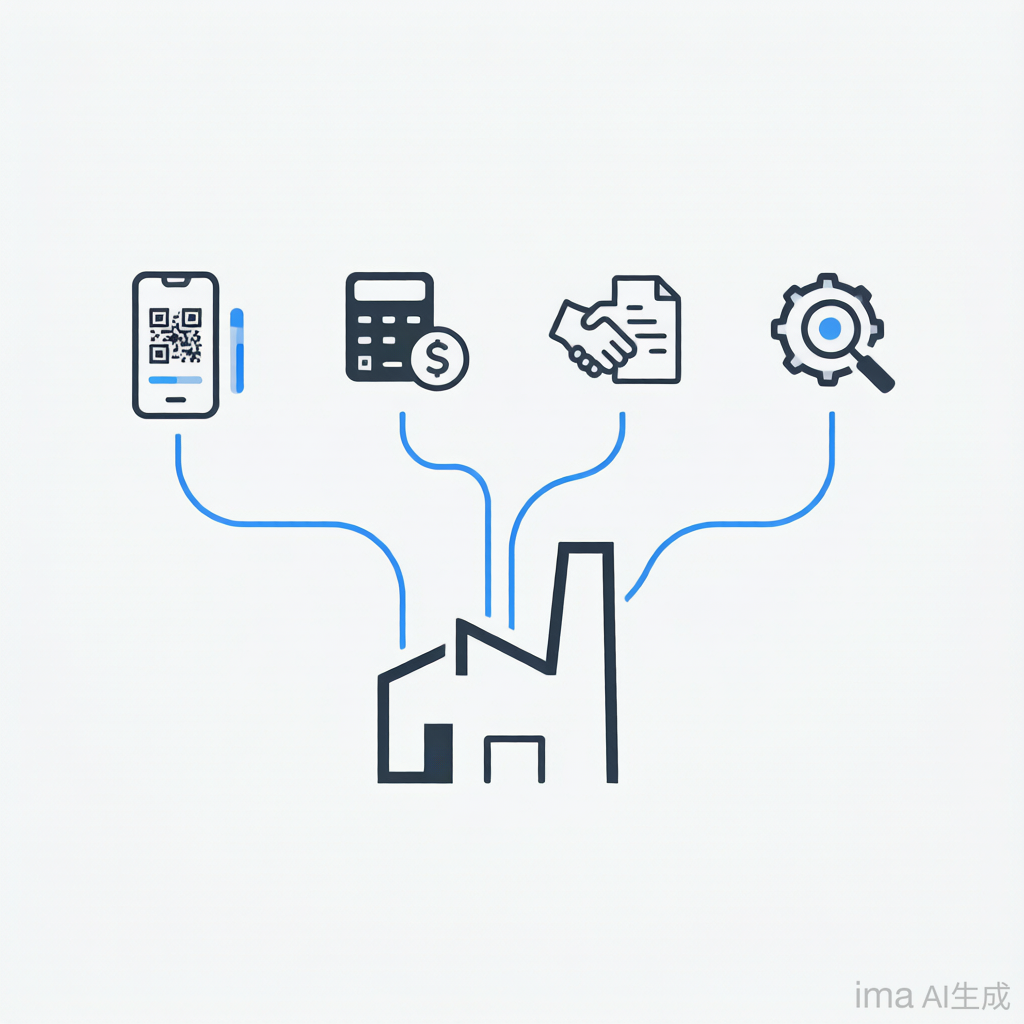
Whichever vendor you choose, first confirm it can solve these four pain points. If it can't even do these, however cheap, however "all-capable" — reject it:
Real-time production progress visibility — goodbye to "walking the shop asking for progress"
A reliable system supports scan-code reporting, done in seconds. Each mold's current process and sticking points at a glance, viewable on mobile anytime. The boss grasps the whole picture even on business trips — no more spending an hour or two daily chasing on-site.Precise per-mold cost accounting — profit or loss crystal clear
Many factories know only the monthly total profit; per-mold profit or loss is a muddy account. Good software precisely collects materials, labor, and outsourcing fees to each mold — which set earns, which drags — data speaking, not gut feeling.Full closed-loop outsourcing — reconciliation without flipping notebooks
Outsourced processes like heat treatment and slow wire EDM often suffer reconciliation errors from manual records. The system must cover the entire chain from order, receipt, to reconciliation, linking every outsourcing job to a specific mold number; export data and verify — saving time and preventing overpayments and wrong payments.End-to-end quality traceability — problems never repeat
Quality problems without findable root causes mean the same mistakes next time? The system should record every process's operator, materials, and parameters — one-click tracing when problems arise. Meanwhile, excellent experience accumulates, preventing craft knowledge from being lost with staff turnover.
3. Two Things More Important Than Features: Architecture and Implementation
Feature lists look similar; real-world experience differs enormously — the key lies in underlying architecture and landing capability.
Architecture determines stability: Windows architecture is virus-prone and laggy, with high data-loss risk. A native Linux architecture is more secure, stable, and high-performing — worry-free long-term. Additionally, if the factory does both molds and volume machining, be sure to choose a system supporting dual-mode architecture — one suite handles both modes, avoiding data fragmentation across two systems.
Implementation determines success or failure: "Three parts software, seven parts implementation" is no empty phrase. Reliable providers offer on-site implementation, pilot-first approach, and core modules going live first — fully usable within 3 months. The industry benchmark's implementation success rate exceeds 95% and renewal rate exceeds 90% — that's the real guarantee of a system landing.
4. Don't Believe "Expensive Means Good" — Fit Is the Truth
Big-factory systems are designed for thousand-person scale: high prices, redundant features, steep maintenance — completely mismatched to small and medium factories. Digitalization isn't a big-factory privilege — small and medium factories have thin margins and weak risk resistance; one progress delay or one reconciliation error impacts them far more than big factories. They need precise digital tools even more.
Moges has focused on the mold industry for 14 years; the founding team came out of Foxconn and deeply understands small and medium factories' real pain points. We provide solutions only for factories with annual output of 10-500 million — pushing no big-and-empty features, solving only real problems.
Conclusion: Scale Isn't the Threshold — Pain Points Are the Signal
Bosses often ask: "My annual output is under 20 million — is a system really necessary?"
The answer lies not in scale but in pain points: if you still spend days monthly on unclear progress, muddy costs, and reconciliation errors — even losing orders and money over it — it's time to act.
Finding the right provider and solving today's most painful problems is the best digital transformation. Which link headaches your factory most right now? Contact us for a dedicated diagnosis and lightweight solution.