The Outsourcing Cost Black Hole at Custom Equipment Shops: Why Does Your Outsourcing Supplier Management System Save No Money?
2026-06-29 10:03:16
I have worked with more than a few dozen owners of custom automation plants, and on the subject of outsourcing cost, eight out of ten say they "have no idea". Building one custom machine usually puts 30%-40% of total cost into outsourced machining. On a RMB 1 million order, outsourcing eats up three or four hundred thousand, yet few can work out how much of that is simply wasted.
I have seen a small or mid-sized custom shop with RMB 5 million of outsourcing a year. At year-end reconciliation it turned out that hidden costs from mis-issued parts, wrong accounts and late delivery swallowed RMB 400,000 — roughly the annual wages of two senior technicians! Why do many plants that have already adopted an outsourcing supplier management system still save no money? Where exactly is the problem?
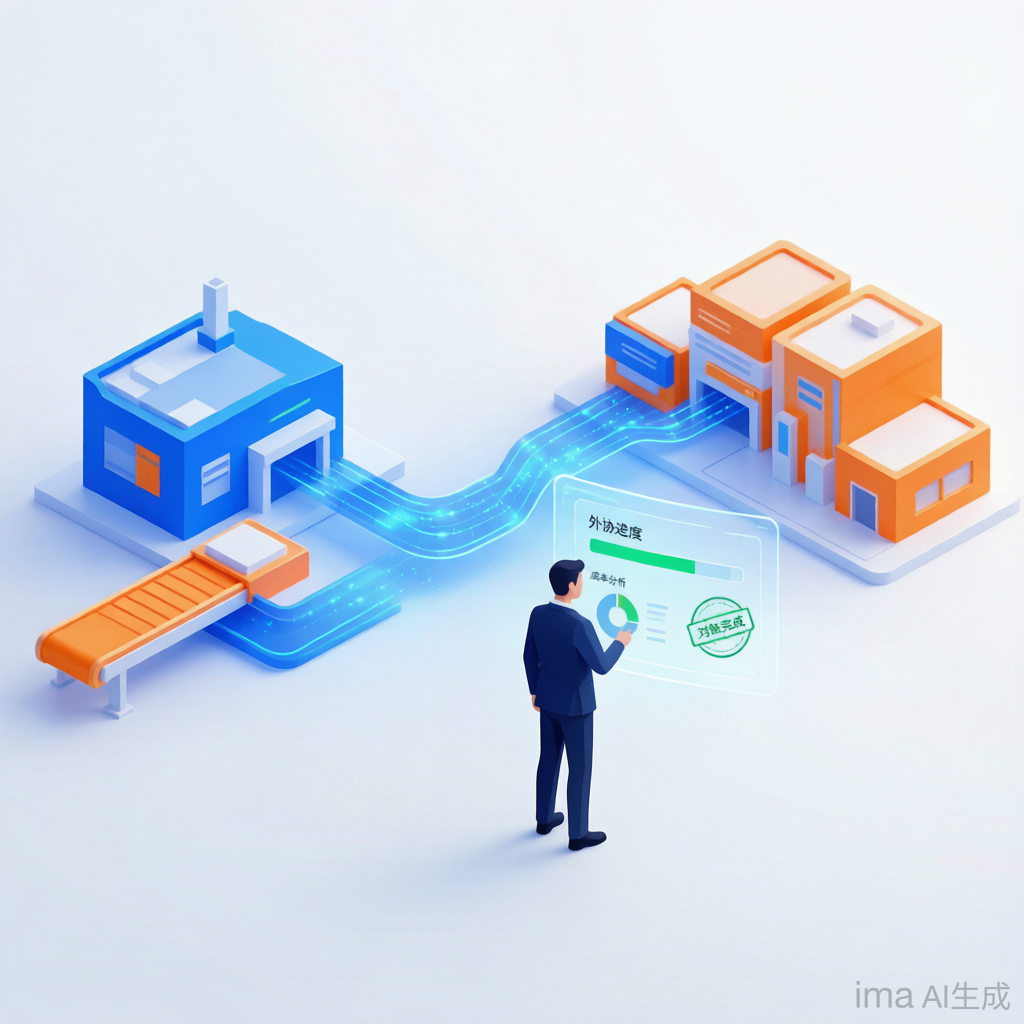
1. Four Muddled Accounts in Custom Outsourcing, Every One Real Money
Most small and mid-sized custom shops still manage outsourcing with "an Excel ledger plus a buyer chasing suppliers on WeChat". Nothing looks badly wrong, yet every step hides a black hole that drains profit:
1. BOM split errors and omissions: wrong issues and missed issues both cost money
The BOM of a custom machine runs from hundreds of lines to thousands. Manually separating in-house parts, standard parts and outsourced parts carries an error rate of 3%-5%. A part that should have been machined in-house is sent out, adding a few thousand yuan of machining fee for nothing; an outsourced part is missed, and by the time assembly finds it missing, urgent outsourcing costs over 30% more and delays the project. Where the contract has a late-delivery penalty clause, a deduction of tens of thousands at a time is very common.2. Reconciliation does not match reality: paying more in a fog
Outsourced parts are all custom-made, and quantity and price differ with every batch. The buyer checks the supplier's statement against the outsourcing orders and acceptance records in hand, line by line, and after dozens of statements a month, misreading is normal. I have come across a factory that could not reconcile a quarter's accounts, overpaid RMB 23,000, and could not recover it because the supplier had already used the money — the equivalent of losing half a month's wages of a buyer for nothing.3. Inspection process lags: either delays the schedule or accepts a bad batch
When outsourced parts come back, inspection means filling in forms, checking dimensions and recording quality; at its slowest, a batch takes three to five days to enter stock, while the assembly shop waits to start and the project falls behind. In a rush, inspection is skipped and the parts go straight into stock; if a nonconforming part is installed and then has to be removed and sent back out, the back-and-forth not only doubles the machining cost but also risks late delivery.4. No data for supplier evaluation: bad suppliers keep making money off you
Which supplier is often late? Which has a low pass rate? It all depends on the buyer's memory, and when the buyer leaves the information is gone. You keep using the same supplier, and even if quality is poor and prices rise fast, there is not enough data to replace them; over the long run the extra cost is no small sum.
On RMB 5 million of annual outsourcing, 2% of errors is RMB 100,000, 1% of account errors is RMB 50,000, and 2% of inspection and quality problems is RMB 100,000. Invisible waste adds up to at least RMB 250,000, which is more than the tail end of a year's net profit at most small and mid-sized custom shops!
2. An Outsourcing System That Saves Money Must Meet These 3 Core Requirements
Many factories adopt an outsourcing management system and still save no money, mainly because they have not hit the real pain points of the custom industry: outsourcing is not an isolated step but one link in the full process from BOM design to project delivery. General systems only solve the problem of "recording information", not the problem of "cutting waste". A system that really saves money must at least do the following:
| Core Function | Pain Point of Traditional Management | Moges PMS9 Solution |
|---|---|---|
| Intelligent BOM splitting | Outsourced parts are picked by hand, with an error rate as high as 3%-5% | When the design releases the BOM, outsourced parts are filtered automatically and an outsourcing list is generated in one click, cutting the error rate to under 0.2% and raising order creation efficiency 10 times. |
| Minimalist inspection process | Cumbersome paperwork and slow inspection leave assembly idle waiting for parts | One-click inspection by scanning on mobile, with qualified parts triggering stock-in automatically and rejected parts recording the return reason and binding to the supplier, all in 3 minutes. |
| Automatic reconciliation engine | Dozens of documents checked by hand, time-consuming and prone to overpayment | The system automatically matches issued quantity, qualified quantity and the agreed unit price, flags discrepancies in red for warning, and cuts monthly reconciliation from 3 days to half a day. |
3. Full-Chain Linkage Matters More Than Managing Suppliers in Isolation
Many custom shops make the mistake of looking only for an isolated system that "manages suppliers", storing a contact and a quotation and calling it done. In fact, outsourcing is tightly connected to purchasing, inventory and project cost.
Once an outsourced part passes inspection, stock-in must update inventory automatically and assembly requisition must deduct it automatically, so there is never a case of "stock on the books but no goods in reality", and no overbuying or overproduction that ties up cash.
There is also an easily overlooked issue of permission control. Outsourcing procurement in custom manufacturing is a high-risk area for kickbacks, and fine-grained permission control prevents a great deal of unnecessary loss: a regular buyer can create an outsourcing order but cannot change the agreed price, and any price change needs approval and leaves a record; the administrator controls every step, while a frontline assembler can only report quality problems and cannot change price data.
I once worked with a customer using Moges PMS9 whose project costs had never been accurate; the outsourcing cost of every project was estimated by finance. After the full-chain linkage went live, it emerged that three already-closed projects had each overestimated outsourcing cost by more than RMB 20,000, recovering more than RMB 60,000 of pure profit out of thin air. That is the direct benefit of digital full-chain linkage.
4. Conclusion: Work Out the Invisible Accounts and Plug the Profit Leaks
Many owners look at outsourcing cost and see only the machining quotation for the part, never the hidden costs of errors, delays and manual reconciliation. Take your plant's annual outsourcing spend and multiply it by 3% to see how much waste a year is entirely avoidable.
Outsourcing management is not simply "sending work out and receiving goods"; it is the core battleground of cost control for a custom automation company. Choose a full-chain management system that understands the custom industry, turn the muddled account into a clear one, and every cent you save is real net profit for the company.