Where Did the Profit of Your Custom Automation Project Go? Use Moges PMS9 to Calculate Every Cent of Cost and Plug the Profit Leaks
2026-07-01 10:03:07
I have worked in the custom automation industry for 14 years and seen far too many owners slam the table at year-end closing: "We took 20 orders this year with combined sales of over RMB 20 million, so how is profit under RMB 1 million?" Quite a few owners even finish a million-yuan project and end up losing fifty or sixty thousand on it, with no idea where the money went.
The nature of custom manufacturing is that "every project is different", there is no repeat batch, and cost is inherently hard to calculate. If everything relies on Excel bookkeeping and mental arithmetic by the project manager, errors and omissions are normal. Today we will dig into how a custom shop's money actually disappears, and how to use Moges PMS9 project management software to calculate every cent of cost clearly.
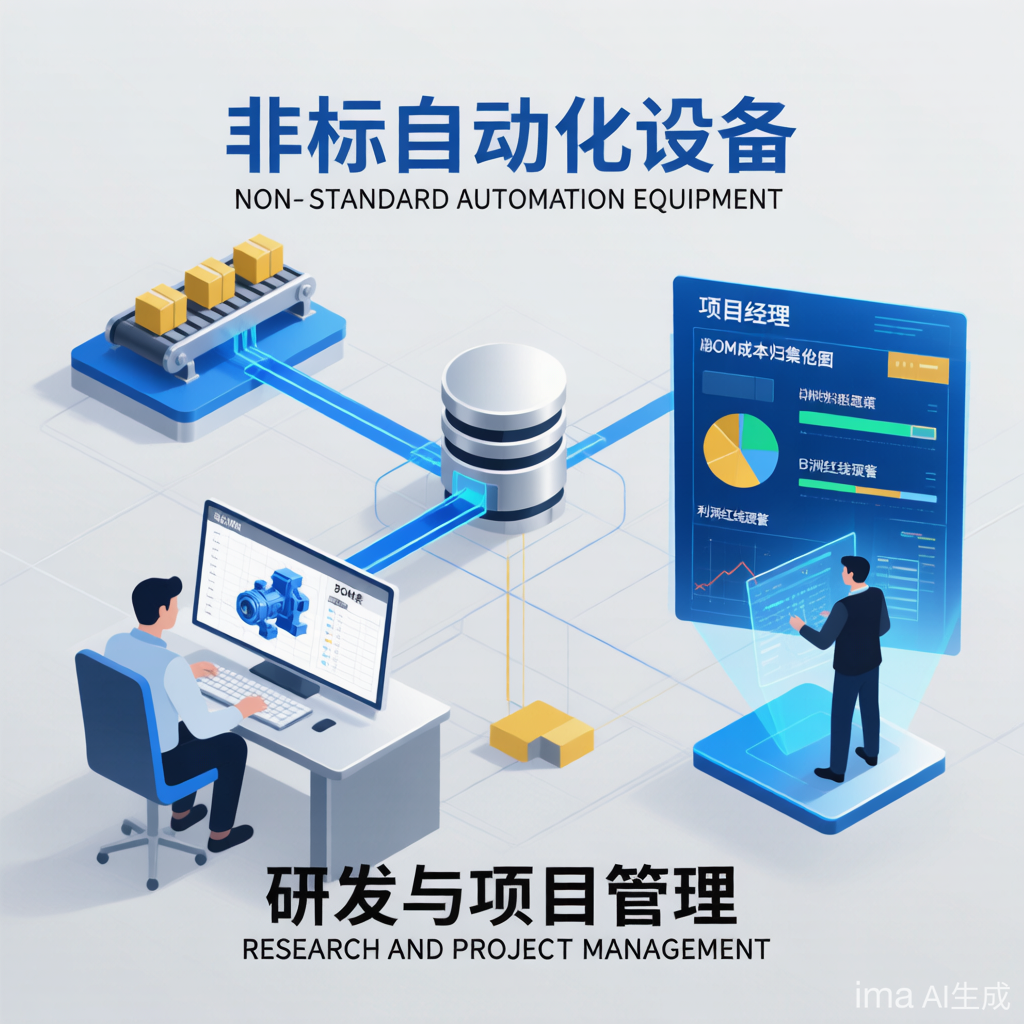
1. The 4 Common "Muddled Cost Accounts" at Custom Shops, Each Eating Real Money
I have sorted through the cost leaks at most custom shops, and they are all small things that look insignificant, yet add up to eating 10%-20% of profit:
| Hidden Cost Leak | Specific Symptom and Profit Drain |
|---|---|
| Missing or wrong BOM items, premium on emergency purchases | It is routine for a designer to omit a terminal or a pneumatic fitting from the BOM. The shortage is only discovered at assembly, so the part has to be bought same-day from a local supplier at 30%-50% more than batch purchase, plus express shipping. On a large project, omitting a core module can mean tens of thousands of extra spending. |
| Dead stock buildup, expired parts scrapped | To guard against shortages, designers often overstate usage by 10%. Excess standard parts sit in the warehouse, and after a year or two the screws rust and the seals age into scrap metal. At a custom shop with annual sales of RMB 30 million, dead-stock loss typically runs from RMB 150,000 to 300,000 a year, and that is all pure profit. |
| Cost not collected, profit or loss guessed | All purchasing, labor and outsourcing costs are piled together and spread across all projects at month end, so there is no way to know how much a specific project actually spent. New orders are quoted on a guess: quote high and lose the order, quote low and lose money on it. |
| Schedule delays, extra penalties and expediting fees | Project progress depends on the owner chasing it, and nobody synchronizes promptly when an operation slips. Only near delivery is it found that parts are not finished, so high-priced expediting is the only option, plus late-delivery penalties to the customer, a few thousand at the low end and tens of thousands at the high end. |
2. Collect Cost Around the BOM So Every Cent Maps to a Specific Project
All the cost of a custom project has its source in the BOM. Get the BOM right and the cost cannot go wrong. When we designed Moges PMS9, we put "BOM-driven cost collection" at the core:
A unique project number runs through everything: once a project is established a unique number is generated automatically (for example M202607-0001), and all subsequent material purchases, machining hours and outsourcing fees are linked automatically to that project, never crossed over.
Intelligent BOM splitting and inventory deduction: after the designer creates a multi-level tree BOM, one click releases and splits it. The system automatically calculates the inventory gap and generates purchase orders (if the BOM needs 10 screws and stock has 3, the system suggests buying only 7), avoiding overbuying and dead stock at the source.
Precise booking of outsourcing and labor: once an outsourced part is machined and received, the machining fee is collected directly against the corresponding project; for in-house parts, hours are recorded at every operation and labor cost is booked directly when reporting is complete. The owner opens the project list at any time and sees how much has been spent and how much budget remains.
3. Full-Process Linkage and Control to Squeeze Out the Hidden Costs
Truly useful cost control is control during the process, stopping money that should not be spent before it leaves:
Real-time inventory linkage: stock movements link automatically to purchasing, machining and assembly, with books matching reality. One of our custom customers with 50 people used to generate more than RMB 200,000 of dead stock a year from duplicate purchasing; after adopting the system it fell to under RMB 30,000, and everything saved is pure profit.
Transparent operation progress: every operation on an in-house part must be reported, so the project lead can see at a glance which operation is behind and coordinate resources in advance. The commissioning process supports multi-round records and defect closure, avoiding repeated commissioning of the same problem and wasted labor.
Fine-grained access control (RBAC): the administrator can assign 187 specific permissions, and a regular role has only the permissions for its own operations (for example, a designer can edit only the BOM of that person's own projects, and purchasing can process only orders within its authority), preventing from the process the data errors and cost miscalculations caused by unauthorized changes.
4. Use Historical Data to Calculate the Future, So You Know How Much You Will Make When Taking an Order
The ultimate purpose of cost control is to help the owner quote the right price when taking an order. Quoting used to rely on experience (for example, part cost times 1.5), ignoring hidden costs such as management, quality and delays.
Now, the cost of every project in the system is collected clearly. When taking a similar new order, the historical data can be pulled up directly: material, labor, outsourcing and management expense are all obvious.
For example: for a RMB 400,000 assembly machine, the historical data shows material RMB 180,000 + labor RMB 80,000 + outsourcing RMB 70,000 + allocated management fee RMB 30,000 = total cost RMB 360,000. A quotation of RMB 400,000 then earns a solid RMB 40,000. Without data support, the owner might quote RMB 380,000, and a little extra spending means a direct loss.
Conclusion: Do Not Let Invisible Waste Eat Your Profit
When the plant is small and three or five projects run at once, the brain can still keep up; but once it scales up and a dozen or twenty projects run at the same time, nobody can calculate every cent of cost by memory. Many times you feel the margin is thin, not because the industry is bad, but because invisible waste is eating your profit.
Suggested action: today, work out how much hidden cost your plant incurs each year from BOM errors, dead-stock buildup and schedule delays. Once this account is clear, you will know how much real money a digital tool can help you recover.