Fixture Checkout and Return Registration System: A Digital Solution for Small and Mid-Sized Machining Shops to End "Fixtures Cannot Be Found"
2026-07-02 08:01:52
Cannot Find a Fixture During a Rush Order? This Is the Most Common Invisible Waste in Small and Mid-Sized Machining Shops
Last week I went to visit a customer at a precision mold plant in Kunshan with annual output of RMB 30 million. I had just entered the shop when I found the setup technician squatting by the fixture cabinet smoking: he was rushing a customer's trial-mold order, and the fixture used last week to machine the positioning of a new-energy battery shell could not be found. He asked around and nobody admitted borrowing it, searched three fixture cabinets, the corners of the warehouse and even the gaps around the CNC machines, and still could not find it. In the end he had to cut and rough a new one, which ate more than an hour and pushed the day's delivery back a full shift.
This is not an isolated case. In small and mid-sized machining shops across the Yangtze River Delta, fixtures that cannot be found, borrowing with no record, and items kept without being returned are headaches almost every factory has experienced. Many owners consider these small matters not worth dedicated management, but day after day these "small matters" are quietly eating your profit.
Why Does Fixture Checkout and Return Management Always Become a Shop Bottleneck?
Anyone who has done machining knows that fixtures are genuinely troublesome: a mid-sized machining plant has several hundred sets at the low end and two or three thousand at the high end, ranging from small positioning blocks and clamping blocks to complete sets of tooling fixtures. Specifications and models are many, commonality is poor, and many belong to one specific mold, so if one is lost it can only be remade.
At the vast majority of factories today, fixture management is done in one of two ways:
By memory and asking around: whoever borrowed it is supposed to remember, there is no record, and if they forget to mention it when they leave nobody knows.
Excel sheet registration: a computer sits in the warehouse and the storekeeper enters the record, but the worker, finding it troublesome, often takes the fixture first and fills in the record later, and sooner or later forgets.
Over time, three core problems surface:
| Problem | Specific Symptom | Invisible Loss Caused |
|---|---|---|
| Fixtures lost and unfindable | Nobody knows when it was lost; it is only discovered at the month-end stocktake | Remaking one costs several hundred to several thousand yuan, with annual loss reaching tens of thousands |
| Shared fixtures kept and not returned | An urgently needed fixture was borrowed by another workstation months ago, and everyone says they do not know | Production waiting, schedule delays and customers chasing orders |
| Stocktaking entirely manual | A month-end fixture count takes most of a day, the accounts do not match and the whereabouts cannot be traced | Inaccurate cost accounting; mold project profit or loss cannot be calculated |
I have seen many factories where the fixtures lost without explanation each year add up to tens of thousands of yuan, not counting the lost production time from not being able to find a fixture. These costs never appear in the financial statements, yet they steadily erode profit.
Why Can a Shared Excel Sheet Not Handle Fixture Checkout and Return?
Many owners, hearing about a system, react first by thinking: is it not just registration? I can set up a shared Excel sheet and spend nothing. In practice, within two months you will find a pile of problems:
It cannot keep up with the shop rhythm: workers borrow fixtures while rushing production, so who has time to open a computer and fill in a form? Most fill it in afterwards, and missed or wrong entries are routine.
No status reminders: you do not know which fixture is overdue for return, or when a fixture's calibration expires, and the problem is only discovered when an out-of-calibration fixture produces scrap parts.
No mobile operation: Excel can only be operated at a computer, and running back and forth between the shop and the warehouse is extremely inefficient.
No permission control: anyone can change anything, data is easily deleted or modified by mistake, and when a problem arises there is no way to find out who touched it.
Then there are vendors of general office automation or general stock software who claim at once that they can do checkout and return registration, yet do not understand the needs of mold machining at all: fixtures must correspond to a specific mold project, be linked to calibration and maintenance records, and be searchable by workstation and by project. No general system can do these individualized requirements, so in the end you have spent the money and still cannot use it.
A Good Fixture Checkout and Return Registration System Must Meet Four Core Functions
Fixture checkout and return is a small matter in the shop, so the system must keep small matters simple rather than making them complicated. Based on our experience serving more than 200 small and mid-sized mold factories, meeting the following four points is enough:
1. Scan to Operate, Complete in One Minute, No Training for Workers
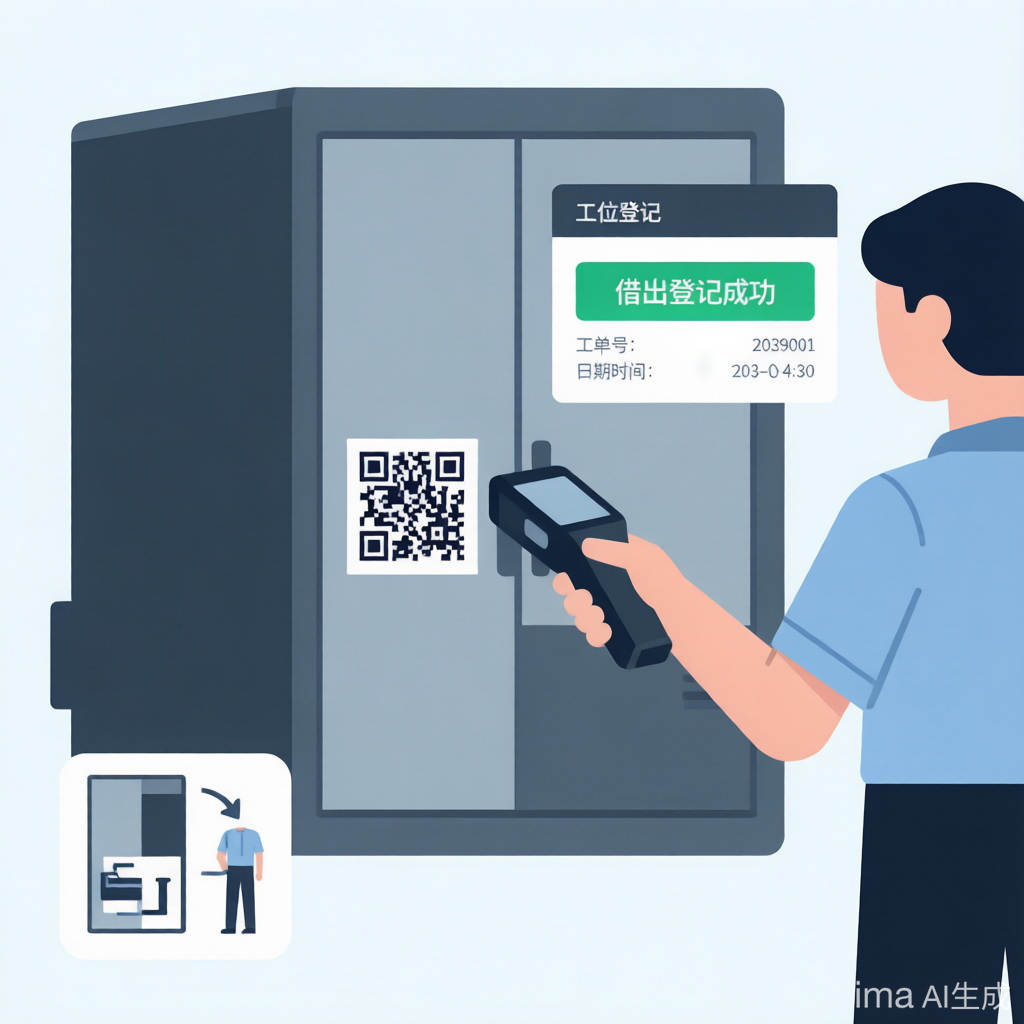
Stick a dedicated QR code on every fixture. To borrow it, scan with a phone or handheld terminal, choose your workstation and tap "check out"; to return it, scan again and tap "return". The whole process takes under a minute, and a frontline worker can use it immediately without finding it troublesome, which solves the core problem of missed and wrong entries at the root.
Compared with a handwritten register or an Excel sheet, scanning has obvious advantages:
No need to open a computer; operate directly on the shop floor
Automatically records the borrower, borrowing time and workstation, eliminating human omissions
Every record carries a timestamp, so any problem can be traced precisely
2. Automatic Overdue Reminders So Fixtures Are Not Kept Unused
Different fixtures can be given different checkout and return cycles, and for any that are overdue the system automatically pushes a reminder to the storekeeper and the borrower, so there is no need to visit every workstation every day. This greatly improves fixture turnover.
At the same time, the fixture's calibration and maintenance information can be linked, with an automatic reminder as the expiry date approaches, so that a nonconforming fixture does not produce scrap work. This matters especially for precision machining: one out-of-calibration positioning fixture can scrap a whole batch of workpieces, with a loss far beyond the value of the fixture itself.
3. Locate in One Second, No Searching the Whole Shop
To find a fixture, simply search the number or purpose in the system and see which workstation it is at, who borrowed it and when, then go straight to the person instead of searching the whole shop. What you save is all working time.
One of our customers in Hangzhou did the math: before go-live, each technician spent an average of 15 minutes a day looking for fixtures, and with 10 technicians that was 150 minutes, equivalent to 2.5 wasted labor hours every day. After go-live there is basically no searching, and the time saved alone lets them produce more than a dozen extra molds a month.
4. Automatic Stocktaking So Cost Is Calculated Clearly
Month-end stocktaking no longer requires counting one by one by hand. The system exports the inventory ledger and the checkout and return transaction history directly, and any discrepancy can be traced through the movement records to its whereabouts quickly. Annual fixture loss is perfectly clear, and the cost of each mold can be calculated accurately.
The system also supports multi-dimensional statistics by category, by project and by workstation. The owner can produce a report for any data on demand, without asking a clerk to spend days sorting it by hand.
Traditional Methods vs. a Fixture Checkout and Return Registration System
| Comparison Dimension | Handwritten / Excel Registration | General OA / Stock Software | Dedicated Fixture Checkout and Return System |
|---|---|---|---|
| Operating mode | Fill in by hand or open a computer | Mainly PC operation | Mobile scanning, on the spot |
| Registration efficiency | Slow, often missed | Average, complex process | Done in under 1 minute |
| Overdue reminder | None | Partially supported | Automatic push reminder |
| Fixture location | Memory and searching | Not supported | Find who has it in one second |
| Calibration / maintenance link | None | Not supported | Automatic link, expiry reminder |
| Stocktaking efficiency | More than half a day by hand | Requires export and checking | One-click export, done in minutes |
| Mold project link | None | Not supported | Trace fixture usage by project |
When Choosing a Fixture Checkout and Return System, Avoid These Three Traps
First trap: going all-encompassing. The vendor immediately wants you to buy a full system for hundreds of thousands, claiming it is for overall digital transformation. In fact, the first thing a small or mid-sized machining plant needs to solve is concrete small matters such as fixture checkout and return and work reporting. Save the small money first, then talk about the rest; do not spend money for nothing on a pile of unused features.
Second trap: choosing a general system from a vendor that does not understand mold machining. Many pure IT companies have never worked in molds and do not know that fixtures must correspond to projects and be calibrated. The functions they build are an empty shell and still awkward to use. Find a system built by a team that comes from molds; only those who know the industry understand your pain points.
Third trap: buying only software without looking at implementation. Many small vendors disappear after selling the software and leave you to figure it out, and nine out of ten end up unusable. Three parts software, seven parts implementation: only implementation consultants who know the business, on site to help sort out the process and teach the workers, can truly get it running.
What Does a Factory Get After Going Live With a Fixture Checkout and Return System?
When Moges implements systems for more than 200 small and mid-sized mold factories, we always include fixture checkout and return registration as a basic module. Based on customer feedback, the following improvements are commonly seen after go-live:
Fixture search time drops sharply: from an average of 15 minutes a day to near zero, and the time saved converts directly into capacity.
Fixture loss rate falls significantly: the whereabouts of every set can be traced, and loss is reduced by more than 60%.
Stocktaking efficiency rises 10 times: from most of a day to a few minutes, and financial cost accounting becomes more accurate.
Fixture turnover improves: overdue reminders mean shared fixtures are no longer tied up long term, and one set can serve more workstations.
More stable delivery: no more rush-making because a fixture cannot be found, no more delayed delivery, and higher customer satisfaction.
Final Thoughts: Profit Often Leaks Away Through Small Matters Nobody Notices
Many small and mid-sized mold shop owners think digitalization is something only big plants can afford, requiring a lot of money and a big project. In reality, factory profit often leaks away quietly through small matters nobody pays attention to, such as fixture checkout and return.
Sort out one small matter, and the time and cost saved is profit that lands squarely in your pocket.
If your factory is also troubled by fixtures that cannot be found, chaotic checkout and return, and difficult stocktaking, start with the "small entry point" of a fixture checkout and return registration system, and plug the biggest invisible hole in the shop at the lowest cost and the fastest speed.
Moges — 14 years focused on digitalization of the mold manufacturing industry, having served more than 200 small and mid-sized factories. To learn more about the detailed fixture checkout and return system solution, feel free to contact us at any time: 186 2522 0688.