How to Fix Chaotic Loose-Part Inventory: A Hands-On From-Zero-to-One Management Plan for Small and Mid-Sized Machining Shops
2026-07-02 08:32:01
Stock on the Books but Nowhere to Be Found: The Loose-Part Inventory Problem That Haunts Machining Shops
Have you just finished a walk through the workshop, only to have procurement come running: the loose aluminum parts that arrived last week have vanished? The warehouse keeper says the records show them in stock, but two hours of searching the racks turned up nothing, and the urgent job waiting for the machine has to stop - reordering costs money and delays delivery.
This is the loose-part inventory chaos that machining and mold shops face every single day. People searching for this problem want practical solutions that actually land, not empty theory. This article contains no grand all-in-one framework - onlypractical, field-tested methodsdrawn from 14 years in the industry and hundreds of factories visited, walking you step by step from tidying up the inventory to getting it fully under control. You can put it to work the moment you finish reading.
Why Loose-Part Inventory Always Ends Up Chaotic: Understand the Root Cause First
I have spent 14 years in management work in the mold machining industry and visited hundreds of factories. Loose-part inventory chaos hits almost every factory once it grows beyond a certain size:
A factory that once made a few dozen molds a year, with a few thousand loose parts, could manage on the warehouse keeper's memory alone
After orders grow two- or three-fold, loose part categories balloon to thousands or tens of thousands, and the old methods are guaranteed to fail
Workers rushing jobs grab material without logging it, stash the excess in a corner, and after a while nobody knows what it even is
Month-end counts never reconcile with the books, so the gap gets written off as shrinkage - over RMB 100,000 a year going straight down the drain
Just last month we met the owner of a mold shop with an annual output of RMB 30 million, who told us thatre-purchasing loose parts that could not be found alone costs him over RMB 10,000 every month- more than RMB 100,000 a year wasted, and nothing but headaches to show for it.
The essence of loose-part inventory chaos is not a careless warehouse keeper; it is thatthe old methods can no longer keep up with the new order volume. The approach that managed a few dozen molds a year simply cannot handle the inventory of several hundred. Once this root cause is clear, the solution becomes obvious.
Step One: Tidy Up the Physical Inventory First - Put Everything in Its Place
Many factories want to buy a system right away, but if the existing inventory is already a mess, a system on top of it is useless. The first step of fixing the chaos costs nothing: get the physical inventory in order first.
Set aside two or three days for a full warehouse count and tidy-up. Doing the following few things is enough:
| Organizing Action | How to Do It | What It Solves |
|---|---|---|
| Divide fixed zones by category | One zone for standard loose parts (screws, ejector pins, seals), one for raw-material stock (aluminum blocks, copper stock), a separate zone for remnants/offcuts, and another for outsourced parts awaiting machining | Ends mixed storage and gives every search a direction |
| Assign a unique code to every bin location | Label every bin location with a large, clearly legible tag stating the category information | New staff can find items by code without errors |
| Every returned remnant must carry a label | Mark material, specification, and remaining size; no label, no shelf | Eliminates "ownerless loose parts" at the source |
Don't balk at the effort - we have seen countless factories wherethis single step cuts item-searching time by more than half. Finding a loose part used to take 20 minutes on average; after the tidy-up it takes three to five, and the warehouse keeper immediately has time for everything else.
Step Two: Set Clear Issue-and-Return Rules to Plug the Source of the Chaos
With the physical layout in order, the next job is plugging the source. Most inventory chaos comes from loose rules: workers rushing jobs walk into the warehouse and grab material without logging it, stash the excess in a corner, and over time nobody knows what anything is.
You don't need many rules -two hard requirementscontrol 80% of the problem:
Every material issue and return must be logged: whether it's the boss or the workshop supervisor, no log entry, no material. Nobody gets special treatment.
Same-day movements get logged the same day: never let entries pile up for three or five days; by the end everything is recorded wrong and the books will never match reality.
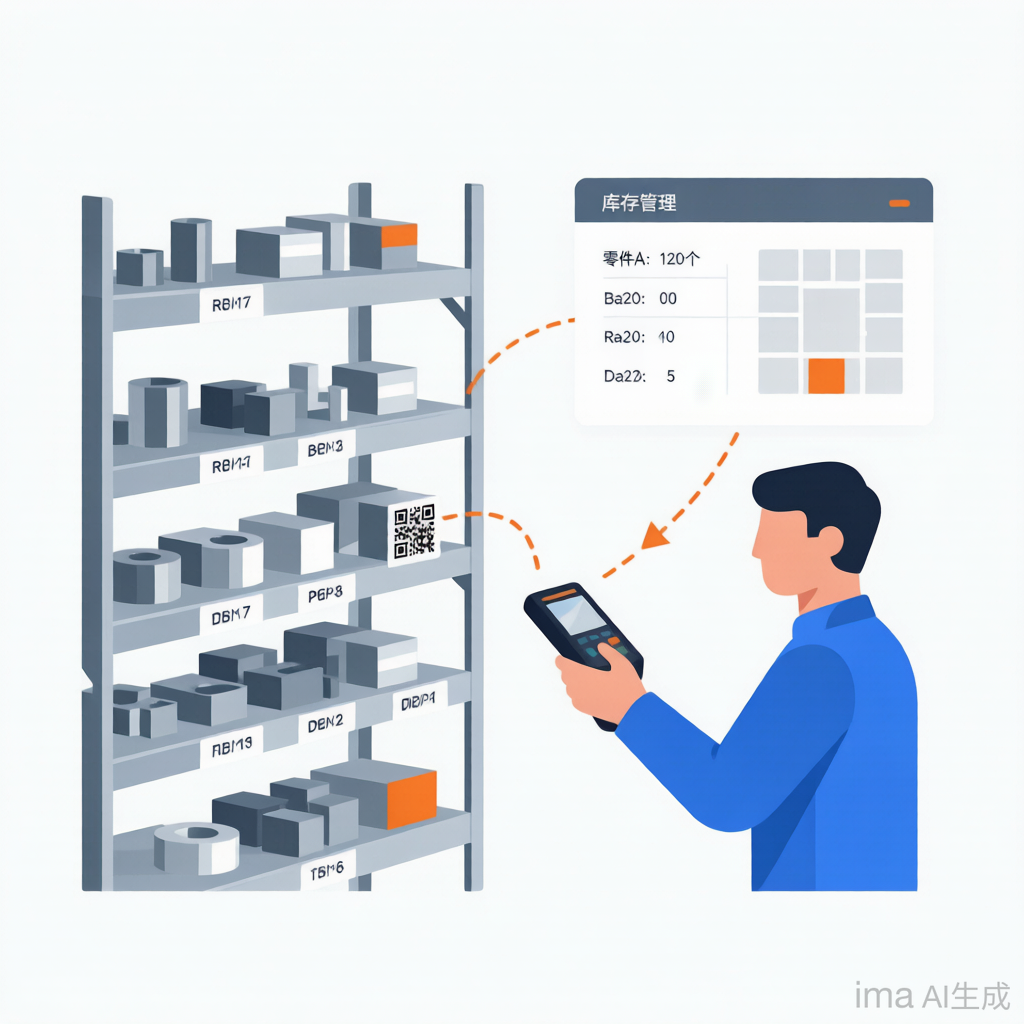
Handwritten logs used to be a chore; now a simple scan does the job. Scan the bin code, enter the issue or return quantity, and the entry is done in a dozen seconds - workers chasing deadlines never lose time. For example, Moges' system ships with a built-inscan-based material issue and return feature; no complicated operations, frontline staff learn it in ten-odd minutes, and nobody resists it.
Step Three: Use the Right Tool to Solve the Core Problem of "In Stock on Paper, Missing in the Warehouse"
Inventory tidied, rules set - but manual bookkeeping in Excel still can't hold the line. Loose parts move in and out far too often: 5 issued today, 2 returned tomorrow; the constant edits breed errors, and over time the books drift from reality, so "in stock on paper, missing in the warehouse" reappears.
Many owners flinch at the idea of a tool: worried it's expensive, complicated, or that staff will never adopt it. In fact you need no grand all-in-one package - just something that fits your scale. Choosing a tool comes down tothree core needs:
Fast bin-location lookup: enter the part name and specification, and the system shows the zone and bin location instantly - no more blind searching across the warehouse.
Automatic inventory updates: every issue and return automatically adjusts stock quantities - no manual arithmetic, eliminating bookkeeping errors at the root.
Standalone remnant management: remnants get their own records, so when a new order comes in, you first search the warehouse for usable remnants instead of ordering new material outright - saving unnecessary cost.
Manual Management vs Scan-Based Digital Management: A Comparison
| Dimension | Manual / Handwritten / Excel Management | Scan-Based Digital Management |
|---|---|---|
| Item search time | 20 minutes on average, often unsuccessful | 3-5 minutes with precise location |
| Issue/return logging | Handwritten, entries frequently missed or wrong | Completed by scan in a dozen seconds |
| Inventory updates | Manual calculation, error-prone | Automatic, real-time updates |
| Month-end counting | Half a day at minimum, rarely reconciles | One-click export, done in minutes |
| Remnant utilization | Piled in a corner, ignored | Automatic matching, saving RMB 100,000+ a year |
| New staff onboarding | Takes months to get familiar | Scan operations learned in ten minutes |
Remnant Utilization: The "Hidden Profit" Most Factories Ignore
Among the factories I have worked with, many savewell over RMB 100,000 a year in procurement costs from remnant utilization alone- pure profit, and easier to earn than landing a new order.
Many people think inventory management and proper tools are a privilege of large factories. The truth is the opposite: small and mid-sized shops run on thin margins, so every yuan saved is earned - which makes disciplined loose-part inventory management even more critical for them. Give remnants their own records, and when scheduling a new order, search for usable remnants first; anything directly reusable means no new material. Stick with this simple habit and the savings will astonish you.
The Owner Must Lead the Push Personally - the Single Most Critical Factor
One more reminder: whatever tool you use,the owner has to lead the rollout personally. Of the 10 failed adoptions I have seen, 9 happened because the owner never took it seriously and dumped everything on the warehouse keeper and the workshop; the rules never took hold, so naturally the system never got used.
If the owner supervises for two or three months until the habits form, the system then runs on its own and needs no daily attention. Concretely:
Month one: the owner spot-checks issue/return logs once a week and corrects problems on the spot
Month two: switch to a spot-check every two weeks, letting the warehouse keeper and workshop supervisor build the habit
Month three: switch to monthly spot-checks - by then the process has solidified and the system runs automatically
How Big Is the Hidden Cost of Loose-Part Inventory Chaos, Really?
Many owners think loose-part chaos merely means "a bit of trouble finding things" and have never tallied the hidden costs behind it. We ran the numbers for one customer:
| Hidden Cost Item | Typical Manifestation | Estimated Annual Loss (factory with RMB 30 million output) |
|---|---|---|
| Re-purchasing lost loose parts | In stock on the books but nowhere to be found, so a new order gets placed | RMB 80,000-150,000/year |
| Idle machines waiting for parts | Machine tools spinning idle waiting for loose parts; wasted labor hours | RMB 50,000-100,000/year |
| Remnants sold as scrap | Usable remnants ignored until they are finally scrapped | RMB 30,000-80,000/year |
| Delivery delay penalties | Orders delayed because loose parts could not be found | Depends on the order |
| Total | RMB 150,000-300,000+/year |
None of these costs ever appears as a separate line in the financial statements, yet they steadily eat into the profit of every single order.
Final Words: Take Five Minutes in the Warehouse Before You Leave Today
Before you leave work today, spend five minutes in the warehouse: ask the keeper how much time goes into finding material every day, and calculate how much money gets wasted each month on material that cannot be found - and you will know exactly where to start.
The solution to loose-part inventory chaos is actually simple:tidy up the physical inventory first, then set clear issue-and-return rules, and finally adopt the right digital tool. Three steps bring the chaos under control. The key is the owner leading the push personally for two or three months until the habits form - after that, it runs on its own.
Moges - 14 years focused on digitalization for the machining and mold manufacturing industries, serving 200+ small and mid-sized factories. For a detailed loose-part inventory management solution, contact us anytime: 186 2522 0688.