How Much Does an Automated Equipment Production Management System Cost? Do Not Fall for the Per-Machine Pricing Trick
2026-07-03 08:04:03
You Bought Automation Equipment, So Why Can You Still Not Control Utilization?
Last week I visited a customer making precision molds in Zhangpu, Kunshan. The owner had invested RMB 2 million of his own money in 4 new automated machining centers, thinking that with few people it was hard to keep up and automation would save effort. One month after production started, he found that how long each machine sat idle every day and which operation it had reached still required the team leader to run around the floor asking.
Sometimes a machine alarm went unnoticed for one or two hours, wasting several labor hours for nothing, and equipment utilization was nearly 20% below expectation. The owner was eager to adopt MES to manage equipment and his first question was: "How much does MES for automated equipment cost? Is a budget of RMB 150,000 enough?"
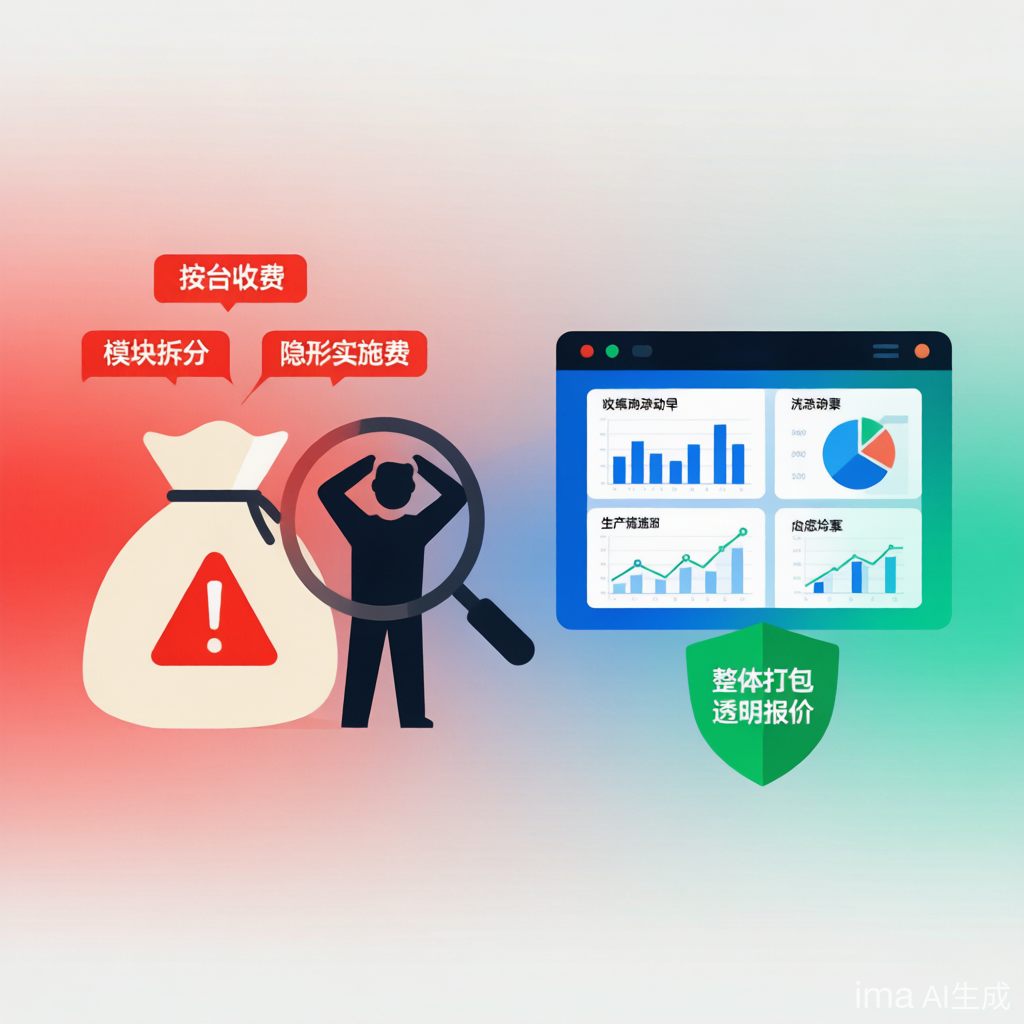
Three Common Quotation Methods on the Market, With the Traps Hidden in the Rules
Nine out of ten owners who bought automation equipment and want MES ask about price first, with no idea of the industry's quotation tricks. Three quotation methods are common today:
| Quotation Method | The Stated Rule | The Hidden Trap |
|---|---|---|
| Priced by number of connected machines | RMB 3,000-20,000 per machine, pay more for more | New machines added later cost extra per unit, and many vendors also charge an annual service fee per machine; over ten years the service fees exceed the software cost. |
| Priced by function module | Split into N modules such as data collection and production tracking, bought as needed | Core functions are split into several small modules, and the total ends up more expensive than a package. |
| Priced as an overall package by factory scale | A flat price based on output, headcount and needs, including software, implementation and service | Most transparent for small and mid-sized shops, with little risk of overrunning the budget |
Many vendors of automated equipment integration default to per-machine pricing, essentially splitting general software functions into multiple copies and selling them repeatedly. For a small shop buying three or five automated machines, the MES cost works out higher than the small change on one machining center, which makes no sense at all.
The Factors That Really Affect the Quote; Do Not Pay for Irrelevant Parameters
The level of the quote never depends simply on how many automated machines you have. The core is these three points:
First, whether data collection is needed for older equipment.
New automated equipment has open data interfaces, so connecting directly retrieves running status and machining progress without extra hardware. For old equipment used for five or six years or more, which has no built-in interface, a collection module is needed and an extra cost arises, adding a few hundred to over a thousand yuan per machine, not the several thousand per machine many vendors claim.
Second, how many core functions you need.
Many salespeople pile on all kinds of fancy functions (digital-twin BI dashboards, AI full-process inspection and so on) and charge hundreds of thousands. But for a small or mid-sized shop with annual output from RMB 10 million to 500 million, the core needs are just four: see equipment status in real time, get automatic alerts on anomalies, update production progress automatically and calculate cost clearly. 80% of the value comes from these 20% core functions, and those fancy functions are of no use at all.
Third, whether implementation service is included in the quote.
This is where traps hide most easily. Many vendors quote a very low software price and bill implementation separately by the day (three to five thousand a day), so implementation alone comes to over RMB 100,000. Everyone in the industry knows it is three parts software and seven parts implementation, so always ask clearly whether implementation is included. Moges includes the implementation fee in the overall quote for small and mid-sized shops: following the five-step implementation method, the core modules are in use within 3 months, with no extra implementation charge.
Real Budget Range for Small and Mid-Sized Machining Shops Adopting Automated Equipment MES
Drawing on our 14 years of experience working only in the mold and precision machining industry, for target customers with annual output from RMB 10 million to 500 million, the rough price ranges are clear:
Within 10 automated machines: only the core equipment monitoring, production tracking and scan-to-report functions are needed, and the whole thing can be delivered for under RMB 100,000.
10 to 30 automated machines: accurate cost accounting, quality traceability, outsourcing management, AI intelligent scheduling and other advanced functions are also needed, with an overall budget of roughly RMB 100,000 to 250,000, including all implementation services and with no hidden charges.
Quotes from different vendors differ so much because the core difference is whether they understand the industry. A pure IT company does not understand the mold shop's production process, so even a small request requires custom development and charging hundreds of thousands for customization is normal. A vendor focused on the industry for over a decade has a product built around the industry's standard processes, so most needs require no change and can be used directly, and the price naturally comes down.
Avoid These Two Price Traps and Spend Your Money Where It Counts
Trap one: charging a service fee per machine every year.
Many vendors quote a low first price and then require about 10% of the machine price per year per machine. For 10 machines that is several thousand a year, and over 14 years the service fees approach the price of a new system. The proper approach is a one-time purchase, then a fixed annual maintenance fee, not stacked per machine.
Trap two: over-selling with an all-encompassing pitch.
Sales promise that a few tens of thousands more will get every module, and more than half the functions go unused for three to five years. For a small or mid-sized shop adopting MES, solve the core pain points first and raise automated equipment utilization; once you are making money, adding functions is not too late, and there is no need to aim for everything in one step.
Final Thoughts: Working Out the Full-Lifecycle Cost Is the Best Deal
The role of MES is to dig out the efficiency of the automated equipment you bought for millions, reduce idle waste and calculate the cost of each job clearly, and the money earned soon covers the MES investment.
Before asking how much automated equipment MES costs, think about which problem you most urgently need to solve. Do not pay for functions you do not need, and do not look only at the low price in front of you; working out the full-lifecycle cost is the best deal.
Moges — 14 years focused on digitalization of the custom automation and mold manufacturing industry. To learn about the Moges PMS9 transparent quotation plan for automated equipment MES, feel free to contact us at any time: 186 2522 0688.