A Progress Tracking Guide for Mold Shops: How Small and Mid-Sized Factories Pick the Right Real-Time Tracking Software
2026-07-06 08:33:37
No Progress Tracking Tool? Small and Mid-Sized Mold Shops Bleed Hidden Money Every Day
Do you spend every day in the workshop yet still cannot say which mold is at which step? When a customer asks about the delivery date, you dig through records and still cannot pin down the timing? This is exactly the core pain point that real-time mold machining progress tracking software exists to solve.
Fourteen years of industry experience show that the hidden costs of ignoring progress tracking far exceed imagination:
| Waste Type | Typical Manifestation | Direct Loss |
|---|---|---|
| Management time black hole | Supervisors spend a third of every day running through the workshop asking about progress; managing 10 molds at once is already chaos | Low labor efficiency, leading to extra headcount or rising error rates |
| Delivery delays | Stalled operations go unnoticed (e.g. parts sitting idle 2-3 days after EDM), with remedies only tried right before delivery | Penalty payments, rushed work that degrades quality, loss of long-term customers |
| Muddled outsourcing accounts | Quantities sent out and return times rest on memory; each side tells a different story at reconciliation | Overpayments and damaged partnerships, costing tens to hundreds of thousands of RMB a year |
The mold industry runs on high variety, small batches, and non-standard operations - paper and memory simply cannot keep anything real-time and clear. This hidden waste devours 10%-20% of profit year after year. It is not that employees are irresponsible; it is the absence of management tools.
Four Practical Selection Criteria: No Flashy Extras - Only Real Problems Solved
Small and mid-sized mold shops need not chase the biggest and most complete. Meeting these four points is enough:
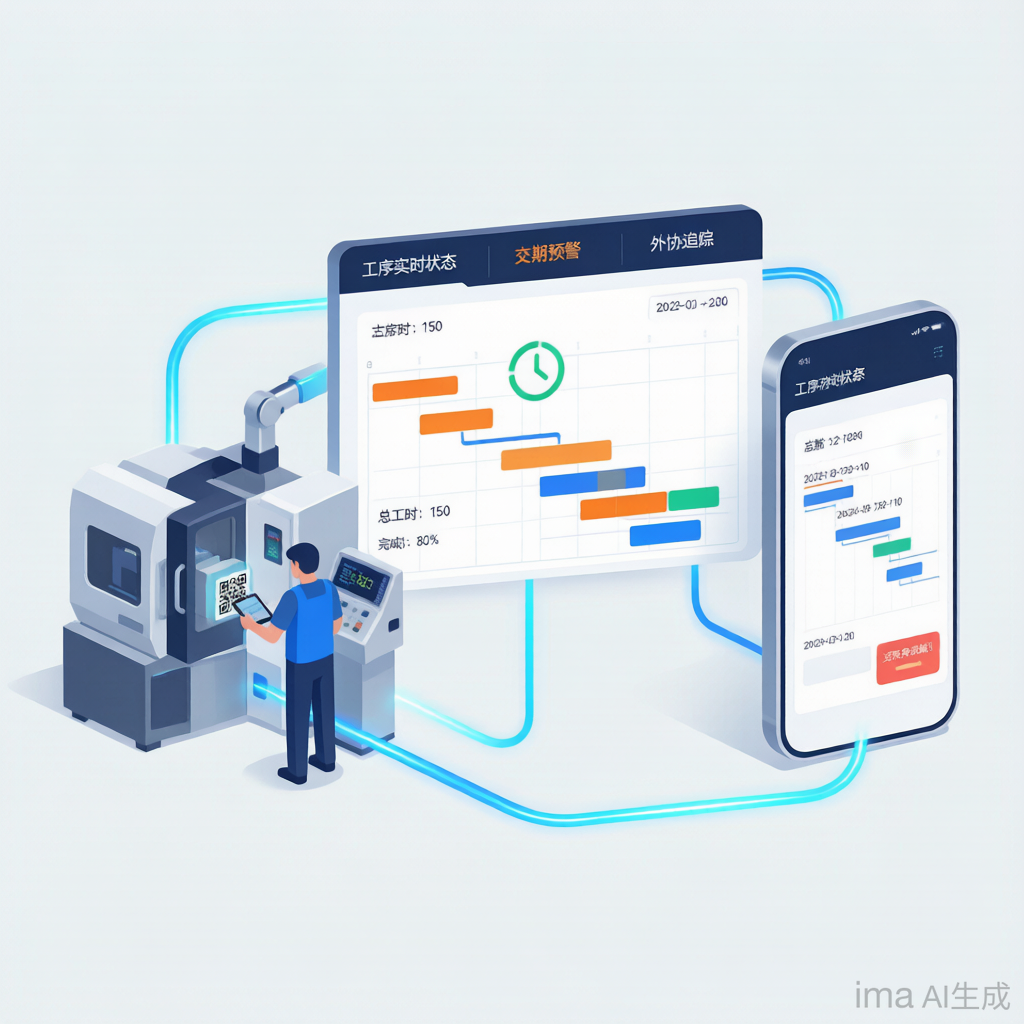
Second-level scan-based reporting for the frontline: an extremely simple interface - when an operation finishes, scan the machine or job-ticket QR code and completion is confirmed in 10 seconds. This avoids workers abandoning complex entry and the data distortion that follows.
Dual-mode support for projects and batches: manage project-based mold work and batch machining orders at the same time, seeing the whole factory's progress in one interface - no switching between two systems.
Real-time mobile lookup: when the owner is traveling or the supervisor is meeting a customer, the phone shows each mold's current operation, delay alerts, and outsourcing status - a straight answer for the customer within seconds.
Core feature focus: 80% of problems are solved by 20% of the core features. Prefer lightweight solutions dedicated to progress tracking over expensive bundles of dozens of features.
Four Principles for Landing It Well: Choose the Right Software, Then Use It the Right Way
Principle 1: choose a vendor that understands the mold industry
Generic software doesn't understand mold operation logic; customization takes long and fits poorly. Prefer a vendor with 14 years focused on the mold track (such as Moges), with an implementation success rate above 95%.
Principle 2: pilot first, then roll out
Never take the whole factory live in one stroke. Start with 1 core workshop and 3-5 molds as a trial; expand only after workers build the habit, keeping risk at the minimum.
Principle 3: add features in stages
Start with the progress tracking module to solve the most painful problem; after it stabilizes, add cost accounting, quality traceability, and more. With a mature methodology, the whole factory can be up and running in 3 months.
Principle 4: the boss leads the push
Adopting a system is, at its core, changing management habits, and frontline staff naturally resist. If the boss doesn't take charge personally, nine out of ten projects fail.
Conclusion: Run the Hidden Numbers - Digitalization Is Not a Big-Company Privilege
Many owners feel a small factory doesn't need a system. But one calculation makes it clear: the money wasted each year on unclear progress and missed delivery dates usually far exceeds the software investment. Small and mid-sized factories run on thin margins, which makes plugging these hidden leaks all the more urgent.
Stop and ask yourself: how much time does your supervisor spend hunting for progress every day? If that time went into optimizing processes and winning business, how much more value could it create for the factory?