CNC Machines Always Down at Your Mold Shop? A Remote Maintenance Management Platform Cuts Losses and Boosts Efficiency
2026-07-07 08:33:29
Introduction: Don't Let "Hidden Losses" Eat Your Profit
Does this scene look familiar? A CNC machine alarms and stops in the middle of the night; the maintenance technician lives far away and needs two or three hours to get there; or the fault cause is unclear, and waiting for the equipment vendor's service visit takes three to five days. Half a day or a whole night goes by - delivery dates slip, and with depreciation, rent, labor allocation, plus potential penalties, you can lose several thousand RMB in minutes.
Many mold shop owners searching for a "CNC machine remote maintenance management platform" are essentially looking for a way to stop less and lose less. That instinct is completely right. With 14 years in the mold machining industry, we have found that the factories doing well long ago turned equipment maintenance from "after-the-fact firefighting" into "before-the-fact prevention". Let's run this account together and see whether your factory really needs such a system.
1. Without a Professional Tool Managing Maintenance, You Bleed Hidden Money Every Day
Many owners' attitude toward machine maintenance is: "If it's not broken, leave it; fix it when it breaks. Why spend money on a management platform?" But run a precise calculation and the losses exceed anything you imagined:
Direct downtime cost: for a machining center worth RMB 500,000-600,000, ignoring machining profit entirely, the hard cost of depreciation, rent, and labor allocation alone runs about RMB 300 per hour of downtime.
Penalty and reputation losses: hit a customer's rush order and delay penalties range from thousands to tens of thousands of RMB - one major failure can cost half a year's maintenance budget.
Inefficient repairs: with no unified tool, fault diagnosis rests entirely on the technician's experience and flipping through manuals; problems solvable in a dozen minutes drag into hours.
Without digital management tools, the vast majority of factories fall into these three vicious cycles:
Failures found late, response painfully slow: small and mid-sized factories usually have only 1-2 maintenance technicians; on night shifts or across multiple buildings, nobody knows a machine has stopped. By the next working day, the equipment has idled or sat down for hours, and losses have doubled outright.
Diagnosis depends on personal experience, with excessive waiting for vendor service: a factory may run seven or eight machine brands with entirely different error codes. No technician is omniscient; for obscure faults there is nothing to do but wait for OEM service - a day at best, a week at worst - while the machine lies flat.
Preventive maintenance stored in "brain memory", minor issues festering into major ones: oil changes, accuracy calibration, oil-line cleaning - written in a notebook, easily lost; kept in one's head, easily forgotten. A hidden flaw fixable for a few dozen RMB eventually becomes a major overhaul costing thousands, with downtime losses on top.
2. How a Good Remote Maintenance Platform Solves the 3 Core Pain Points
Many people assume "remote maintenance" means "repairing machines remotely". Not so. An excellent platform restructures the repair logic from "passive emergency response" to "active prevention", compressing response and diagnosis time by over 80%.
1. Active anomaly alerts: first-minute response, not a minute wasted
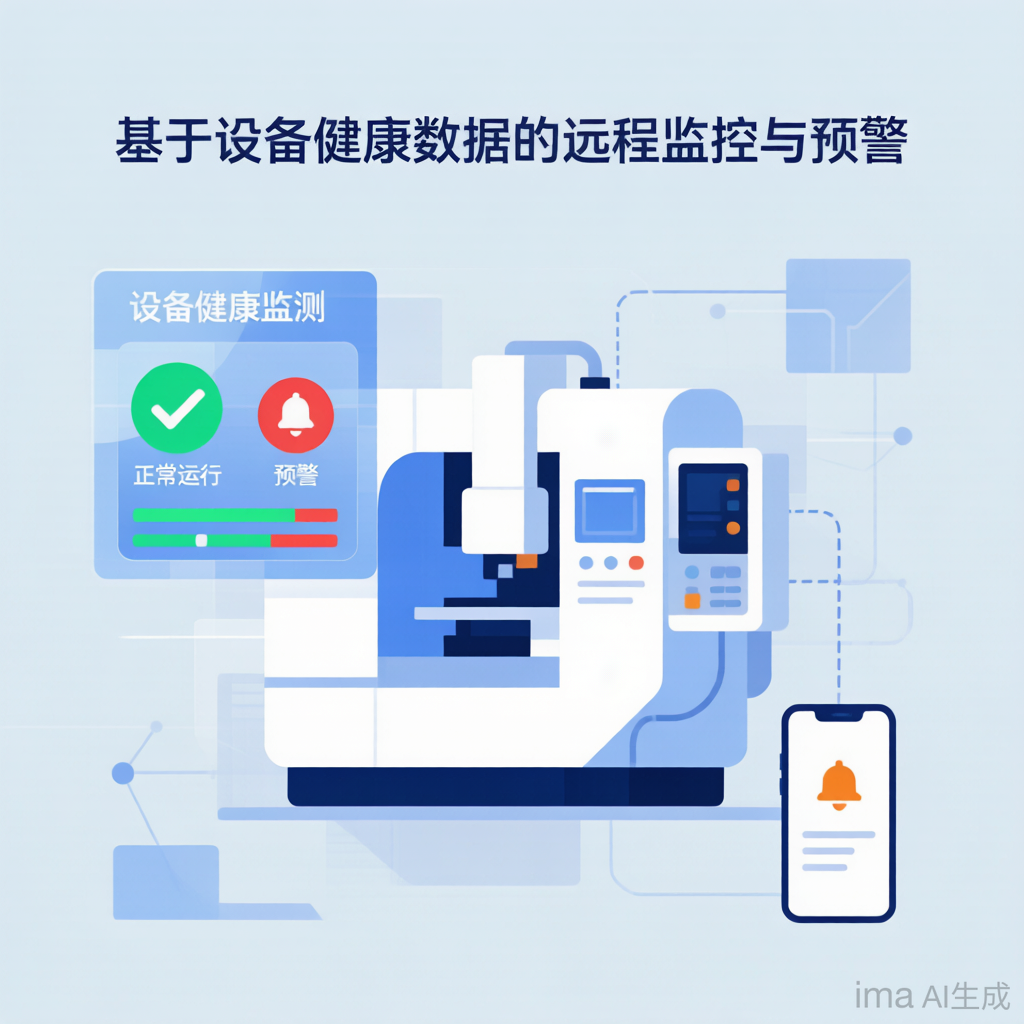
The platform connects directly to the machine's CNC control system; the moment an anomaly or fault alarm triggers, the message is pushed within milliseconds to technicians' mobile app or WeChat. Whether off duty or in another workshop, they know instantly. Even for major faults requiring an on-site visit, the technician can prepare tools and spare parts from the alarm code beforehand and repair on arrival - eliminating hours of blind waiting.
2. Remote parameter adjustment and diagnosis: minor issues skip the site visit, solved online in seconds
Statistics show that over 70% of common faults (parameter drift, program errors, sensor false alarms) need no on-site handling. Through the platform, technicians or vendor engineers can remotely pull machine logs and historical parameters and locate the root cause within minutes. Fixable remotely? Fix it. Not fixable? Talk the operator through it by phone. Problems that once took a day or two now clear within a dozen minutes - and everything saved is real money.
3. Automatic preventive maintenance: kill failures in the bud
Say goodbye to paper checklists and brain memory. Simply set maintenance rules for each machine in the system (for example: remind to change oil after 500 hours of spindle runtime; remind for accuracy calibration every 2000 hours), and the system dispatches tasks to the responsible person automatically when due. All maintenance records are archived automatically, forming a full-lifecycle equipment health file. Data shows factories running this feature cut major failure rates by over 50% on average, with spare-part replacement frequency dropping significantly.
Beyond that, the owner and workshop supervisor can check real-time equipment status, utilization, and maintenance progress for the whole factory from a phone anywhere - a true "factory in your palm". Moges' mold industry management suite deeply integrates this capability, built specifically for small and mid-sized mold factories.
3. Selection Pitfall Guide: Remember These 3 Standards and Don't Waste Money
Industrial IoT products abound, but not all fit small and mid-sized mold factories. Hold to these three points when selecting:
| Selection Dimension | Wrong Approach | Correct Standard |
|---|---|---|
| Industry fit | Choosing a generic IoT platform: retrofitting old machines is costly and interfaces incompatible | Choose a platform focused on the mold/machining industry, compatible with multiple brands of new and old equipment - no hardware changes, fast landing |
| Ease of operation | Feature dumping that demands frontline staff manually enter masses of data, breeding resistance | Core features kept minimal: automatic data collection, automatic alert pushing, scan-based maintenance logging - no added frontline burden |
| Implementation service | Selling accounts only with no delivery support; the company fumbles alone and eventually abandons it | On-site guidance plus pilot rollout: solve 80% of core pain points first, then expand, ensuring real adoption |
Special reminder: don't blindly chase "big and complete" feature lists. For a small or mid-sized factory with annual output in the tens of millions of RMB, actually using it and solving real problems matters more than feature counts. Moges has built only mold industry management systems for 14 years; its founders came from the mold frontline, know the factory's real pain points, reject empty concepts, and deliver only solutions that land.
4. Conclusion: Run the Numbers - the Investment Is Far Smaller Than the Loss
Many owners worry a system is expensive. But think in reverse: would a year's savings from avoided downtime, unnecessary part replacements, and reduced dedicated maintenance headcount cover the software investment?
For most mold factories, the answer is usually yes. Take ten minutes right now to calculate: last month, how many hours did CNC machines in your factory sit down for fault maintenance? How much of that loss could have been avoided through digital means?
Digital transformation is not a big-company privilege - it is a compulsory course for small and mid-sized enterprises' survival and growth. Choose the right tool, turn equipment management from a "cost center" into a "profit guarantee" - that is how a mold factory breaks through in fierce competition.