Suzhou Outsourcing Machining Management System: A Systematic Solution to Wrong, Missing and Delayed Outsourced Parts at Custom Shops
2026-07-11 10:01:45
A Real Case: The Lesson of RMB 100,000 in Scrapped Parts
Last month in Xiangcheng District, Suzhou, Mr. Li, who makes 3C custom inspection equipment, sat down and the first thing he did was pull out his WeChat chat history: three outsourcing factories were asking him at the same time about the machining dimensions of the same aluminum profile base. It turned out that three days earlier engineering had changed the hole dimensions in the BOM, procurement updated the Excel, but forgot to forward it to all the outsourcing factories. As a result, two of them still worked from the old drawing, RMB 100,000 of parts were scrapped outright, the project was delayed 18 days, and in the end he paid the customer RMB 50,000 in penalties.
Mr. Li said that in ten years of custom work, half of all project delays were tied to outsourcing: lost parts, wrong work, delays, reconciliation errors, one or two incidents every month. This is not an isolated case but a microcosm of the Suzhou custom industry.
Four Major Pain Points of Outsourcing Management in Suzhou's Custom Automation Industry
Suzhou is a distribution center for custom automation equipment in China, with countless custom shops large and small. The vast majority of small and mid-sized custom shops do not keep a full machining team, and 60%-80% of structural parts are sent out for processing; the quality of outsourcing management directly determines project profit. Having worked with many local Suzhou customers, the common pain points basically fall into the following four:
| Pain Point | Symptom | Consequence |
|---|---|---|
| BOM splitting all by hand | After design produces the BOM, procurement manually picks outsourced parts into Excel; every BOM change means resending, and missed or wrong sends are normal | A wrong dimension is only found after machining; parts scrapped and project delayed |
| Opaque progress | After sending out, which part is at which step requires the buyer to call one by one | Missing material is found only at assembly time; a rush switch to another factory doubles the machining fee |
| Reconciliation all by flipping documents | Every month, reconciling machining fees means finance flipping through three months of outsourcing orders, acceptance slips and deduction slips | One reconciliation takes over a week; quantities do not match and rework deductions are unrecorded, causing frequent disputes |
| Hard quality traceability | A part fails after a few months, and you cannot find which factory made it or which batch of material | You can only redo it for the customer free of charge, with high extra cost |
Choosing an Outsourcing Machining Management System: Do Not Step on These Three Misconceptions
Many custom shops, once aware of the problem, either grab a generic ERP and tweak it to make do, or insist on using Excel to the end. In fact both paths are common pits; here are the three most common misconceptions:
Misconception one: making do with a generic ERP
A generic ERP is built for batch-production factories and simply cannot fit the custom model of per-machine BOM customization. You still have to manually enter the outsourcing details, which adds a step and increases procurement workload. Many factories abandon it two months after buying it, spending money without solving the problem.
Misconception two: only handling orders, not connecting the whole flow
Many small systems handle only the outsourcing order step, and the data after outsourcing acceptance is not synced to project progress and inventory. Parts come back and pile up in the warehouse, cannot be found at assembly, and project progress cannot update automatically, so manual tracking remains and the core problem is not solved.
Misconception three: permissions too coarse, core data unsafe
In custom work the biggest fear is leakage of BOM and cost data. Many systems are either fully open or fully closed; one buyer can see the machining prices of all projects, which easily causes problems. Permissions cannot be flexibly adjusted for different positions, planting hidden risks for enterprise management.
A Good Outsourcing Management System Must Solve These Four Core Problems
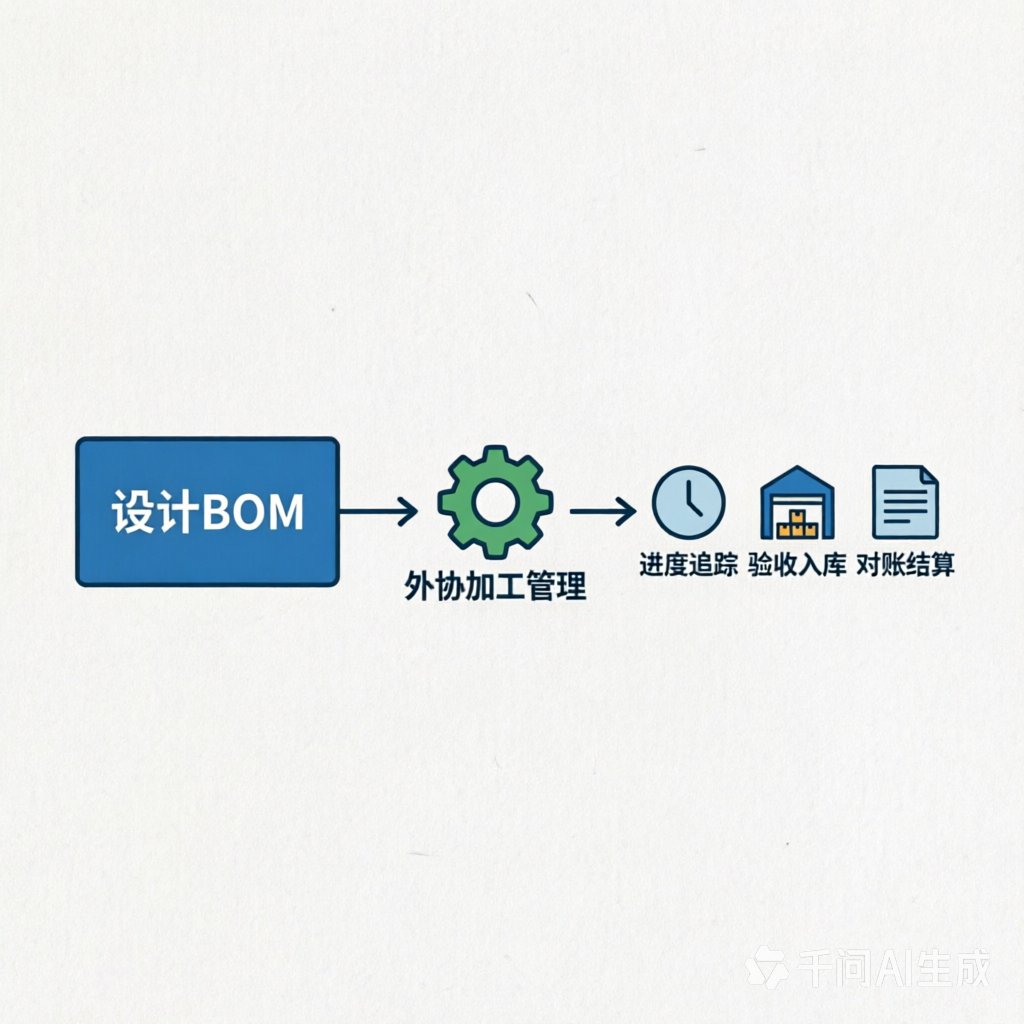
Custom outsourcing management must connect the whole flow from design to inbound receipt, not become an information silo. The following four core functions are all hard requirements honed from real projects:
One, automatic BOM splitting and automatic generation of outsourcing details
When design finishes the BOM and releases the order, the system automatically separates outsourced parts, standard parts and in-house parts, so procurement does not pick by hand. When the BOM changes a dimension or drawing number, the outsourcing order syncs the change automatically, and the error of machining from an old drawing no longer occurs. Outsourcing orders also support batch creation: send a dozen parts to the same factory at once instead of making orders one by one, saving procurement at least half the order-making time.
Two, acceptance and inbound linkage with automatic progress update
When outsourced parts come back, quality inspection can complete acceptance in one click: qualified parts are automatically put into stock, and unqualified ones are returned with a deduction. The data syncs to project progress, and the project manager does not need to ask procurement; open the system and see which outsourced parts are in stock and which are still on the way, so missing material is not discovered only at assembly.
Three, automatic collection of reconciliation data, no more flipping documents
All outsourcing orders' machining quantities, unit prices and rework deductions are stored in the system, and at month-end you pull the reconciliation statement and check it directly with the supplier. If there is a dispute, click into it and see the original record, without digging through piles of paper. What used to take a week now takes a day.
Four, fine-grained permission control so core data does not leak
Different positions see only what is within their permission: buyers cannot see machining cost prices, engineers cannot see financial data, far safer than a crude on-off switch. Moges PMS9 is designed around custom industry needs, with fine-grained permissions that can split into over a hundred items, enough for factories of different sizes to configure flexibly.
Comparison of Core Functions of Outsourcing Management Systems
| Function Module | Traditional Way (Excel + Phone) | Moges PMS9 Outsourcing Management System |
|---|---|---|
| BOM splitting | Manual picking, easy to miss and err | Automatic splitting, changes sync automatically |
| Outsourcing order creation | Excel per order, inefficient | Batch creation, one-click release |
| Progress tracking | Call and chase one by one | Real-time board, automatic late-delay alerts |
| Acceptance and inbound | Manual records, data lags | One-click acceptance, automatic inbound sync |
| Reconciliation and settlement | Flip paper documents, over a week | Automatic collection, done in a day |
| Quality traceability | No records, cannot find the source | Full-process trace, one-click traceback |
| Permission control | No permission separation | Over a hundred fine-grained permission settings |
Choosing a Local Service Provider Is More Practical Than Choosing a Big Brand
For Suzhou custom shops choosing an outsourcing machining management system, I have always advised giving priority to a provider deeply rooted locally. It is not that big-brand systems are bad, but custom outsourcing has many detailed requirements: for example, adapting to the reconciliation rules of local outsourcing factories commonly used in Suzhou, and adjusting the acceptance process; a local provider can come the next day to adjust it for you, while a big-brand provider far away needs half a month to go through the process and change the configuration, which delays things badly.
Also, do not replace the whole company and the whole process all at once. Most small and mid-sized custom shops can first get the most painful outsourcing link running smoothly, solve the problems of errors, omissions and delays, see real cost savings, and then gradually roll out the whole process, with much lower risk and easier adoption.
Manage Outsourcing Well and Earn 10% More on Every Project
Custom automation is about taking one order and building one machine, with profit coming entirely from squeezing the details. One mistake in the outsourcing link can make a whole project worthless. Among the Suzhou custom shops I have worked with, after managing outsourcing well, the average loss per project drops by about 10% and the delay rate drops by more than half; that number is real profit.
Why not calculate how much your factory lost to outsourcing problems over the past year? If a system can help you plug these leaks, is it worth half an hour to learn about it?
Implementation Advice: Three Steps With the Least Risk
Step one: first run the core outsourcing flow, BOM splitting, outsourcing order creation, acceptance and inbound, and reconciliation and settlement, replacing the most painful link with the system, live in 1-2 weeks.
Step two: connect the progress board and quality traceability, bringing in project managers and quality inspection to make the whole process transparent.
Step three: extend to project cost accounting, connecting outsourcing data with project budgets and actual costs to achieve refined profit control.
The advantage of three steps is that each step has clear output, controllable investment and minimal risk. For small and mid-sized custom shops in Suzhou, this is the most pragmatic digital transformation path.