Reasons and Solutions for Slow Sheet Metal Quotation: How Small Sheet Metal Manufacturers Can Reduce Quotation Time from 2 Hours to 10 Minutes
2026-07-13 08:01:49
A real-world case of a lost order: A quote took half a day, and the customer had already placed an order with a competitor.
Last week, I visited a sheet metal factory in Kunshan with an annual turnover of 30 million, and the owner, who had just finished a phone call with a client, scratched his head: "The client wants a quote for 100 sets of equipment frames, and they require a response within the same day. Our quoting representative is on leave, and he has spent half an hour trying to sort through his historical Excel data, but he hasn't been able to clearly determine the various costs."
What was the cost of similar-sized sheet metal bending last time? Does the laser cutting cost include the loss? What is the latest quotation for powder coating, given that it has increased twice this year? After a thorough check, the quotation is only available just before the end of the day. When sending the quotation to the customer, they have already placed an order with another company.
This isn't an isolated incident. More than half of the small and medium-sized sheet metal workshops I've worked with have experienced this "slow quoting and losing orders" problem. The sheet metal industry is highly competitive, and customers often inquire with multiple factories simultaneously. The factory that provides the most accurate quote first has a much higher chance of winning the order. If you're too slow, the order will likely be awarded to someone else.
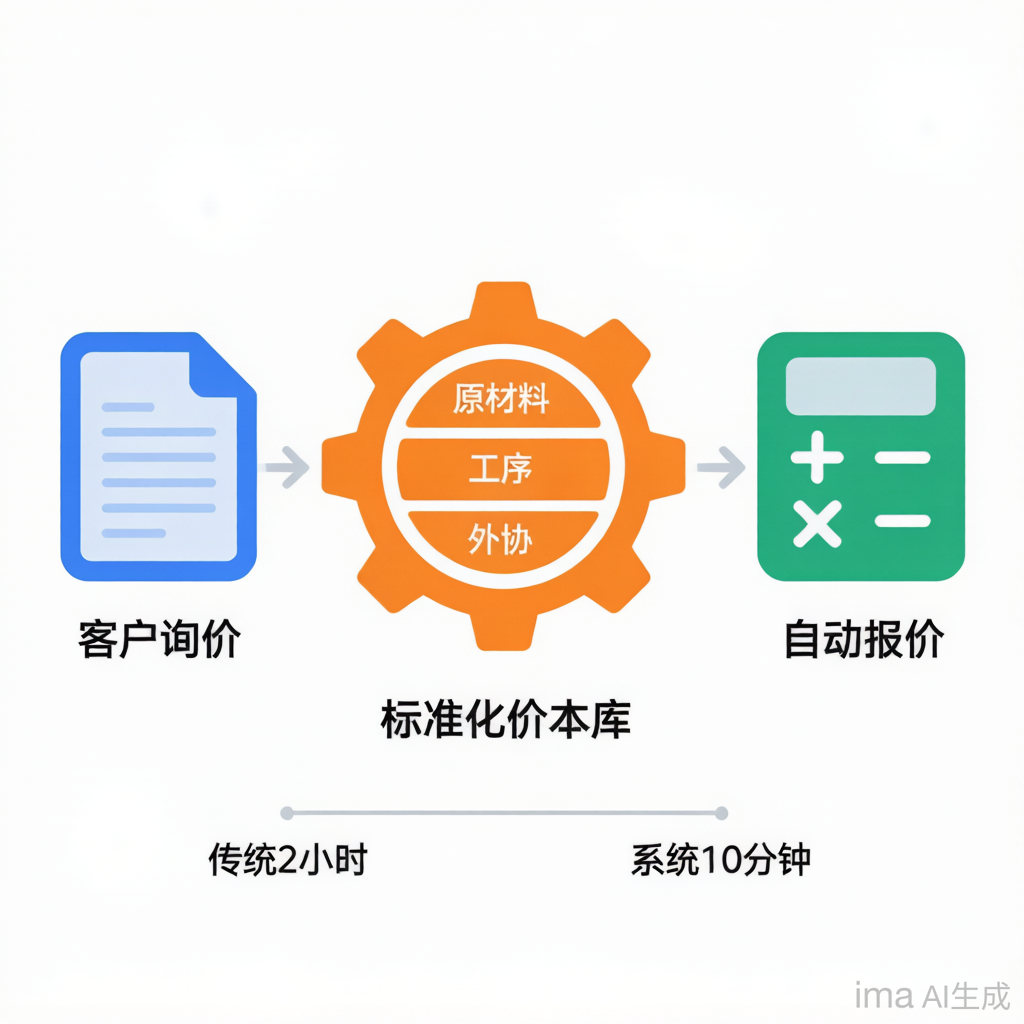
The three core reasons why sheet metal quotations take a long time are primarily unrelated to people.
Many business owners' initial reaction is to criticize the sales team for being slow or lacking the necessary skills. However, by streamlining the quotation process, it becomes clear that the majority of the problems stem from the process itself. Common issues include the following three:
| Reasons | Specific examples | Time-consuming processes |
|---|---|---|
| Pricing relies on experience, and there is no standardized basis to follow. | The experience is currently stored in individual employees' minds. New hires require six months to become fully proficient. The existing historical pricing data is stored in Excel, and searching for specific information results in a mix of data. For example, searching for the price of a 2mm cold-rolled sheet bending operation yields five to six different prices. | Spending half the time searching for data and verifying timestamps. |
| Multi-stage verification and cross-departmental communication are time-consuming. | To obtain a quote, you need to: 1. Check with warehouse management to determine the raw material purchase price. 2. Consult with purchasing to obtain the price from external vendors. 3. Confirm the processing difficulty and labor hours with the workshop. This process typically takes a full day to complete. | Waiting for responses and repeated confirmations account for more than 60% of the time. |
| Splitting operations can easily lead to omissions; if an error occurs, redo the process. | The sheet metal manufacturing process, from raw material cutting, laser cutting, bending, welding, and threading to surface treatment, typically involves five to six, or even more than ten, individual processes. Newcomers often miss smaller processes such as welding and polishing. | After calculating the total cost and finding discrepancies, we start the process from the beginning. |
Underlying Issue: Lack of a standardized bill of materials (BOM) library; changing the BOM by multiple sales representatives has proven ineffective.
In essence, the process of quoting for sheet metal fabrication involves calculating costs based on the breakdown of processes, and then adding a reasonable profit margin. Many factories are slow because they have never standardized this process, turning it into a database that can be used by the entire company. All experience is locked in individual minds, and when those individuals leave, the experience goes with them.
I have seen many factories spend a lot of money hiring experienced pricing specialists, only for them to leave within six months. The new specialist then has to start from scratch. It's a slow and inefficient process. Additionally, I have seen factories that use Excel to create price lists, but never update them. For example, if steel prices have increased by three months, the price list still uses the prices from six months ago. This results in inaccurate calculations, either showing a loss or an error, and requires constant revisions, making the process even slower.
Due to the lack of a stable and unified price database, regardless of how many quotation specialists are employed, the problem of slow quotation processing cannot be resolved.
Three-step implementation plan: Solve 80% of problems without significant investment.
When people hear about solving quoting issues, they often talk about investing in automatic quoting systems costing tens of thousands of dollars, and even AI-powered image recognition. For small sheet metal factories with annual sales of several million, this is completely unnecessary. In reality, by simply implementing the following three steps, you can solve 80% of the problems:
Step 1: Establish a three-tiered standardized cost base (core foundation)
| Cost-Material Hierarchy | Content | Maintenance Rules |
|---|---|---|
| Raw Materials Warehouse | Common sheet materials are classified by material and thickness, with the latest and standard consumption rates synchronized. | Update purchase price each time goods are received, and maintain it centrally. |
| Work Process Price Database | Laser cutting priced per circumference, bending priced per number of knives used, welding priced per length, and unit prices are set accordingly. | The workshop supervisor should review and update the information quarterly, and make timely adjustments as needed. |
| External Pricing Database | Latest quotes from long-term cooperating surface treatment outsourcing factories, categorized by process (powder coating, electroplating, anodizing, etc.) | Procurement should confirm the latest prices with external manufacturers each month and update them accordingly. |
Once the three-tier pricing database is established, everyone will see the latest data, eliminating the need to repeatedly check purchase orders, call the procurement department, or confirm with the workshop. This single step alone can save over 50% of the communication time.
Step 2: Automatically calculate prices using templates, eliminating manual data entry.
After organizing the pricing database, create a standardized quotation template. Once the order is broken down into individual processes, select the appropriate materials, processes, and quantities. The system automatically calculates the total cost plus profit, allowing you to generate quotes in minutes without manually adding up each item. The template can also predefine common process combinations, such as "laser cutting + bending + welding + powder coating," allowing you to quickly apply these common combinations, further reducing the number of steps required.
Step 3: Automatically archive historical quotes for reuse.
Each time a price is quoted, it is automatically categorized and saved. When encountering similar orders next time, you can directly search by parameters (material, thickness, size range) to retrieve the historical quote, and then adjust the size and quantity to use it, without having to start from scratch. For 90% of orders placed by small sheet metal workshops, these are similar models, and this step allows most quotes to be completed in 5 minutes.
Traditional Quotation vs. Standardized Quotation: A Comparison of Efficiency
| Comparison Dimensions | Traditional method (Excel + manual labor) | Standardized Cost Base + Template Pricing |
|---|---|---|
| Standard part quotation time | 1~2 hours | 5~10 minutes |
| Complex part quotation time | Half a day ~ 1 day | 30 minutes ~ 1 hour |
| Quote Accuracy | 70%~85%, often missing work steps | 95% or higher, templates cover all processes. |
| Personnel Dependency | Highly dependent on experienced sales personnel | New users can become proficient in just half a day. |
| Price data update | Often delayed by several months | Real-time updates, accessible at any time. |
| Historical Quote Reuse | Manually reviewing Excel files is time-consuming and incomplete. | Search by parameters, results displayed in seconds. |
| Order cancellation rate | High (Quotes take too long and are rejected) | Significantly reduce (quote generation time, even to the same day or immediate) |
Achieve "speed" without sacrificing "accuracy".
Many factories, in their pursuit of faster quoting, simply estimate prices without a formal process, leading to either overpricing and lost orders or underpricing and financial losses. A standardized pricing database is not meant to be a rigid, unchangeable system – it should allow for manual adjustments when dealing with special materials or special processes. Standard items should follow the established pricing, while special items can be adjusted as needed, allowing for both speed and accuracy.
Another key action: After each order is completed, compare the actual costs with the quoted prices. If the difference exceeds the acceptable range, update the parameters in the price book. For example, if the actual loss from laser cutting is always 2% higher than the set value, increase the loss parameter. The more you use it, the more accurate the price book becomes, and the faster you can generate quotes – this creates a positive feedback loop.
Implementation Recommendations: How to Successfully Implement ERP/MES for Small Sheet Metal Factories
Many small and medium-sized sheet metal factory owners feel that their small operations with high order volumes and limited resources make it difficult to manage pricing and inventory effectively. However, it is not necessary to implement everything at once. We recommend a phased approach:
Week 1: First, build the raw materials inventory – Enter the materials of the 20-30 most commonly used types of boards, including their materials, thicknesses, latest purchase prices, and loss rates, into the system. This step is the simplest and can be completed in half a day.
Week 2: Re-establish Work Process Pricing Library – Collaborate with the workshop supervisor to define pricing rules for common processes such as laser cutting, bending, welding, and grinding, creating a unified standard.
Week 3: Complete the external vendor price database – Allow procurement to organize and enter the latest quotes from long-term external vendors, categorizing them by process.
Week 4: Launch Pricing Template – Based on the three-tier pricing database, establish standardized pricing templates, and switch to the new templates after a two-week trial run.
Within four weeks, without significant investment or production downtime, you can significantly improve your quotation efficiency. When Moges has implemented management systems for over 200 small and medium-sized precision machining factories, including those with sheet metal business, the following logic has resulted in a reduction in quotation time from an average of 2 hours per quotation to just 10 minutes, while maintaining a quotation accuracy rate of over 95%. This has also resulted in a significant reduction in the rate of lost orders.
Summary: Fast quoting is the key competitive advantage.
Given the intense competition in the sheet metal industry, customers often request quotes from multiple factories simultaneously. The factory that provides the most accurate quote first has a significantly higher chance of winning the order. If you are too slow, the order will likely be awarded to someone else.
Don't be misled into implementing a large, all-encompassing solution. For 90% of small and medium-sized sheet metal workshops, the majority of orders are for similar products. Standardizing the core pricing database and addressing the core issues is sufficient. There's no need to spend a lot of money on unnecessary features. Consider opening your current quotation Excel and checking: How many data entries haven't been updated in six months? How many process prices are simply estimated? These are the opportunities you're missing.