Mold Workshop Equipment Failure Warning System: From "Fix It After It Breaks" to Predicting 3 Days Ahead and Avoiding Costly Sudden Downtime
2026-07-13 08:31:47
A Real Lesson: One Sudden Downtime Wiped Out the Profit of a Mold Set
Are you searching for a "mold workshop equipment failure warning system" because you just lost money to a sudden equipment breakdown?
I have worked with a mold factory in the Pearl River Delta with 18 machining centers. The owner said that last year alone, losses from sudden equipment failures added up to nearly RMB 200,000: minor failures caused late-delivery deductions, while major failures meant replacing core parts and three to five days of downtime, which is tens of thousands in lost capacity.
Take a machining center spindle: replacing a worn bearing in advance costs a few thousand yuan; waiting until the bearing seizes and replacing the whole spindle costs tens of thousands and delays production for days. This is a typical example of reactive repair costing 3-5 times preventive maintenance.
In a mold workshop with dozens of machines, which one will fail is guessed entirely from experience, and maintenance is recorded in notebooks. When a rush order is due, half a day goes into adjusting and repairing machines, and penalty payments plus idle labor waste thousands to tens of thousands.
Three Common Pain Points of Traditional Equipment Management
Many mold factory owners still see equipment management as "fix it after it breaks, maintain it on schedule," and rarely calculate the hidden cost of sudden downtime. Traditional equipment management cannot avoid the following three problems:
| Pain Point | Specific Symptom | Consequence |
|---|---|---|
| Relying entirely on veteran experience | Veterans judge abnormalities by sound and vibration; when they retire, newcomers cannot take over and the failure rate rises 30% | Major failures are discovered only after they happen, too late |
| Imprecise scheduled maintenance | Machines are torn down on schedule even at low load, wasting production time; when busy, maintenance is forgotten | Either over-maintenance wastes capacity, or small problems drag into major failures |
| Firefighting only after a failure | The production plan is thrown into disarray, rush orders cannot be moved, and delivery delays are watched helplessly | Penalties paid and customer trust lost |
A Good Mold Workshop Equipment Failure Warning System Must Meet Four Core Requirements
Not every warning system suits a mold factory. Many generic systems in a mold workshop either flood you with false alarms or are too complex for anyone to use. Look for the following four points:
First, it must understand the production conditions of a mold workshop
Mold factories produce in single-piece small batches, and equipment load fluctuates widely: one machine may run seven days straight to catch up on an order, then sit idle for two days waiting for material. Generic warning systems calculate failures only by fixed running time and are easily inaccurate. A warning system that understands molds combines actual machining load, tool wear data and real-time current and temperature to make a comprehensive judgment, with fewer false alarms and useful reminders. Moges has spent 14 years doing only management systems for the mold industry, its founders come from mold making, and its warning features were tuned against real mold workshop conditions.
Second, no manual data entry; automatic anomaly alerts
Mold workshop masters are busy enough; asking them to fill in a pile of equipment data every day after work means no one wants to do it and it is abandoned within days. A good warning system collects equipment data automatically with no manual entry and pushes anomalies to the phones of the maintenance foreman and workshop director, so no one has to patrol beside the machines all day.
Third, it must match the production plan and not disrupt normal production
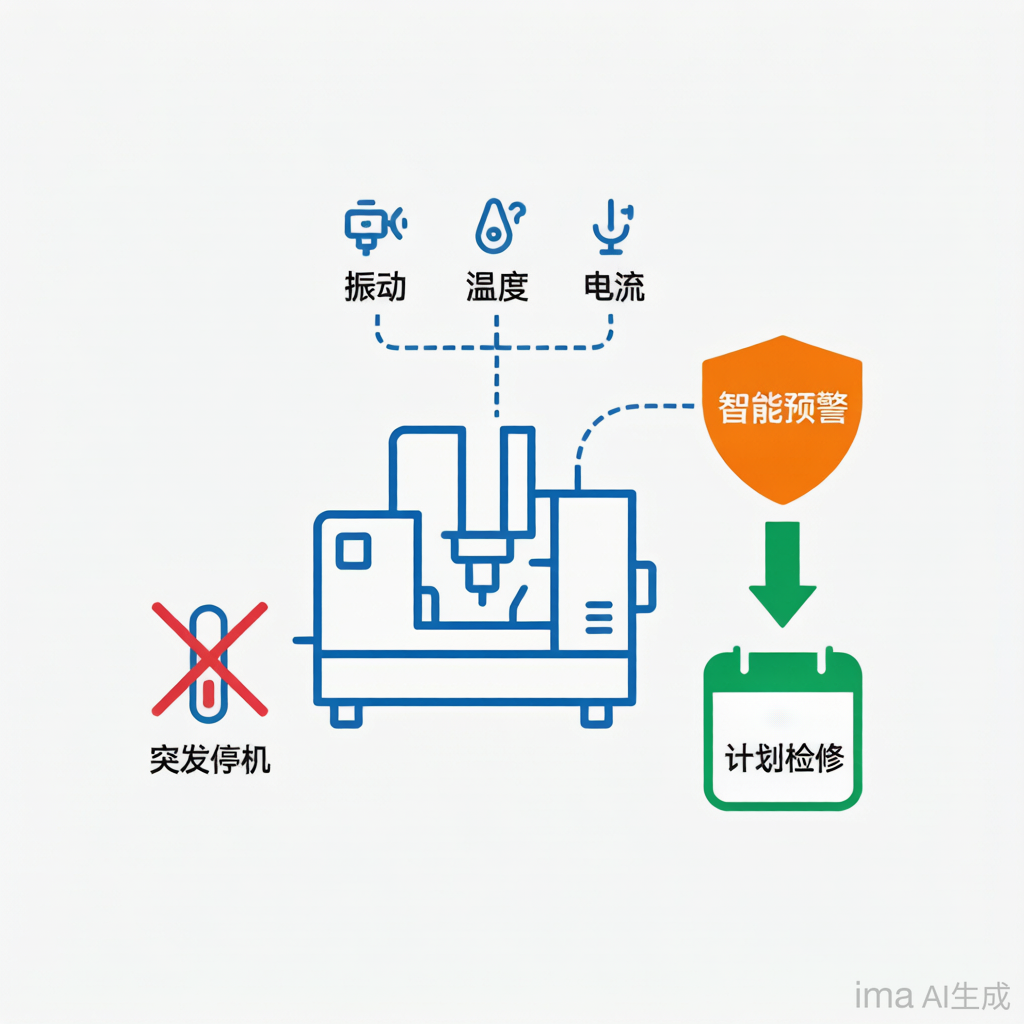
The core of a warning is not the alarm but the time it gives you to adjust production. If an anomaly in a machine can be detected 3 days ahead, the work originally scheduled for that machine can be moved to other idle equipment, or maintenance can be arranged over the weekend, without occupying normal production time. That is truly solving the problem.
Fourth, small and mid-sized mold factories can use it; no big-and-complete approach
Many vendors push million-yuan full-process systems from the start, and most functions are useless to small and mid-sized shops. A warning that fits a mold factory's needs focuses on solving sudden downtime; 80% of problems can be solved with 20% of core functions, with no paying for features you will not use.
Selection Comparison: Generic Warning Systems vs Mold-Specific Warning Systems
| Comparison Dimension | Generic Equipment Warning System | Mold-Specific Warning System (Moges) |
|---|---|---|
| Adapted conditions | Batch production, fixed running time | Single-piece small batch, wide load fluctuation |
| Judgment basis | Single running-time threshold | Multi-dimensional parameters: machining load, tool wear, current and temperature |
| False-alarm rate | High; frequent false alarms cause "crying wolf" | As low as under 5%; precise and trustworthy reminders |
| Data collection | Partly manual entry | Fully automatic collection, no human intervention |
| Link with production | Isolated alarm, no scheduling impact | Alerts link to the production plan and suggest machine reassignment |
| Equipment compatibility | Usually covers only some equipment | Full coverage of CNC, injection molding machines, milling machines and other mold equipment |
| Investment cost | Bundled into a million-yuan full process | Lightweight core functions; pays for itself by preventing 1-2 major failures |
Implementation Pitfall Guide: Never Step on These Four
Many factories have adopted similar systems and ended up not using them, mostly by stepping on the following four pitfalls:
Pitfall one: buying a big-and-complete generic system for its features
Many generic systems are built for large batch-production plants; in a single-piece small-batch mold setting the parameters do not match, false alarms increase, people stop trusting the warnings, and the system ends up idle. Choosing the right industry matters more than choosing the right features.
Pitfall two: buying only software and neglecting implementation
Three parts software and seven parts implementation; an implementation team that understands the mold industry matters more than the software itself. Many vendors walk away after the sale and leave you on your own with equipment connection and parameter tuning. Choose one with on-site implementation that adjusts step by step; Moges' five-step implementation method pilots first and then rolls out, and the system runs stably within 3 months.
Pitfall three: rolling out across the whole workshop at once
Start with the 2-3 most critical and highest-value machines in the workshop, run for two or three months, calculate how much downtime and money were actually saved, and only then expand gradually once workers see the benefits: lower risk and easier adoption.
Pitfall four: thinking only big plants need it
Many small and mid-sized owners think a dozen machines are not worth the money. In fact it is the opposite: big plants have many machines and can substitute when one breaks; at a small or mid-sized shop, one core machine failing can stop the whole workshop. The tens of thousands lost may be a quarter's profit, so they can bear sudden-failure losses even less.
Use the Right System and Get These Four Tangible Results
Among the customers we work with, factories that use it well basically achieve the following results:
| Improvement Dimension | Effect | Economic Value |
|---|---|---|
| Sudden downtime | Reduced by at least 50% (from 10 hours a month to 4-5 hours) | The freed capacity can take on 1-2 more mold sets, earning tens of thousands more |
| Repair and maintenance cost | Reduced by about 30% | No big money spent on major failures, no waste from over-maintenance |
| Delivery stability | Greatly improved | No delays from equipment failure; old customers' trust retained |
| Dependence on people | No longer reliant on veteran experience | Newcomers also receive anomaly alerts; staff turnover does not disrupt rhythm |
Implementation Advice: Three Steps for Small and Mid-Sized Mold Factories With the Lowest Risk
Step one: pilot 2-3 core machines (weeks 1-2). Pick the most expensive, most critical and most failure-sensitive machines first; add external sensors without changing the original wiring, installation takes two or three days, and schedule it off-peak so rush orders are not delayed.
Step two: run data, tune parameters and verify results (weeks 3-12). Let the system accumulate two or three months of operating data, and have the implementation team adjust the warning model to actual conditions, bringing the false-alarm rate under 5%. Compare downtime and repair cost before and after the pilot at the same time.
Step three: do the math and roll out across the workshop (from week 13). Use the pilot data to calculate clearly: how much downtime was reduced, how much repair cost saved, how many delivery delays avoided. Once workers see the benefits, rollout resistance naturally shrinks.
Summary: Equipment Is How a Mold Factory Makes a Living
For a mold factory, equipment is the capital it lives on. Most owners know they should maintain equipment, but most fail to detect hidden problems in advance. Rather than spending big money firefighting every time a problem arises, it is better to block the hidden problem before it happens.
Take half a day to calculate how much your workshop lost last month to sudden equipment downtime: repair fees, parts fees, idle labor, late-delivery penalties, lost orders. Add these numbers together, and the answer will tell you whether to do this.
The core is one sentence: reactive repair costs 3-5 times preventive maintenance. Prevent 1-2 major failures and the system pays for itself; every cent saved afterward is real profit.