FAQ
Q: What is the essential difference between enterprise-grade AI applications and ordinary chatbots?
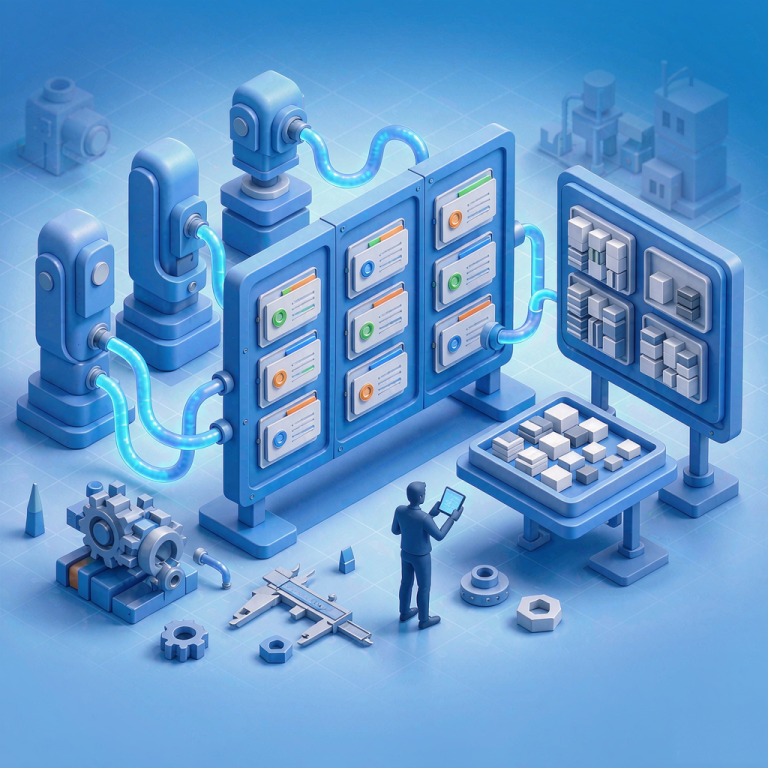
A: Ordinary chatbots lean toward Q&A, depend on manual input, and struggle to accumulate enterprise capability. AI agents connect to the knowledge base, link to business systems, and execute tasks by process. Enterprise-grade AI applications do not chase gimmicks; the focus is stability, controllability, and reusability, and truly solving business problems.
Q: We are just a small discrete parts factory with about ten machine tools. Would a scheduling system be too complex and too expensive?
A: Scheduling systems for small and medium discrete parts factories are lightweight-adapted. You do not need to spend a lot on the full-process modules; buying only the scheduling-related functions is enough. Operation is visual drag-and-drop, so a production supervisor can get the hang of it in two or three days. A modest investment solves the chaotic planning problem, which is very cost-effective for a small factory.
Q: We have too many molds and often cannot find where they are. Production is in a hurry to start and has to ask around. Can a system solve this?
A: The essence of this problem is that mold location, picking, and return have not formed a closed loop. The system should first manage mold numbers, storage locations, current status, and responsible persons clearly, recording who took it, when, and whether it was returned. Then production supervisors do not have to shout for people to find molds, cutting the time lost to people waiting for molds and machines waiting for molds.